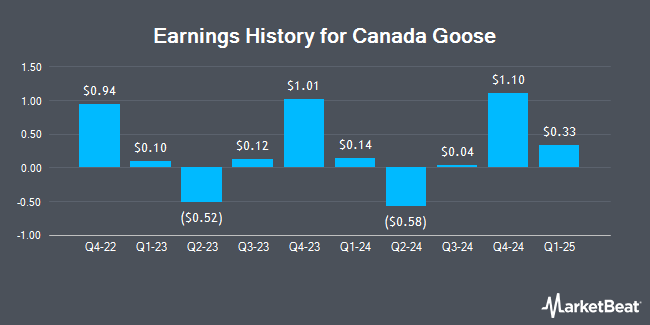
Canada Goose (NYSE:GOOS - Get Free Report) issued its quarterly earnings results on Thursday. The company reported ($0.14) earnings per share (EPS) for the quarter, beating the consensus estimate of ($0.16) by $0.02, Zacks reports. The company had revenue of $192.54 million for the quarter, compared to analyst estimates of $193.24 million. Canada Goose had a return on equity of 12.33% and a net margin of 2.95%. The company's revenue for the quarter was up .5% compared to the same quarter last year. During the same quarter last year, the company posted ($0.14) EPS.
Here are the key takeaways from Canada Goose's conference call:
- Q2 revenue rose 5% to CAD 274 million, and first-half revenue increased 6%. Canada Goose maintained its full-year outlook for low-single-digit revenue growth and an adjusted EBIT margin of 11%–12%.
- Wholesale remained a bright spot, with Q2 revenue up 5% and year-to-date revenue up 13%; the Spring/Summer 2027 order book grew significantly year over year. Management said partner sell-through was up and channel inventory was more balanced.
- Gross margin expanded 280 basis points to 66.8%, driven by product mix, pricing, sourcing and production efficiencies, and lower freight and duty costs. First-half adjusted EBIT margin expanded 170 basis points, although Q2 adjusted EBIT margin narrowed to negative 7.9% from negative 5.5% a year earlier, partly due to planned investment timing.
- DTC comparable sales declined 7.5% in Q2 as softer store traffic outweighed improved conversion and e-commerce strength; October comps also remained negative amid warmer weather and delayed seasonal purchasing. Management identified driving traffic—particularly in U.S. stores—as a key challenge for the second half.
- EMEA revenue fell 14%, with DTC comparable sales down 27%, amid softer demand and product-flow delays tied to the new logistics network. The company said product availability is improving and expects delayed EMEA wholesale orders to catch up in Q3.
Canada Goose Price Performance
Shares of Canada Goose stock traded down $0.14 during trading on Friday, hitting $8.82. 1,891,046 shares of the stock traded hands, compared to its average volume of 984,950. The stock has a market cap of $861.85 million, a price-to-earnings ratio of 27.58, a PEG ratio of 0.64 and a beta of 1.65. Canada Goose has a 52 week low of $7.36 and a 52 week high of $14.60. The firm's fifty day moving average is $7.94 and its 200-day moving average is $9.87. The company has a quick ratio of 0.97, a current ratio of 2.33 and a debt-to-equity ratio of 0.77.
Analyst Ratings Changes
A number of research analysts have recently issued reports on the stock. Zacks Research upgraded shares of Canada Goose from a "strong sell" rating to a "hold" rating in a research report on Monday, September 28th. Robert W. Baird set a $11.41 price objective on Canada Goose in a research note on Friday, July 31st. Wall Street Zen downgraded shares of Canada Goose from a "buy" rating to a "hold" rating in a research report on Saturday, July 25th. Weiss Ratings downgraded Canada Goose from a "sell (d+)" rating to a "sell (d)" rating in a report on Tuesday, September 22nd. Finally, UBS Group decreased their price objective on shares of Canada Goose from $10.50 to $9.00 and set a "neutral" rating for the company in a research note on Wednesday, October 28th. One investment analyst has rated the stock with a Strong Buy rating, three have assigned a Hold rating and four have given a Sell rating to the company's stock. According to data from MarketBeat, the stock currently has a consensus rating of "Reduce" and a consensus target price of $11.48.
Get Our Latest Research Report on GOOS
Key Stories Impacting Canada Goose
Here are the key news stories impacting Canada Goose this week:
- Positive Sentiment: Canada Goose authorized a share buyback plan, which may provide support for shares, although the announcement details supplied do not specify its size. Buyback Plan
- Positive Sentiment: The company’s fiscal Q2 loss of $0.14 per share was narrower than analysts’ expected loss of $0.16. Revenue increased year over year, though only modestly in the reported results. Q2 Results
- Negative Sentiment: The second-quarter loss widened as higher marketing and retail expansion costs weighed on results. Revenue of $192.54 million also fell just short of the $193.24 million analyst consensus. Higher Costs Weigh on Results
- Negative Sentiment: Comparable sales declines reportedly deepened as shoppers put off winter purchases, raising concerns about near-term demand during a key seasonal period. Comparable Sales and Delayed Purchases
Canada Goose Company Profile
(
Get Free Report)
Canada Goose Holdings Inc designs, manufactures, and sells luxury apparel and accessories focused on cold-weather performance. Its product range includes parkas, jackets, vests, knitwear, footwear, gloves, hats, and other seasonal apparel for women, men, and children.
The company traces its origins to 1957, when Metro Sportswear was established in Toronto. It later adopted the Canada Goose name and built its reputation around insulated outerwear designed for harsh climates, combining technical materials and construction with premium fashion positioning.
Canada Goose sells its products through company-operated retail stores, e-commerce platforms, and select wholesale partners.
Featured Articles
This instant news alert was generated by narrative science technology and financial data from MarketBeat in order to provide readers with the fastest reporting and unbiased coverage. Please send any questions or comments about this story to contact@marketbeat.com.
Before you consider Canada Goose, you'll want to hear this.
MarketBeat keeps track of Wall Street's top-rated and best performing research analysts and the stocks they recommend to their clients on a daily basis. MarketBeat has identified the five stocks that top analysts are quietly whispering to their clients to buy now before the broader market catches on... and Canada Goose wasn't on the list.
While Canada Goose currently has a Reduce rating among analysts, top-rated analysts believe these five stocks are better buys.
View The Five Stocks Here
A strong long-term portfolio starts with companies that can survive recessions, inflation, changing consumer habits, and shifting market leadership.
This report names seven blue-chip stocks across technology, retail, consumer staples, healthcare, networking, sporting goods, and utilities that offer investors a mix of stability, income, growth, and staying power.
Get This Free Report
Continue following MarketBeat
Add MarketBeat as your preferred source on Google to see our latest stories in your feed.
Like this article? Share it with a colleague.
Link copied to clipboard.
