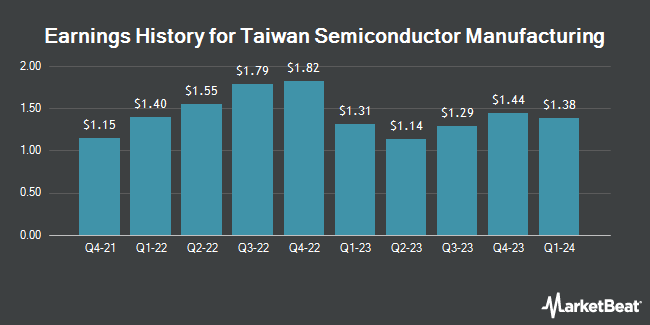
Taiwan Semiconductor Manufacturing (NYSE:TSM - Get Free Report) announced its earnings results on Thursday. The semiconductor company reported $4.60 earnings per share (EPS) for the quarter, beating analysts' consensus estimates of $4.45 by $0.15, Zacks reports. Taiwan Semiconductor Manufacturing had a return on equity of 39.25% and a net margin of 50.31%.
Here are the key takeaways from Taiwan Semiconductor Manufacturing's conference call:
- Strong third-quarter performance: Revenue rose 17.6% sequentially to $46.7 billion, above guidance, driven by leading-edge demand; advanced technologies represented 79% of wafer revenue.
- TSMC forecast fourth-quarter revenue of $52.3 billion-$54.3 billion, implying approximately 58% year-over-year growth at the midpoint, and raised its 2026 revenue growth outlook to around 44% in U.S. dollar terms.
- Management described AI demand as extremely robust, with growing adoption of agentic AI, AI CPUs, accelerators, networking chips, and open-source models. TSMC believes demand remains well above available supply and expects AI-related growth could exceed its prior mid-to-high-50% CAGR outlook.
- TSMC is accelerating capacity expansion, maintaining 2026 capital expenditures of $60 billion-$64 billion and signaling significantly higher investment in 2026-2028. N2 capacity is expected to more than double in 2027, while additional N3 fabs are planned in Taiwan, the U.S., and Japan.
- Profitability faces pressure from the steep N2 ramp and higher-cost overseas fabs; gross margin fell to 66.4% in the third quarter and is guided to about 66% in the fourth quarter, with overseas-fab dilution expected to widen to 3%-4% in the coming years. Management also flagged weakness in consumer and price-sensitive markets due to rising component costs and macroeconomic uncertainty.
Taiwan Semiconductor Manufacturing Stock Down 3.2%
Shares of Taiwan Semiconductor Manufacturing stock opened at $430.69 on Thursday. The company has a quick ratio of 2.25, a current ratio of 2.46 and a debt-to-equity ratio of 0.14. Taiwan Semiconductor Manufacturing has a 52-week low of $266.82 and a 52-week high of $487.47. The company has a market capitalization of $2.23 trillion, a P/E ratio of 31.07, a P/E/G ratio of 0.92 and a beta of 1.37. The company has a 50 day moving average of $434.77 and a 200 day moving average of $416.47.
Taiwan Semiconductor Manufacturing Cuts Dividend
The company also recently declared a quarterly dividend, which will be paid on Thursday, January 7th. Investors of record on Thursday, December 10th will be paid a $1.0854 dividend. This is a decrease from Taiwan Semiconductor Manufacturing's previous quarterly dividend of $1.1136. This represents a $4.34 dividend on an annualized basis and a yield of 1.0%. The ex-dividend date is Thursday, December 10th. Taiwan Semiconductor Manufacturing's payout ratio is presently 24.75%.
Wall Street Analysts Forecast Growth
Several equities research analysts recently issued reports on TSM shares. Sanford C. Bernstein boosted their price objective on Taiwan Semiconductor Manufacturing from $430.00 to $554.00 and gave the company an "outperform" rating in a report on Tuesday, August 11th. Wall Street Zen cut Taiwan Semiconductor Manufacturing from a "strong-buy" rating to a "buy" rating in a report on Saturday, August 8th. Susquehanna raised their target price on Taiwan Semiconductor Manufacturing from $575.00 to $600.00 and gave the company a "positive" rating in a report on Thursday, July 16th. Stifel Nicolaus started coverage on Taiwan Semiconductor Manufacturing in a research report on Tuesday, September 1st. They issued a "buy" rating and a $515.00 target price for the company. Finally, Citigroup reiterated a "buy" rating on shares of Taiwan Semiconductor Manufacturing in a research note on Wednesday, October 7th. Three analysts have rated the stock with a Strong Buy rating, eleven have given a Buy rating and two have assigned a Hold rating to the company. Based on data from MarketBeat.com, the stock has a consensus rating of "Buy" and an average price target of $528.22.
Read Our Latest Analysis on TSM
Insider Buying and Selling at Taiwan Semiconductor Manufacturing
In other news, VP Shyue-Shyh Lin bought 1,000 shares of the stock in a transaction that occurred on Tuesday, July 21st. The stock was purchased at an average price of $74.13 per share, for a total transaction of $74,130.00. Following the completion of the purchase, the vice president owned 30,269 shares in the company, valued at approximately $2,243,840.97. This trade represents a 3.42% increase in their position. The purchase was disclosed in a filing with the Securities & Exchange Commission, which can be accessed through this hyperlink. Also, VP Lipen Yuan bought 350 shares of the company's stock in a transaction that occurred on Tuesday, August 18th. The stock was acquired at an average cost of $73.58 per share, for a total transaction of $25,753.00. Following the acquisition, the vice president directly owned 2,000 shares of the company's stock, valued at $147,160. The trade was a 21.21% increase in their ownership of the stock. Additional details regarding this purchase are available in the official SEC disclosure. In the last three months, insiders have bought 16,043 shares of company stock valued at $1,185,746. Insiders own 1.11% of the company's stock.
Key Stories Impacting Taiwan Semiconductor Manufacturing
Here are the key news stories impacting Taiwan Semiconductor Manufacturing this week:
- Positive Sentiment: TSMC posted record third-quarter net profit of approximately NT$763 billion, up 68.7% year over year and above the NT$746.3 billion analyst estimate. Revenue also exceeded expectations, supported by strong demand for advanced AI and high-performance-computing chips. TSMC posts record profit for a sixth straight quarter
- Positive Sentiment: Management issued fourth-quarter revenue guidance of $52.3 billion to $54.3 billion, well above the roughly $48.8 billion consensus estimate. Advanced technologies accounted for about 79% of wafer sales, reinforcing TSMC’s position in leading-edge semiconductor manufacturing. TSMC beats estimates as AI demand drives sales growth
- Positive Sentiment: Chief Executive Officer C.C. Wei said he sees no indication of a slowdown, suggesting that AI infrastructure demand remains robust despite concerns that technology companies may be approaching the limits of their spending boom. TSMC CEO sees no sign of a slowdown
- Neutral Sentiment: TSMC also has an approximately $2 billion agreement with GlobalFoundries to manufacture U.S. silicon interposers for advanced AI-chip packaging. The deal supports supply-chain diversification but is unlikely to materially affect near-term earnings.
- Negative Sentiment: Despite the earnings beat, investors appear concerned that much of the AI-driven growth was already reflected in TSM’s valuation. Shares trade near a historically elevated earnings multiple and below their recent high, increasing the risk of profit-taking when results fail to dramatically exceed already aggressive expectations. Why TSM stock is sliding after earnings
- Negative Sentiment: A hotter-than-expected inflation reading and slowing revenue growth reported by Anthropic extended a wider technology and AI-stock selloff. Higher interest-rate concerns and scrutiny of the enormous cost of AI infrastructure are weighing on semiconductor shares, including TSM.
About Taiwan Semiconductor Manufacturing
(
Get Free Report)
Taiwan Semiconductor Manufacturing Company Limited NYSE: TSM, commonly known as TSMC, is a Taiwan-based semiconductor manufacturer and the world's largest dedicated semiconductor foundry. Founded in 1987 by Morris Chang, the company pioneered the pure-play foundry model, producing chips designed by other companies rather than selling products under its own semiconductor brand.
TSMC manufactures a broad range of integrated circuits, including advanced logic chips used in high-performance computing, smartphones, automotive systems, communications equipment, and consumer electronics.
Read More
This instant news alert was generated by narrative science technology and financial data from MarketBeat in order to provide readers with the fastest reporting and unbiased coverage. Please send any questions or comments about this story to contact@marketbeat.com.
Before you consider Taiwan Semiconductor Manufacturing, you'll want to hear this.
MarketBeat keeps track of Wall Street's top-rated and best performing research analysts and the stocks they recommend to their clients on a daily basis. MarketBeat has identified the five stocks that top analysts are quietly whispering to their clients to buy now before the broader market catches on... and Taiwan Semiconductor Manufacturing wasn't on the list.
While Taiwan Semiconductor Manufacturing currently has a Buy rating among analysts, top-rated analysts believe these five stocks are better buys.
View The Five Stocks Here
Nuclear energy is entering a new growth cycle as rising power demand, expanding data centers, and renewed policy support bring the sector back into focus. After strong gains in recent years, the most impactful phase of nuclear investment may still be ahead. This report highlights seven nuclear energy stocks positioned across the value chain—combining near-term revenue with long-term upside as next-generation technologies scale. Click the link below to unlock the full list.
Get This Free Report
Continue following MarketBeat
Add MarketBeat as your preferred source on Google to see our latest stories in your feed.
Like this article? Share it with a colleague.
Link copied to clipboard.
