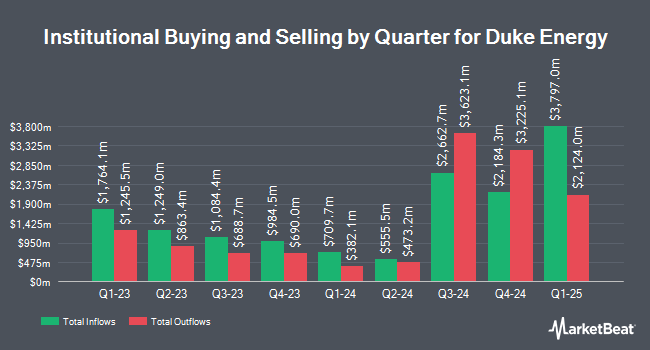
Farther Finance Advisors LLC boosted its stake in shares of Duke Energy Corporation (NYSE:DUK - Free Report) by 26.1% in the third quarter, according to its most recent 13F filing with the Securities and Exchange Commission (SEC). The institutional investor owned 96,972 shares of the utilities provider's stock after buying an additional 20,067 shares during the quarter. Farther Finance Advisors LLC's holdings in Duke Energy were worth $11,056,000 as of its most recent SEC filing.
A number of other institutional investors have also modified their holdings of the stock. Ables Iannone Moore & Associates Inc. boosted its holdings in shares of Duke Energy by 1.2% in the second quarter. Ables Iannone Moore & Associates Inc. now owns 6,623 shares of the utilities provider's stock valued at $838,000 after purchasing an additional 80 shares during the period. Sharp Wealth Advisory LLC raised its position in Duke Energy by 4.5% during the 1st quarter. Sharp Wealth Advisory LLC now owns 1,876 shares of the utilities provider's stock valued at $246,000 after purchasing an additional 81 shares in the last quarter. Absher Wealth Management LLC lifted its holdings in shares of Duke Energy by 2.3% in the 1st quarter. Absher Wealth Management LLC now owns 3,648 shares of the utilities provider's stock worth $478,000 after buying an additional 81 shares during the period. Sovereign Financial Group Inc. grew its position in shares of Duke Energy by 2.8% during the 1st quarter. Sovereign Financial Group Inc. now owns 3,052 shares of the utilities provider's stock worth $400,000 after buying an additional 84 shares in the last quarter. Finally, Walker Asset Management LLC raised its holdings in shares of Duke Energy by 1.7% in the first quarter. Walker Asset Management LLC now owns 4,973 shares of the utilities provider's stock valued at $651,000 after acquiring an additional 85 shares in the last quarter. 65.31% of the stock is owned by hedge funds and other institutional investors.
Duke Energy Trading Down 0.2%
Duke Energy stock opened at $116.62 on Friday. The stock has a market cap of $90.93 billion, a PE ratio of 17.51, a price-to-earnings-growth ratio of 2.73 and a beta of 0.36. Duke Energy Corporation has a one year low of $112.40 and a one year high of $134.49. The company has a debt-to-equity ratio of 1.47, a quick ratio of 0.43 and a current ratio of 0.66. The stock has a 50-day moving average of $119.45 and a two-hundred day moving average of $124.11.
Duke Energy (NYSE:DUK - Get Free Report) last posted its quarterly earnings results on Monday, August 3rd. The utilities provider reported $1.43 earnings per share (EPS) for the quarter, topping analysts' consensus estimates of $1.30 by $0.13. The business had revenue of $7.59 billion during the quarter, compared to analysts' expectations of $7.66 billion. Duke Energy had a net margin of 15.78% and a return on equity of 9.78%. The business's quarterly revenue was up 1.1% on a year-over-year basis. During the same quarter last year, the company posted $1.25 earnings per share. On average, research analysts anticipate that Duke Energy Corporation will post 6.72 EPS for the current fiscal year.
Duke Energy Dividend Announcement
The firm also recently declared a quarterly dividend, which will be paid on Wednesday, December 16th. Investors of record on Friday, November 13th will be issued a $1.0850 dividend. This represents a $4.34 annualized dividend and a yield of 3.7%. The ex-dividend date is Friday, November 13th. Duke Energy's dividend payout ratio is 65.17%.
Wall Street Analyst Weigh In
Several equities research analysts have recently commented on the stock. JPMorgan Chase & Co. boosted their price target on shares of Duke Energy from $136.00 to $141.00 and gave the company a "neutral" rating in a report on Thursday, July 16th. Mizuho set a $136.00 price objective on shares of Duke Energy in a report on Wednesday, August 5th. Truist Financial lowered their target price on Duke Energy from $138.00 to $135.00 and set a "buy" rating for the company in a report on Monday, August 17th. BTIG Research reaffirmed a "buy" rating on shares of Duke Energy in a research report on Thursday, July 23rd. Finally, Barclays cut their price target on Duke Energy from $132.00 to $124.00 and set an "overweight" rating on the stock in a report on Friday. Ten equities research analysts have rated the stock with a Buy rating and eight have issued a Hold rating to the company. According to data from MarketBeat, the company has an average rating of "Moderate Buy" and a consensus price target of $136.12.
View Our Latest Research Report on Duke Energy
Key Headlines Impacting Duke Energy
Here are the key news stories impacting Duke Energy this week:
- Positive Sentiment: Data-center agreement could protect customers and support growth. Duke Energy and North Carolina regulators reached a settlement requiring data centers and other large-load customers to pay upfront grid-connection costs and provide additional protections against stranded infrastructure expenses. The arrangement could reduce cost-shifting to existing customers while allowing Duke to benefit from rising electricity demand from technology companies. Duke Energy comes to an agreement on large load tariff
- Positive Sentiment: Income-focused commentary remains supportive. Jim Cramer said Duke’s decline makes the stock potentially attractive, particularly if its dividend yield reaches about 4%. Other recent coverage highlights Duke as a regulated utility with relatively visible cash flows and dividend appeal, which may help attract defensive investors. Jim Cramer weighs Duke Energy against an income alternative
- Neutral Sentiment: Hurricane Isaias preparations are underway. Duke is mobilizing crews and warning customers in Florida, South Carolina and North Carolina about possible outages from heavy rain and strong winds. The response demonstrates operational readiness, but storm damage, restoration costs and service disruptions could create short-term financial and sentiment pressure. Duke Energy prepares for Isaias
- Negative Sentiment: Valuation is facing scrutiny. Analysts and income-investing coverage are questioning whether Duke’s share price is fully supported by its dividend stream after a 43.9% three-year return. This could limit upside until earnings, dividend growth or the yield becomes more compelling. Is Duke Energy priced above what its dividend can support?
Duke Energy Company Profile
(
Free Report)
Duke Energy Corporation NYSE: DUK is an energy holding company that operates regulated electric and natural gas utilities in the United States. Its electric utilities generate, transmit, distribute and sell electricity to residential, commercial, industrial and other customers.
The company serves customers across the Carolinas, Florida, Indiana, Ohio and Kentucky. Duke Energy also operates natural gas utilities and related infrastructure in several states, including North Carolina, South Carolina, Ohio, Kentucky and Tennessee.
Featured Articles
This instant news alert was generated by narrative science technology and financial data from MarketBeat in order to provide readers with the fastest reporting and unbiased coverage. Please send any questions or comments about this story to contact@marketbeat.com.
Before you consider Duke Energy, you'll want to hear this.
MarketBeat keeps track of Wall Street's top-rated and best performing research analysts and the stocks they recommend to their clients on a daily basis. MarketBeat has identified the five stocks that top analysts are quietly whispering to their clients to buy now before the broader market catches on... and Duke Energy wasn't on the list.
While Duke Energy currently has a Moderate Buy rating among analysts, top-rated analysts believe these five stocks are better buys.
View The Five Stocks Here
Nuclear energy is entering a new growth cycle as rising power demand, expanding data centers, and renewed policy support bring the sector back into focus. After strong gains in recent years, the most impactful phase of nuclear investment may still be ahead. This report highlights seven nuclear energy stocks positioned across the value chain—combining near-term revenue with long-term upside as next-generation technologies scale. Click the link below to unlock the full list.
Get This Free Report
Continue following MarketBeat
Add MarketBeat as your preferred source on Google to see our latest stories in your feed.
Like this article? Share it with a colleague.
Link copied to clipboard.
