Affiance Financial LLC trimmed its position in shares of NVIDIA Corporation (NASDAQ:NVDA - Free Report) by 35.9% in the 2nd quarter, according to the company in its most recent Form 13F filing with the Securities and Exchange Commission. The institutional investor owned 9,386 shares of the computer hardware maker's stock after selling 5,262 shares during the period. Affiance Financial LLC's holdings in NVIDIA were worth $1,878,000 as of its most recent filing with the Securities and Exchange Commission.
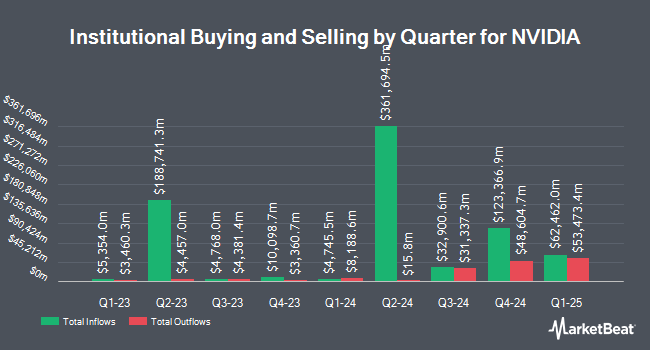
A number of other institutional investors have also recently bought and sold shares of NVDA. Norges Bank acquired a new position in NVIDIA during the fourth quarter worth $62,244,133,000. J. Stern & Co. LLP raised its holdings in NVIDIA by 13,709.1% during the fourth quarter. J. Stern & Co. LLP now owns 125,760,307 shares of the computer hardware maker's stock valued at $23,454,297,000 after buying an additional 124,849,603 shares in the last quarter. Cardano Risk Management B.V. lifted its holdings in shares of NVIDIA by 896.4% during the fourth quarter. Cardano Risk Management B.V. now owns 78,123,960 shares of the computer hardware maker's stock worth $14,570,119,000 after buying an additional 70,283,539 shares during the last quarter. Capital Research Global Investors boosted its position in shares of NVIDIA by 16.1% in the third quarter. Capital Research Global Investors now owns 165,377,852 shares of the computer hardware maker's stock valued at $30,855,564,000 after acquiring an additional 22,896,705 shares during the period. Finally, Laurel Wealth Advisors LLC boosted its position in shares of NVIDIA by 15,496.1% in the second quarter. Laurel Wealth Advisors LLC now owns 21,865,525 shares of the computer hardware maker's stock valued at $3,454,534,000 after acquiring an additional 21,725,326 shares during the period. Institutional investors and hedge funds own 65.27% of the company's stock.
Insiders Place Their Bets
In other NVIDIA news, Director John Dabiri sold 625 shares of the firm's stock in a transaction on Wednesday, May 27th. The stock was sold at an average price of $214.00, for a total value of $133,750.00. Following the sale, the director owned 14,163 shares of the company's stock, valued at approximately $3,030,882. This trade represents a 4.23% decrease in their position. The sale was disclosed in a document filed with the SEC, which can be accessed through the SEC website. The transaction was executed under a pre-arranged Rule 10b5-1 trading plan. Also, Director Stephen C. Neal sold 15,500 shares of the firm's stock in a transaction on Wednesday, June 3rd. The shares were sold at an average price of $215.73, for a total value of $3,343,815.00. Following the completion of the sale, the director directly owned 116,135 shares in the company, valued at approximately $25,053,803.55. This represents a 11.77% decrease in their position. The SEC filing for this sale provides additional information. Insiders sold 1,901,125 shares of company stock worth $410,583,015 over the last three months. Insiders own 3.94% of the company's stock.
NVIDIA Price Performance
NASDAQ:NVDA opened at $214.75 on Friday. The firm has a market capitalization of $5.20 trillion, a price-to-earnings ratio of 32.89, a P/E/G ratio of 0.43 and a beta of 2.23. The stock's 50 day moving average price is $207.47 and its two-hundred day moving average price is $199.52. NVIDIA Corporation has a 12-month low of $164.07 and a 12-month high of $236.54. The company has a quick ratio of 2.85, a current ratio of 3.44 and a debt-to-equity ratio of 0.04.
NVIDIA (NASDAQ:NVDA - Get Free Report) last posted its quarterly earnings data on Wednesday, May 20th. The computer hardware maker reported $1.87 earnings per share (EPS) for the quarter, beating analysts' consensus estimates of $1.76 by $0.11. The firm had revenue of $81.61 billion during the quarter, compared to the consensus estimate of $78.42 billion. NVIDIA had a net margin of 62.97% and a return on equity of 96.94%. The business's revenue for the quarter was up 85.2% compared to the same quarter last year. During the same quarter in the previous year, the firm posted $0.81 EPS. On average, analysts anticipate that NVIDIA Corporation will post 8.61 earnings per share for the current year.
NVIDIA announced that its Board of Directors has approved a share buyback plan on Wednesday, May 20th that permits the company to buyback $80.00 billion in outstanding shares. This buyback authorization permits the computer hardware maker to buy up to 1.5% of its shares through open market purchases. Shares buyback plans are typically a sign that the company's management believes its stock is undervalued.
Key Stories Impacting NVIDIA
Here are the key news stories impacting NVIDIA this week:
- Positive Sentiment: NVIDIA is reportedly in advanced talks to invest several hundred million dollars in Cloverleaf Infrastructure, a developer of U.S. data-center power and infrastructure. The move could help address the electricity bottleneck limiting AI capacity while strengthening NVIDIA’s role in projects that use its systems. Nvidia in Talks to Invest in Data-Center Power Developer Cloverleaf Infrastructure
- Positive Sentiment: Analyst support remains strong before earnings. BMO named NVIDIA its top semiconductor pick with a $340 price target, while Jefferies reportedly expects revenue to exceed consensus by roughly $3 billion. Consensus forecasts call for approximately $91 billion of quarterly revenue, supported by Blackwell and broader AI infrastructure demand. Nvidia stock dubbed top pick ahead of Q2 earnings
- Positive Sentiment: Reports that SpaceX is standardizing its AI infrastructure on NVIDIA chips reinforce the company’s competitive position and could support demand for its next-generation Vera Rubin platform. NVIDIA is also exploring a potential partnership or acquisition involving South Korean AI-chip designer Rebellions, indicating continued investment in its AI ecosystem. NVIDIA Could Snap up Korean AI Chip Startup Rebellions
- Neutral Sentiment: NVIDIA’s proposed investment in Cloverleaf follows other efforts to finance AI infrastructure and convert future GPU capacity into a financeable asset. The strategy could accelerate deployments, but it also exposes NVIDIA to capital-allocation and customer-financing risks. Nvidia Makes Another Bet on the AI Power Bottleneck
- Negative Sentiment: Investors are weighing possible competitive and product risks. NVIDIA is reportedly testing Rubin Ultra configurations with less high-bandwidth memory than originally planned, while Microsoft is preparing its own Maia 300 AI chip. These developments could raise questions about performance, supply availability and long-term customer diversification. NVIDIA and AMD: Rubin Ultra memory reports
- Negative Sentiment: NVIDIA denied a report that it plans small-batch shipments of a China-specific AI chip by year-end, removing a potential near-term catalyst. Analysts also say any renewed China H200 sales may have only a limited effect on revenue. Nvidia to ship AI chip for China by year-end
- Negative Sentiment: Higher Treasury yields and warnings from investors such as Michael Burry that AI data-center financing may be excessive are adding valuation pressure ahead of a high-expectation earnings event.
Analysts Set New Price Targets
Several research firms have recently weighed in on NVDA. Stifel Nicolaus set a $282.00 target price on shares of NVIDIA and gave the stock a "buy" rating in a report on Thursday, May 21st. Wall Street Zen cut shares of NVIDIA from a "strong-buy" rating to a "buy" rating in a research note on Saturday, July 4th. Mizuho set a $300.00 price objective on NVIDIA in a research note on Thursday, May 21st. Benchmark restated a "buy" rating on shares of NVIDIA in a report on Friday. Finally, BNP Paribas Exane upped their price target on NVIDIA from $270.00 to $285.00 and gave the company an "outperform" rating in a research note on Thursday, May 21st. Three investment analysts have rated the stock with a Strong Buy rating, forty-nine have given a Buy rating and two have given a Hold rating to the company. According to MarketBeat, the company presently has an average rating of "Buy" and an average target price of $308.01.
Read Our Latest Report on NVIDIA
About NVIDIA
(
Free Report)
NVIDIA Corporation, founded in 1993 and headquartered in Santa Clara, California, is a global technology company that designs and develops graphics processing units (GPUs) and system-on-chip (SoC) technologies. Co-founded by Jensen Huang, who serves as president and chief executive officer, along with Chris Malachowsky and Curtis Priem, NVIDIA has grown from a graphics-focused chipmaker into a broad provider of accelerated computing hardware and software for multiple industries.
The company's product portfolio spans discrete GPUs for gaming and professional visualization (marketed under the GeForce and NVIDIA RTX lines), high-performance data center accelerators used for AI training and inference (including widely adopted platforms such as the A100 and H100 series), and Tegra SoCs for automotive and edge applications.
See Also
This instant news alert was generated by narrative science technology and financial data from MarketBeat in order to provide readers with the fastest reporting and unbiased coverage. Please send any questions or comments about this story to contact@marketbeat.com.
Before you consider NVIDIA, you'll want to hear this.
MarketBeat keeps track of Wall Street's top-rated and best performing research analysts and the stocks they recommend to their clients on a daily basis. MarketBeat has identified the five stocks that top analysts are quietly whispering to their clients to buy now before the broader market catches on... and NVIDIA wasn't on the list.
While NVIDIA currently has a Buy rating among analysts, top-rated analysts believe these five stocks are better buys.
View The Five Stocks Here
Discover the next wave of investment opportunities with our report, 7 Stocks That Will Be Magnificent in 2026. Explore companies poised to replicate the growth, innovation, and value creation of the tech giants dominating today's markets.
Get This Free Report
Continue following MarketBeat
Add MarketBeat as your preferred source on Google to see our latest stories in your feed.
