Assenagon Asset Management S.A. decreased its position in Delta Air Lines, Inc. (NYSE:DAL - Free Report) by 44.7% during the 2nd quarter, according to the company in its most recent filing with the SEC. The fund owned 56,382 shares of the transportation company's stock after selling 45,638 shares during the quarter. Assenagon Asset Management S.A.'s holdings in Delta Air Lines were worth $5,281,000 at the end of the most recent reporting period.
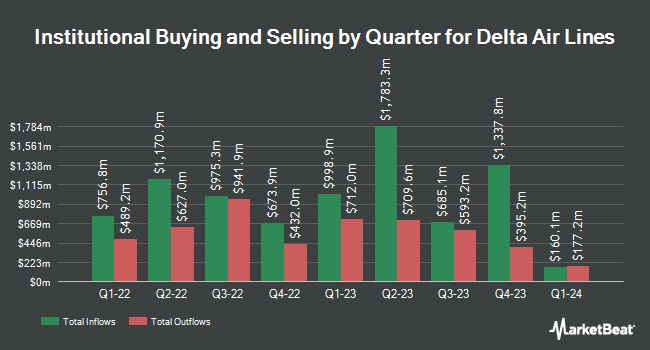
A number of other hedge funds have also made changes to their positions in the company. Capital International Investors lifted its holdings in Delta Air Lines by 4.4% during the 4th quarter. Capital International Investors now owns 24,211,101 shares of the transportation company's stock valued at $1,680,249,000 after purchasing an additional 1,012,265 shares during the last quarter. State Street Corp grew its stake in Delta Air Lines by 0.7% during the fourth quarter. State Street Corp now owns 23,163,644 shares of the transportation company's stock worth $1,607,557,000 after buying an additional 165,729 shares during the last quarter. Geode Capital Management LLC grew its stake in Delta Air Lines by 1.2% during the fourth quarter. Geode Capital Management LLC now owns 17,413,841 shares of the transportation company's stock worth $1,215,766,000 after buying an additional 202,865 shares during the last quarter. Wellington Management Group LLP increased its holdings in shares of Delta Air Lines by 137.4% during the fourth quarter. Wellington Management Group LLP now owns 13,811,787 shares of the transportation company's stock worth $958,538,000 after buying an additional 7,994,004 shares in the last quarter. Finally, Morgan Stanley increased its holdings in shares of Delta Air Lines by 0.5% during the fourth quarter. Morgan Stanley now owns 12,310,804 shares of the transportation company's stock worth $854,370,000 after buying an additional 56,455 shares in the last quarter. Institutional investors and hedge funds own 69.93% of the company's stock.
Delta Air Lines Price Performance
DAL opened at $90.01 on Thursday. The company has a debt-to-equity ratio of 0.48, a current ratio of 0.42 and a quick ratio of 0.35. The stock has a market capitalization of $59.19 billion, a P/E ratio of 14.93, a price-to-earnings-growth ratio of 1.14 and a beta of 1.31. The company's 50 day simple moving average is $87.05 and its 200-day simple moving average is $75.37. Delta Air Lines, Inc. has a one year low of $55.03 and a one year high of $95.68.
Delta Air Lines (NYSE:DAL - Get Free Report) last posted its quarterly earnings data on Thursday, July 9th. The transportation company reported $1.56 earnings per share for the quarter, topping the consensus estimate of $1.49 by $0.07. Delta Air Lines had a net margin of 5.79% and a return on equity of 17.52%. The firm had revenue of $17.67 billion during the quarter, compared to analysts' expectations of $17.43 billion. During the same quarter in the previous year, the company posted $2.10 EPS. Delta Air Lines's revenue was up 18.7% on a year-over-year basis. Sell-side analysts anticipate that Delta Air Lines, Inc. will post 6.54 earnings per share for the current fiscal year.
Delta Air Lines Increases Dividend
The company also recently announced a quarterly dividend, which was paid on Thursday, July 30th. Stockholders of record on Thursday, July 9th were given a dividend of $0.215 per share. The ex-dividend date was Thursday, July 9th. This is an increase from Delta Air Lines's previous quarterly dividend of $0.19. This represents a $0.86 dividend on an annualized basis and a dividend yield of 1.0%. Delta Air Lines's dividend payout ratio is presently 14.26%.
Wall Street Analysts Forecast Growth
Several brokerages have recently commented on DAL. Zacks Research raised Delta Air Lines from a "strong sell" rating to a "hold" rating in a report on Wednesday, April 15th. Morgan Stanley raised their price target on Delta Air Lines from $115.00 to $125.00 and gave the company an "overweight" rating in a report on Friday, July 10th. Citigroup lifted their price objective on Delta Air Lines from $106.00 to $110.00 and gave the company a "buy" rating in a research report on Sunday, July 12th. BNP Paribas Exane reduced their price objective on Delta Air Lines from $85.00 to $81.00 and set an "outperform" rating on the stock in a research note on Tuesday, April 21st. Finally, Cantor Fitzgerald set a $112.00 target price on Delta Air Lines in a report on Tuesday, July 14th. Twenty-three investment analysts have rated the stock with a Buy rating and two have issued a Hold rating to the stock. According to data from MarketBeat.com, the stock has an average rating of "Moderate Buy" and a consensus price target of $100.40.
Read Our Latest Stock Analysis on DAL
Insider Buying and Selling at Delta Air Lines
In related news, CEO Edward H. Bastian sold 206,510 shares of Delta Air Lines stock in a transaction dated Tuesday, August 4th. The stock was sold at an average price of $92.80, for a total value of $19,164,128.00. Following the completion of the sale, the chief executive officer directly owned 1,363,448 shares in the company, valued at $126,527,974.40. This trade represents a 13.15% decrease in their ownership of the stock. The sale was disclosed in a document filed with the Securities & Exchange Commission, which can be accessed through the SEC website. Also, EVP Steven M. Sear sold 40,460 shares of the business's stock in a transaction dated Wednesday, August 5th. The stock was sold at an average price of $93.55, for a total value of $3,785,033.00. Following the sale, the executive vice president directly owned 104,404 shares of the company's stock, valued at $9,766,994.20. This represents a 27.93% decrease in their ownership of the stock. The SEC filing for this sale provides additional information. Insiders have sold a total of 401,436 shares of company stock valued at $36,617,497 over the last ninety days. Company insiders own 0.80% of the company's stock.
Delta Air Lines Profile
(
Free Report)
Delta Air Lines is a major U.S.-based global airline that provides scheduled passenger and cargo air transportation, aircraft maintenance and repair services, and related travel products. Its operations include mainline domestic and international passenger services, a branded regional network operating under the Delta Connection name, dedicated air cargo carriage, and in-house maintenance, repair and overhaul through Delta TechOps. Delta offers a range of cabin products for different customer segments, including premium business-class service on long-haul routes and tiered economy offerings on domestic and international flights, and it markets customer loyalty benefits through the SkyMiles frequent-flyer program.
The carrier operates a mixed fleet of narrow- and wide-body aircraft from multiple U.S.
Read More
This instant news alert was generated by narrative science technology and financial data from MarketBeat in order to provide readers with the fastest reporting and unbiased coverage. Please send any questions or comments about this story to contact@marketbeat.com.
Before you consider Delta Air Lines, you'll want to hear this.
MarketBeat keeps track of Wall Street's top-rated and best performing research analysts and the stocks they recommend to their clients on a daily basis. MarketBeat has identified the five stocks that top analysts are quietly whispering to their clients to buy now before the broader market catches on... and Delta Air Lines wasn't on the list.
While Delta Air Lines currently has a Moderate Buy rating among analysts, top-rated analysts believe these five stocks are better buys.
View The Five Stocks Here
Nuclear energy is entering a new growth cycle as rising power demand, expanding data centers, and renewed policy support bring the sector back into focus. After strong gains in recent years, the most impactful phase of nuclear investment may still be ahead. This report highlights seven nuclear energy stocks positioned across the value chain—combining near-term revenue with long-term upside as next-generation technologies scale. Click the link below to unlock the full list.
Get This Free Report
Continue following MarketBeat
Add MarketBeat as your preferred source on Google to see our latest stories in your feed.
