Assetmark Inc. raised its position in Rambus, Inc. (NASDAQ:RMBS - Free Report) by 33.2% in the first quarter, according to its most recent Form 13F filing with the Securities & Exchange Commission. The fund owned 147,554 shares of the semiconductor company's stock after acquiring an additional 36,800 shares during the quarter. Assetmark Inc. owned approximately 0.14% of Rambus worth $12,694,000 as of its most recent SEC filing.
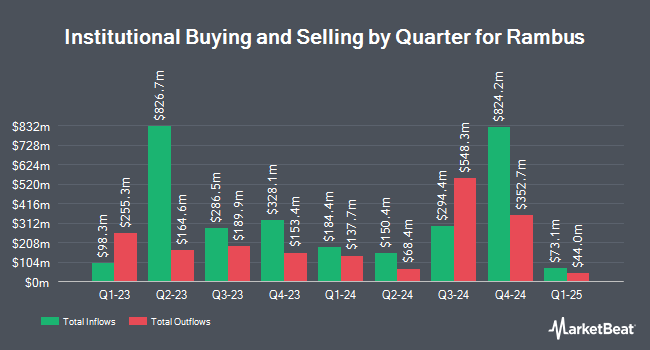
Several other institutional investors and hedge funds also recently added to or reduced their stakes in RMBS. Acumen Wealth Advisors LLC acquired a new stake in shares of Rambus in the 4th quarter valued at $25,000. Torren Management LLC acquired a new position in shares of Rambus during the fourth quarter worth $26,000. Spire Wealth Management increased its holdings in Rambus by 199.0% in the fourth quarter. Spire Wealth Management now owns 302 shares of the semiconductor company's stock valued at $28,000 after buying an additional 201 shares during the last quarter. University of Texas Texas AM Investment Management Co. purchased a new position in Rambus in the fourth quarter valued at $28,000. Finally, IFP Advisors Inc raised its stake in Rambus by 126.7% in the third quarter. IFP Advisors Inc now owns 442 shares of the semiconductor company's stock valued at $47,000 after buying an additional 247 shares in the last quarter. Institutional investors and hedge funds own 88.54% of the company's stock.
Insiders Place Their Bets
In related news, Director Meera Rao sold 2,972 shares of the company's stock in a transaction on Friday, April 24th. The shares were sold at an average price of $150.30, for a total value of $446,691.60. Following the completion of the sale, the director owned 19,974 shares in the company, valued at $3,002,092.20. This represents a 12.95% decrease in their position. The transaction was disclosed in a document filed with the Securities & Exchange Commission, which is available through the SEC website. Also, EVP Xianzhi Sean Fan sold 37,914 shares of the firm's stock in a transaction on Tuesday, May 26th. The stock was sold at an average price of $151.69, for a total transaction of $5,751,174.66. Following the transaction, the executive vice president directly owned 168,358 shares in the company, valued at $25,538,225.02. The trade was a 18.38% decrease in their ownership of the stock. The SEC filing for this sale provides additional information. In the last three months, insiders sold 65,886 shares of company stock valued at $10,171,466. 0.75% of the stock is owned by insiders.
Analyst Ratings Changes
RMBS has been the subject of a number of recent analyst reports. Wells Fargo & Company lifted their price target on Rambus from $115.00 to $145.00 and gave the stock an "overweight" rating in a report on Tuesday, April 28th. Rosenblatt Securities raised their target price on Rambus from $130.00 to $150.00 and gave the stock a "buy" rating in a research report on Tuesday, April 28th. Benchmark started coverage on Rambus in a research note on Wednesday. They set a "buy" rating and a $165.00 target price for the company. Evercore reaffirmed an "outperform" rating and issued a $172.00 price target on shares of Rambus in a report on Tuesday, April 28th. Finally, Weiss Ratings reaffirmed a "hold (c+)" rating on shares of Rambus in a report on Friday, June 5th. Two investment analysts have rated the stock with a Strong Buy rating, five have issued a Buy rating and four have issued a Hold rating to the stock. According to data from MarketBeat, the stock currently has a consensus rating of "Moderate Buy" and a consensus target price of $134.75.
Read Our Latest Research Report on RMBS
Rambus Stock Performance
RMBS opened at $101.44 on Monday. The business's 50-day simple moving average is $131.72 and its 200-day simple moving average is $114.16. Rambus, Inc. has a one year low of $62.81 and a one year high of $174.10. The stock has a market capitalization of $10.97 billion, a P/E ratio of 48.30 and a beta of 1.84.
Rambus (NASDAQ:RMBS - Get Free Report) last posted its earnings results on Monday, April 27th. The semiconductor company reported $0.63 earnings per share for the quarter, beating the consensus estimate of $0.61 by $0.02. The business had revenue of $180.19 million during the quarter, compared to the consensus estimate of $179.94 million. Rambus had a return on equity of 17.41% and a net margin of 31.90%. On average, equities research analysts forecast that Rambus, Inc. will post 2.44 EPS for the current fiscal year.
Rambus Company Profile
(
Free Report)
Rambus Inc is a technology licensing company specializing in semiconductor and system-level interface solutions. Founded in 1990 by Stanford University researchers Mike Farmwald and Mark Horowitz, Rambus established its headquarters in Sunnyvale, California. The company initially gained prominence by developing high-speed DRAM interface technology and securing a broad patent portfolio covering memory architecture, data signaling and power management innovations.
Today, Rambus licenses its proprietary intellectual property (IP) to semiconductor companies, original equipment manufacturers (OEMs) and system integrators worldwide.
Featured Stories
This instant news alert was generated by narrative science technology and financial data from MarketBeat in order to provide readers with the fastest reporting and unbiased coverage. Please send any questions or comments about this story to contact@marketbeat.com.

Continue following MarketBeat
Add MarketBeat as your preferred source on Google to see our latest stories in your feed.
Before you consider Rambus, you'll want to hear this.
MarketBeat keeps track of Wall Street's top-rated and best performing research analysts and the stocks they recommend to their clients on a daily basis. MarketBeat has identified the five stocks that top analysts are quietly whispering to their clients to buy now before the broader market catches on... and Rambus wasn't on the list.
While Rambus currently has a Moderate Buy rating among analysts, top-rated analysts believe these five stocks are better buys.
View The Five Stocks Here
Tesla, Nvidia, and Google helped shape the last era of market growth, but the next wave could come from a new group of companies. Inside this report, you’ll find 7 stocks that could play a major role in the next tech-driven market boom.
Get This Free Report
Like this article? Share it with a colleague.
Link copied to clipboard.
