Great Lakes Advisors LLC acquired a new position in shares of Texas Instruments Incorporated (NASDAQ:TXN - Free Report) in the 2nd quarter, according to the company in its most recent Form 13F filing with the Securities and Exchange Commission (SEC). The institutional investor acquired 8,866 shares of the semiconductor company's stock, valued at approximately $2,643,000.
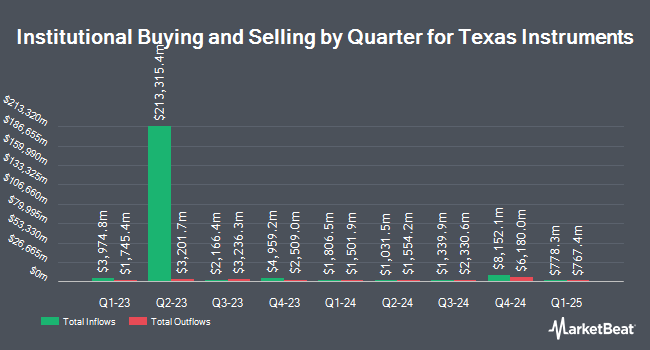
A number of other hedge funds and other institutional investors have also made changes to their positions in the stock. Strategic Wealth Investment Group LLC bought a new position in Texas Instruments during the 2nd quarter worth about $25,000. Portus Wealth Advisors LLC bought a new stake in shares of Texas Instruments in the first quarter valued at about $27,000. High Point Wealth Management LLC acquired a new position in shares of Texas Instruments during the fourth quarter worth about $25,000. Advocate Investing Services LLC acquired a new position in shares of Texas Instruments during the fourth quarter worth about $25,000. Finally, Scarborough Advisors LLC bought a new position in shares of Texas Instruments during the first quarter worth about $29,000. 84.99% of the stock is currently owned by institutional investors and hedge funds.
Texas Instruments Trading Down 0.7%
Shares of Texas Instruments stock opened at $265.60 on Friday. The stock has a market cap of $242.56 billion, a P/E ratio of 40.43, a P/E/G ratio of 1.05 and a beta of 1.33. The company has a quick ratio of 3.44, a current ratio of 4.86 and a debt-to-equity ratio of 0.72. Texas Instruments Incorporated has a 12-month low of $152.73 and a 12-month high of $334.03. The business's 50 day moving average is $291.25 and its 200-day moving average is $258.71.
Texas Instruments (NASDAQ:TXN - Get Free Report) last released its earnings results on Wednesday, July 22nd. The semiconductor company reported $2.14 earnings per share for the quarter, beating the consensus estimate of $1.91 by $0.23. The business had revenue of $5.46 billion during the quarter, compared to analysts' expectations of $5.26 billion. Texas Instruments had a net margin of 31.11% and a return on equity of 35.77%. The firm's revenue was up 22.8% on a year-over-year basis. During the same period last year, the business earned $1.41 earnings per share. Texas Instruments has set its Q3 2026 guidance at 2.230-2.570 EPS. Equities research analysts predict that Texas Instruments Incorporated will post 8.42 earnings per share for the current fiscal year.
Texas Instruments Announces Dividend
The company also recently disclosed a quarterly dividend, which was paid on Tuesday, August 11th. Stockholders of record on Friday, July 31st were given a $1.42 dividend. This represents a $5.68 dividend on an annualized basis and a dividend yield of 2.1%. The ex-dividend date of this dividend was Friday, July 31st. Texas Instruments's dividend payout ratio (DPR) is 86.45%.
Analyst Ratings Changes
A number of equities research analysts recently issued reports on the company. Stifel Nicolaus lifted their target price on Texas Instruments from $340.00 to $360.00 and gave the company a "buy" rating in a research report on Wednesday, June 24th. Truist Financial upped their price target on Texas Instruments from $278.00 to $300.00 and gave the stock a "hold" rating in a research report on Thursday, July 23rd. Weiss Ratings raised shares of Texas Instruments from a "hold (c+)" rating to a "buy (b-)" rating in a research note on Tuesday, July 28th. TD Cowen lowered their price objective on shares of Texas Instruments from $360.00 to $340.00 and set a "buy" rating on the stock in a report on Thursday, July 23rd. Finally, Wall Street Zen raised shares of Texas Instruments from a "hold" rating to a "buy" rating in a research report on Saturday, July 18th. Two analysts have rated the stock with a Strong Buy rating, fifteen have issued a Buy rating, eight have assigned a Hold rating and four have assigned a Sell rating to the stock. According to MarketBeat.com, Texas Instruments has an average rating of "Moderate Buy" and an average price target of $312.12.
View Our Latest Report on TXN
Texas Instruments Profile
(
Free Report)
Texas Instruments Inc NASDAQ: TXN is a global semiconductor company headquartered in Dallas, Texas, that designs and manufactures analog and embedded processing chips. The company's products are used across a wide range of end markets, including industrial, automotive, personal electronics, communications and enterprise equipment. TI's business emphasizes components that condition, convert, manage and move electrical signals—capabilities that are foundational to modern electronic systems.
TI's product portfolio includes a broad array of analog integrated circuits—such as power management, amplifiers, data converters and interface devices—as well as embedded processors and microcontrollers used to control systems and run real-time applications.
Further Reading
Want to see what other hedge funds are holding TXN? Visit HoldingsChannel.com to get the latest 13F filings and insider trades for Texas Instruments Incorporated (NASDAQ:TXN - Free Report).
This instant news alert was generated by narrative science technology and financial data from MarketBeat in order to provide readers with the fastest reporting and unbiased coverage. Please send any questions or comments about this story to contact@marketbeat.com.

Continue following MarketBeat
Add MarketBeat as your preferred source on Google to see our latest stories in your feed.
Before you consider Texas Instruments, you'll want to hear this.
MarketBeat keeps track of Wall Street's top-rated and best performing research analysts and the stocks they recommend to their clients on a daily basis. MarketBeat has identified the five stocks that top analysts are quietly whispering to their clients to buy now before the broader market catches on... and Texas Instruments wasn't on the list.
While Texas Instruments currently has a Moderate Buy rating among analysts, top-rated analysts believe these five stocks are better buys.
View The Five Stocks Here
Robotics and automation are rapidly becoming essential infrastructure across healthcare, manufacturing, logistics, and many other industries.
"Physical AI" is coming to the United States, and there are four ways that investors can gain exposure to this new robotics revolution. Plus, learn which seven companies are most positioned to benefit as intelligent robots enter the workforce.
Get This Free Report
Like this article? Share it with a colleague.
Link copied to clipboard.
