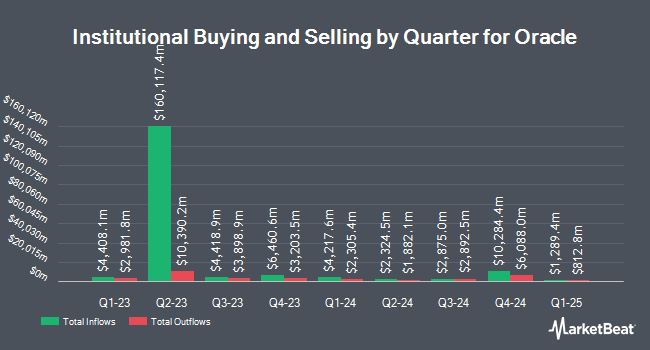
Lee Danner & Bass Inc. boosted its stake in shares of Oracle Corporation (NYSE:ORCL - Free Report) by 34.5% in the 4th quarter, according to the company in its most recent disclosure with the SEC. The firm owned 58,307 shares of the enterprise software provider's stock after buying an additional 14,958 shares during the quarter. Oracle makes up approximately 0.8% of Lee Danner & Bass Inc.'s portfolio, making the stock its 29th largest holding. Lee Danner & Bass Inc.'s holdings in Oracle were worth $11,365,000 as of its most recent SEC filing.
Other institutional investors also recently added to or reduced their stakes in the company. Meeder Advisory Services Inc. raised its stake in Oracle by 8.4% in the third quarter. Meeder Advisory Services Inc. now owns 40,946 shares of the enterprise software provider's stock worth $11,516,000 after buying an additional 3,184 shares in the last quarter. Decker Retirement Planning Inc. bought a new position in Oracle in the third quarter worth about $689,000. Xponance Inc. raised its stake in Oracle by 1.8% in the third quarter. Xponance Inc. now owns 406,544 shares of the enterprise software provider's stock worth $114,336,000 after buying an additional 7,320 shares in the last quarter. Migdal Insurance & Financial Holdings Ltd. raised its stake in Oracle by 62.1% in the third quarter. Migdal Insurance & Financial Holdings Ltd. now owns 483,000 shares of the enterprise software provider's stock worth $135,839,000 after buying an additional 184,996 shares in the last quarter. Finally, Stonegate Investment Group LLC raised its stake in Oracle by 3.2% in the third quarter. Stonegate Investment Group LLC now owns 99,400 shares of the enterprise software provider's stock worth $27,955,000 after buying an additional 3,065 shares in the last quarter. Institutional investors own 42.44% of the company's stock.
Wall Street Analyst Weigh In
ORCL has been the subject of a number of research reports. Oppenheimer increased their price target on shares of Oracle from $185.00 to $210.00 and gave the stock an "outperform" rating in a research note on Wednesday, March 11th. UBS Group reissued a "buy" rating on shares of Oracle in a research note on Monday, February 2nd. TD Cowen lowered their target price on shares of Oracle from $350.00 to $250.00 and set a "buy" rating for the company in a report on Friday, March 6th. Morgan Stanley dropped their price target on Oracle from $213.00 to $207.00 and set an "equal weight" rating on the stock in a research report on Thursday. Finally, BMO Capital Markets cut their price target on Oracle from $205.00 to $200.00 and set an "outperform" rating on the stock in a research note on Wednesday, March 11th. Four research analysts have rated the stock with a Strong Buy rating, twenty-seven have issued a Buy rating, nine have given a Hold rating and one has assigned a Sell rating to the company. According to data from MarketBeat, the stock presently has a consensus rating of "Moderate Buy" and an average target price of $259.56.
Read Our Latest Research Report on ORCL
Oracle Stock Performance
Oracle stock opened at $173.51 on Friday. The company has a quick ratio of 1.35, a current ratio of 1.35 and a debt-to-equity ratio of 3.66. The company has a market capitalization of $499.01 billion, a P/E ratio of 31.15, a PEG ratio of 1.68 and a beta of 1.60. The stock's 50 day moving average is $154.21 and its 200 day moving average is $192.63. Oracle Corporation has a twelve month low of $134.57 and a twelve month high of $345.72.
Oracle (NYSE:ORCL - Get Free Report) last posted its quarterly earnings results on Tuesday, March 10th. The enterprise software provider reported $1.79 earnings per share for the quarter, topping the consensus estimate of $1.71 by $0.08. The company had revenue of $17.19 billion for the quarter, compared to the consensus estimate of $16.91 billion. Oracle had a return on equity of 62.70% and a net margin of 25.30%.The firm's quarterly revenue was up 21.7% compared to the same quarter last year. During the same quarter in the prior year, the business posted $1.47 EPS. Oracle has set its Q4 2026 guidance at 1.960-2.000 EPS. On average, equities research analysts predict that Oracle Corporation will post 6.07 earnings per share for the current fiscal year.
Oracle Dividend Announcement
The company also recently declared a quarterly dividend, which was paid on Friday, April 24th. Investors of record on Thursday, April 9th were given a dividend of $0.50 per share. The ex-dividend date of this dividend was Thursday, April 9th. This represents a $2.00 annualized dividend and a dividend yield of 1.2%. Oracle's dividend payout ratio (DPR) is 35.91%.
Oracle News Summary
Here are the key news stories impacting Oracle this week:
Insider Activity at Oracle
In related news, CEO Clayton M. Magouyrk sold 10,000 shares of the firm's stock in a transaction that occurred on Monday, February 9th. The shares were sold at an average price of $155.23, for a total transaction of $1,552,300.00. Following the completion of the sale, the chief executive officer owned 134,030 shares of the company's stock, valued at $20,805,476.90. This trade represents a 6.94% decrease in their ownership of the stock. The sale was disclosed in a legal filing with the Securities & Exchange Commission, which is available at the SEC website. Also, EVP Stuart Levey sold 15,000 shares of the firm's stock in a transaction that occurred on Thursday, April 16th. The shares were sold at an average price of $176.19, for a total transaction of $2,642,850.00. Following the sale, the executive vice president directly owned 3,429 shares of the company's stock, valued at $604,155.51. This trade represents a 81.39% decrease in their position. Additional details regarding this sale are available in the official SEC disclosure. The transaction was executed under a pre-arranged Rule 10b5-1 trading plan. 40.90% of the stock is owned by company insiders.
About Oracle
(
Free Report)
Oracle Corporation is a multinational technology company that develops and sells database software, cloud engineered systems, enterprise software applications and related services. The company is widely known for its flagship Oracle Database and a portfolio of enterprise-grade software products that support data management, application development, analytics and middleware. Over recent years Oracle has expanded its focus to include cloud infrastructure and cloud applications, positioning itself as a provider of both platform and software-as-a-service solutions for large organizations.
Oracle's product and service offerings include Oracle Database and the Autonomous Database, Oracle Cloud Infrastructure (OCI), enterprise resource planning (ERP), human capital management (HCM) and supply chain management (SCM) cloud applications (often grouped under Oracle Fusion Cloud Applications), middleware such as WebLogic, and developer technologies including Java and MySQL.
See Also
This instant news alert was generated by narrative science technology and financial data from MarketBeat in order to provide readers with the fastest reporting and unbiased coverage. Please send any questions or comments about this story to contact@marketbeat.com.
Before you consider Oracle, you'll want to hear this.
MarketBeat keeps track of Wall Street's top-rated and best performing research analysts and the stocks they recommend to their clients on a daily basis. MarketBeat has identified the five stocks that top analysts are quietly whispering to their clients to buy now before the broader market catches on... and Oracle wasn't on the list.
While Oracle currently has a Moderate Buy rating among analysts, top-rated analysts believe these five stocks are better buys.
View The Five Stocks Here
Nuclear energy is entering a new growth cycle as rising power demand, expanding data centers, and renewed policy support bring the sector back into focus. After strong gains in recent years, the most impactful phase of nuclear investment may still be ahead.
This report highlights seven nuclear energy stocks positioned across the value chain—combining near-term revenue with long-term upside as next-generation technologies scale. Click the link below to unlock the full list.
Get This Free Report
