Bell Bank lifted its holdings in shares of Microsoft Corporation (NASDAQ:MSFT - Free Report) by 3.2% in the second quarter, according to the company in its most recent filing with the Securities & Exchange Commission. The fund owned 46,554 shares of the software giant's stock after buying an additional 1,454 shares during the period. Microsoft accounts for approximately 0.7% of Bell Bank's holdings, making the stock its 11th biggest position. Bell Bank's holdings in Microsoft were worth $17,366,000 as of its most recent SEC filing.
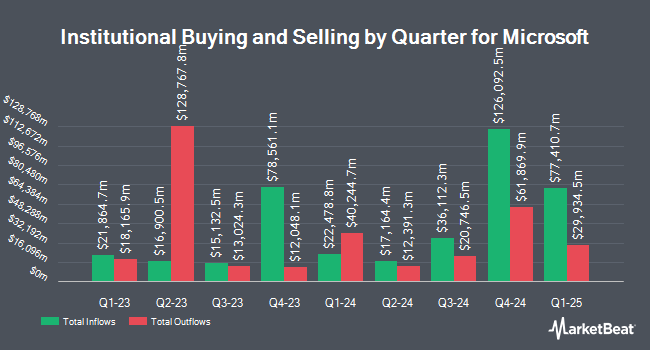
Several other institutional investors and hedge funds have also recently bought and sold shares of the business. Longfellow Investment Management Co. LLC boosted its stake in Microsoft by 51.3% during the 2nd quarter. Longfellow Investment Management Co. LLC now owns 59 shares of the software giant's stock valued at $29,000 after purchasing an additional 20 shares during the period. Shepherd Kaplan Krochuk LLC raised its holdings in shares of Microsoft by 4.9% during the third quarter. Shepherd Kaplan Krochuk LLC now owns 431 shares of the software giant's stock valued at $223,000 after buying an additional 20 shares during the last quarter. Fischer Investment Strategies LLC raised its holdings in shares of Microsoft by 3.1% during the fourth quarter. Fischer Investment Strategies LLC now owns 697 shares of the software giant's stock valued at $337,000 after buying an additional 21 shares during the last quarter. Pollock Investment Advisors LLC boosted its position in shares of Microsoft by 0.8% during the third quarter. Pollock Investment Advisors LLC now owns 2,805 shares of the software giant's stock worth $1,453,000 after buying an additional 21 shares during the period. Finally, Better Money Decisions LLC boosted its position in shares of Microsoft by 0.6% during the second quarter. Better Money Decisions LLC now owns 3,498 shares of the software giant's stock worth $1,740,000 after buying an additional 21 shares during the period. Institutional investors and hedge funds own 71.13% of the company's stock.
Key Stories Impacting Microsoft
Here are the key news stories impacting Microsoft this week:
- Positive Sentiment: Microsoft’s decision to disclose Azure revenue separately beginning in fiscal 2027 is improving visibility into its cloud business. Azure generated $29.4 billion in quarterly revenue and $101.9 billion for fiscal 2026, while the company’s remaining performance obligations reached $678 billion. The clearer reporting may help investors assess Microsoft’s position against Amazon Web Services and Google Cloud. Microsoft Finally Reveals Azure’s Core
- Positive Sentiment: Stifel raised its Microsoft price target to $530, citing improving Copilot adoption and artificial-intelligence momentum. OpenAI’s launch of GPT-6 Astra could also benefit Microsoft because Azure customers are reportedly already using the model, strengthening the strategic value of Microsoft’s OpenAI relationship. Stifel raises Microsoft price target
- Neutral Sentiment: Microsoft is reorganizing its reporting structure around “Devices and Consumer” and “Agents and Infra.” The change could make AI economics easier to evaluate, but it may also increase scrutiny of spending and margins once the new disclosures begin.
- Negative Sentiment: Investors remain concerned that Microsoft’s AI buildout is becoming increasingly expensive. Capital expenditures reached about $41 billion in the latest quarter, cloud gross margin reportedly fell to roughly 65% from 67%, and the company plans to continue adding data centers and AI capacity. The risk is that depreciation, power and chip costs could delay returns on the large backlog. Microsoft faces pressure despite cloud and AI growth
- Negative Sentiment: CEO Satya Nadella sold 86,525 shares worth approximately $43.4 million. The sale was executed under a pre-arranged Rule 10b5-1 plan, limiting its value as a business signal, but the transaction can still add short-term sentiment pressure after the stock’s run-up. Satya Nadella sells Microsoft stock
- Negative Sentiment: Microsoft is limiting Xbox Game Pass cloud gaming to 15 hours per month for some subscribers as infrastructure costs rise. The move may improve service economics, but it risks frustrating users and weakening Microsoft’s consumer-gaming proposition. Microsoft limits Xbox cloud gaming
Wall Street Analysts Forecast Growth
Several analysts recently commented on MSFT shares. Truist Financial restated a "buy" rating and issued a $575.00 target price on shares of Microsoft in a research report on Wednesday, July 22nd. Wedbush reiterated an "outperform" rating and set a $575.00 price target on shares of Microsoft in a research report on Wednesday, May 13th. TD Cowen reissued a "buy" rating and issued a $540.00 price target on shares of Microsoft in a research note on Thursday, July 30th. Morgan Stanley reissued an "overweight" rating on shares of Microsoft in a report on Thursday, July 30th. Finally, KeyCorp restated an "overweight" rating on shares of Microsoft in a research note on Thursday. Forty-two research analysts have rated the stock with a Buy rating and five have assigned a Hold rating to the company. According to MarketBeat, the stock currently has a consensus rating of "Moderate Buy" and a consensus target price of $564.27.
Check Out Our Latest Report on Microsoft
Microsoft Stock Performance
Shares of NASDAQ MSFT opened at $499.70 on Monday. Microsoft Corporation has a 1 year low of $349.20 and a 1 year high of $553.72. The firm has a market cap of $3.71 trillion, a P/E ratio of 27.82, a PEG ratio of 1.61 and a beta of 1.11. The stock has a fifty day moving average price of $444.52 and a two-hundred day moving average price of $415.90. The company has a debt-to-equity ratio of 0.07, a quick ratio of 1.22 and a current ratio of 1.23.
Microsoft (NASDAQ:MSFT - Get Free Report) last posted its quarterly earnings data on Wednesday, July 29th. The software giant reported $4.74 EPS for the quarter, topping analysts' consensus estimates of $4.24 by $0.50. Microsoft had a return on equity of 31.98% and a net margin of 40.31%.The company had revenue of $90.01 billion for the quarter, compared to the consensus estimate of $87.62 billion. During the same quarter in the previous year, the business earned $3.65 EPS. The company's quarterly revenue was up 17.7% compared to the same quarter last year. Research analysts forecast that Microsoft Corporation will post 19.59 EPS for the current fiscal year.
Microsoft Dividend Announcement
The firm also recently declared a quarterly dividend, which will be paid on Thursday, September 10th. Shareholders of record on Thursday, August 20th will be issued a $0.91 dividend. This represents a $3.64 dividend on an annualized basis and a yield of 0.7%. The ex-dividend date of this dividend is Thursday, August 20th. Microsoft's dividend payout ratio is presently 20.27%.
Insider Buying and Selling at Microsoft
In related news, CEO Judson Althoff sold 10,000 shares of the firm's stock in a transaction that occurred on Wednesday, August 5th. The shares were sold at an average price of $487.89, for a total transaction of $4,878,900.00. Following the completion of the sale, the chief executive officer directly owned 100,447 shares in the company, valued at approximately $49,007,086.83. This trade represents a 9.05% decrease in their ownership of the stock. The sale was disclosed in a filing with the SEC, which is available at the SEC website. Also, CEO Satya Nadella sold 86,525 shares of Microsoft stock in a transaction that occurred on Tuesday, September 1st. The stock was sold at an average price of $501.46, for a total transaction of $43,388,826.50. Following the completion of the transaction, the chief executive officer owned 486,763 shares in the company, valued at approximately $244,092,173.98. This trade represents a 15.09% decrease in their position. Additional details regarding this sale are available in the official SEC disclosure. The transaction was executed under a pre-arranged Rule 10b5-1 trading plan. In the last three months, insiders sold 105,835 shares of company stock valued at $52,468,575. 0.03% of the stock is owned by insiders.
Microsoft Company Profile
(
Free Report)
Microsoft Corporation is a global technology company headquartered in Redmond, Washington. Founded in 1975 by Bill Gates and Paul Allen, Microsoft develops, licenses and supports a broad range of software products, services and devices for consumers, enterprises and governments worldwide. Its operations span personal computing, productivity software, cloud infrastructure, enterprise applications, developer tools and gaming.
Microsoft's product portfolio includes the Windows operating system and the Microsoft 365 suite of productivity and collaboration tools (Office apps, Outlook, Teams).
Recommended Stories
Want to see what other hedge funds are holding MSFT? Visit HoldingsChannel.com to get the latest 13F filings and insider trades for Microsoft Corporation (NASDAQ:MSFT - Free Report).
This instant news alert was generated by narrative science technology and financial data from MarketBeat in order to provide readers with the fastest reporting and unbiased coverage. Please send any questions or comments about this story to contact@marketbeat.com.

Continue following MarketBeat
Add MarketBeat as your preferred source on Google to see our latest stories in your feed.
Before you consider Microsoft, you'll want to hear this.
MarketBeat keeps track of Wall Street's top-rated and best performing research analysts and the stocks they recommend to their clients on a daily basis. MarketBeat has identified the five stocks that top analysts are quietly whispering to their clients to buy now before the broader market catches on... and Microsoft wasn't on the list.
While Microsoft currently has a Moderate Buy rating among analysts, top-rated analysts believe these five stocks are better buys.
View The Five Stocks Here
The AI boom extends far beyond the biggest tech names. Discover 10 companies supplying the memory, storage, networking, semiconductor manufacturing, and power infrastructure that make AI possible. Learn where the next wave of AI investment opportunities may emerge—and the key risks investors should watch as the global AI buildout accelerates.
Get This Free Report
