Spartan Planning & Wealth Management lessened its holdings in NVIDIA Corporation (NASDAQ:NVDA - Free Report) by 17.6% during the third quarter, according to its most recent disclosure with the SEC. The institutional investor owned 40,027 shares of the computer hardware maker's stock after selling 8,525 shares during the period. NVIDIA accounts for approximately 5.9% of Spartan Planning & Wealth Management's portfolio, making the stock its 4th largest holding. Spartan Planning & Wealth Management's holdings in NVIDIA were worth $9,141,000 at the end of the most recent quarter.
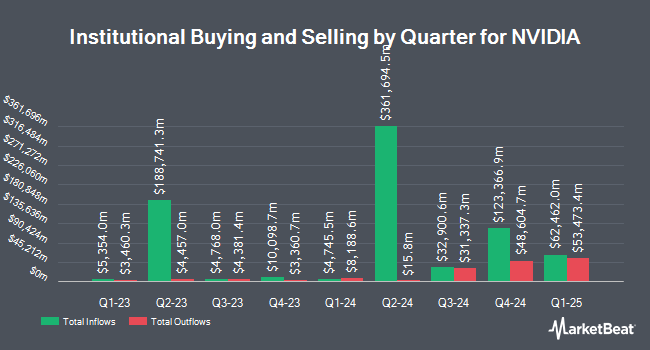
Several other large investors also recently added to or reduced their stakes in the business. State Street Corp boosted its position in shares of NVIDIA by 1.6% during the 2nd quarter. State Street Corp now owns 1,009,783,437 shares of the computer hardware maker's stock valued at $202,047,568,000 after acquiring an additional 15,897,836 shares during the last quarter. Bank of America Corp DE grew its holdings in shares of NVIDIA by 2.2% during the second quarter. Bank of America Corp DE now owns 195,366,864 shares of the computer hardware maker's stock worth $39,090,956,000 after purchasing an additional 4,165,875 shares in the last quarter. Amundi increased its position in shares of NVIDIA by 10.4% in the first quarter. Amundi now owns 133,768,018 shares of the computer hardware maker's stock worth $23,329,141,000 after purchasing an additional 12,575,177 shares during the last quarter. Dimensional Fund Advisors LP increased its position in shares of NVIDIA by 0.6% in the first quarter. Dimensional Fund Advisors LP now owns 94,521,253 shares of the computer hardware maker's stock worth $16,479,126,000 after purchasing an additional 555,221 shares during the last quarter. Finally, Deutsche Bank AG raised its stake in NVIDIA by 2.3% in the second quarter. Deutsche Bank AG now owns 91,954,159 shares of the computer hardware maker's stock valued at $18,399,108,000 after purchasing an additional 2,045,101 shares in the last quarter. Institutional investors own 65.27% of the company's stock.
Analysts Set New Price Targets
NVDA has been the subject of several research analyst reports. Deutsche Bank Aktiengesellschaft reiterated a "buy" rating on shares of NVIDIA in a research report on Monday, August 31st. DZ Bank restated a "buy" rating on shares of NVIDIA in a research report on Wednesday, August 26th. Benchmark restated a "buy" rating and set a $335.00 price objective on shares of NVIDIA in a research report on Thursday, August 27th. Raymond James Financial set a $515.00 price objective on shares of NVIDIA and gave the stock a "strong-buy" rating in a report on Thursday, August 27th. Finally, Zacks Research upgraded shares of NVIDIA from a "hold" rating to a "strong-buy" rating in a research report on Monday, September 21st. Five equities research analysts have rated the stock with a Strong Buy rating, forty-eight have issued a Buy rating and one has given a Hold rating to the company's stock. According to data from MarketBeat, the company has a consensus rating of "Buy" and a consensus price target of $318.85.
Get Our Latest Report on NVIDIA
Insider Activity
In other news, EVP Timothy Teter sold 30,460 shares of NVIDIA stock in a transaction dated Monday, September 21st. The stock was sold at an average price of $222.80, for a total value of $6,786,488.00. Following the transaction, the executive vice president owned 2,687,660 shares in the company, valued at approximately $598,810,648. The trade was a 1.12% decrease in their ownership of the stock. The transaction was disclosed in a filing with the Securities & Exchange Commission, which is accessible through this hyperlink. The transaction was executed under a pre-arranged Rule 10b5-1 trading plan. Also, Director Mark Stevens sold 622,239 shares of the business's stock in a transaction dated Friday, September 4th. The shares were sold at an average price of $231.62, for a total value of $144,122,997.18. Following the completion of the sale, the director directly owned 2,336,531 shares of the company's stock, valued at approximately $541,187,310.22. This trade represents a 21.03% decrease in their position. The disclosure for this sale is available in the SEC filing. Over the last three months, insiders have sold 1,766,118 shares of company stock valued at $399,450,353. 3.94% of the stock is currently owned by insiders.
NVIDIA Stock Down 3.2%
Shares of NASDAQ NVDA opened at $200.13 on Thursday. The stock has a market capitalization of $4.82 trillion, a P/E ratio of 25.30, a PEG ratio of 1.59 and a beta of 2.21. NVIDIA Corporation has a one year low of $164.27 and a one year high of $243.37. The firm's 50 day simple moving average is $221.19 and its two-hundred day simple moving average is $204.51. The company has a debt-to-equity ratio of 0.14, a current ratio of 4.59 and a quick ratio of 3.85.
NVIDIA (NASDAQ:NVDA - Get Free Report) last announced its quarterly earnings data on Wednesday, August 26th. The computer hardware maker reported $2.22 earnings per share (EPS) for the quarter, beating analysts' consensus estimates of $2.09 by $0.13. NVIDIA had a net margin of 63.66% and a return on equity of 96.04%. The company had revenue of $96.22 billion during the quarter, compared to analysts' expectations of $92.27 billion. During the same quarter in the prior year, the company earned $1.05 EPS. The firm's revenue was up 105.9% on a year-over-year basis. As a group, analysts expect that NVIDIA Corporation will post 9.30 EPS for the current fiscal year.
NVIDIA Announces Dividend
The business also recently disclosed a quarterly dividend, which was paid on Thursday, October 1st. Stockholders of record on Thursday, September 10th were paid a dividend of $0.25 per share. This represents a $1.00 dividend on an annualized basis and a dividend yield of 0.5%. The ex-dividend date of this dividend was Thursday, September 10th. NVIDIA's dividend payout ratio (DPR) is 12.64%.
NVIDIA announced that its board has authorized a share repurchase plan on Monday, September 28th that authorizes the company to repurchase $150 billion in outstanding shares. This buyback authorization authorizes the computer hardware maker to reacquire up to 2.8% of its shares through open market purchases. Share buyback plans are generally an indication that the company's board believes its shares are undervalued.
NVIDIA News Roundup
Here are the key news stories impacting NVIDIA this week:
NVIDIA Profile
(
Free Report)
NVIDIA Corporation NASDAQ: NVDA is a technology company that designs graphics processing units (GPUs), accelerated computing platforms, networking products and related software. Its technologies support artificial intelligence, machine learning, scientific computing, data analytics, professional visualization and computer graphics.
The company's products include GeForce GPUs for gaming and personal computing, data center GPUs and systems for AI and high-performance computing, and networking solutions used to connect and manage large-scale computing infrastructure.
Further Reading
Want to see what other hedge funds are holding NVDA? Visit HoldingsChannel.com to get the latest 13F filings and insider trades for NVIDIA Corporation (NASDAQ:NVDA - Free Report).
This instant news alert was generated by narrative science technology and financial data from MarketBeat in order to provide readers with the fastest reporting and unbiased coverage. Please send any questions or comments about this story to contact@marketbeat.com.
Before you consider NVIDIA, you'll want to hear this.
MarketBeat keeps track of Wall Street's top-rated and best performing research analysts and the stocks they recommend to their clients on a daily basis. MarketBeat has identified the five stocks that top analysts are quietly whispering to their clients to buy now before the broader market catches on... and NVIDIA wasn't on the list.
While NVIDIA currently has a Buy rating among analysts, top-rated analysts believe these five stocks are better buys.
View The Five Stocks Here
The AI boom extends far beyond the biggest tech names. Discover 10 companies supplying the memory, storage, networking, semiconductor manufacturing, and power infrastructure that make AI possible. Learn where the next wave of AI investment opportunities may emerge—and the key risks investors should watch as the global AI buildout accelerates.
Get This Free Report
Continue following MarketBeat
Add MarketBeat as your preferred source on Google to see our latest stories in your feed.
