Biopharmaceutical stocks require time and patience. But when the company gets it right, investors get rewarded as they have with Kiniksa Pharmaceuticals NASDAQ: KNSA. The stock is up over 100% in the last year. Much of that growth came after the company’s strong Q1 earnings report on April 28, in which it topped adjusted earnings per share (EPS) estimates by 9 cents, coming in at 27 cents.
Kiniksa Pharmaceuticals International Today
KNSA
Kiniksa Pharmaceuticals International
$53.24 -0.41 (-0.76%) As of 05/22/2026 04:00 PM Eastern
- 52-Week Range
- $25.70
▼
$59.87 - P/E Ratio
- 59.16
- Price Target
- $60.86
At that time, the company announced the launch of a targeted direct-to-consumer TV campaign for ARCALYST in recurrent pericarditis. ARCALYST is the first and only U.S. Food & Drug Administration (FDA) approved therapy for recurrent pericarditis. It received this designation in 2021.
After some initial volatility, ARCALYST saw revenue of about $48 million in March 2023. Revenue growth has accelerated, reaching a new record of $214.27 million in Q1 2026, a 56% year-over-year (YOY) gain. The new campaign is significant because it shows that Kiniksa is investing in demand generation at scale rather than relying solely on prescriber growth.
To that end, the company raised its full-year revenue guidance to $930 million to $945 million. The prior guidance was for a range between $900 million and $920 million.
A Singular Focus Moving Into Its Second Generation
Like many biotech companies, Kiniska focuses on discovering and advancing novel, transformative therapies for patients with unmet medical needs. The company’s specific focus is on cardiovascular diseases, specifically pericarditis.
Pericarditis is an inflammation of the pericardium—the thin, fluid-filled sac surrounding the heart—that causes sharp chest pain, fatigue, and in severe cases, dangerous fluid buildup around the heart. When the condition keeps coming back despite standard anti-inflammatory treatments like NSAIDs and colchicine, it becomes recurrent pericarditis, a chronic autoinflammatory disease driven by an overactive IL-1 immune response.
How big is this market? Approximately 40,000 patients in the U.S. seek and receive treatment for recurrent pericarditis each year, with roughly 14,000 of those experiencing two or more recurrences due to persistent underlying disease or inadequate response to conventional therapies.
That 14,000 is roughly equal to Kiniksa’s initial target, of which 18% were on ARCALYST by the end of 2025. That leaves about 80% of the addressable market untreated, and, for now, Kiniska has the field to itself, and it’s running at full speed to keep competitors out.
That leads to the company’s pipeline, which includes its KPL-387 drug. This is a once-monthly subcutaneous self-injection that marks a significant upgrade over ARCALYST’s more frequent dosing. KPL-387, which is in Phase 2 trials, received FDA Orphan Drug Designation (ODD) in October 2025.
Among the many benefits of ODD is that Kiniksa will have exclusive marketing rights for seven years. Investors in the biotech space like exclusivity, and this is another opportunity for Kiniksa to deliver.
Valuation May Become a Concern
Biotechnology stocks can be volatile, and Kiniksa is no different. However, unlike many speculative biotech names that are unprofitable and have little to no revenue, Kiniksa has become a profitable company with revenue that is growing sequentially and YOY.
That said, KNSA now trades at around 60x earnings. That’s a significant premium to the S&P 500 (around 27x) and the broader biotech sector (around 17x). The bull case is that Kiniksa has earned this premium with an outlook for strong revenue growth and higher margins.
Skeptics could counter that the current stock price is dependent on flawless execution, which may or may not happen. However, playing the wait-and-see game hasn’t worked out well for investors who stayed on the sidelines, and the consensus price target of $60.86 still leaves a healthy upside from current levels.
KNSA Chart Makes an Argument to Wait
The technical picture supports a measured approach for investors considering a position. After surging nearly 20% after the earnings report, KNSA has pulled back to the $53-$54 range on declining volume. This signals a healthy consolidation, not a structural breakdown. The relative strength index (RSI) has retreated from overbought territory near 80 to a neutral 51, meaning the post-earnings momentum excess has been worked off without significant price damage. The MACD crossover, however, suggests modest near-term selling pressure may not be fully exhausted.
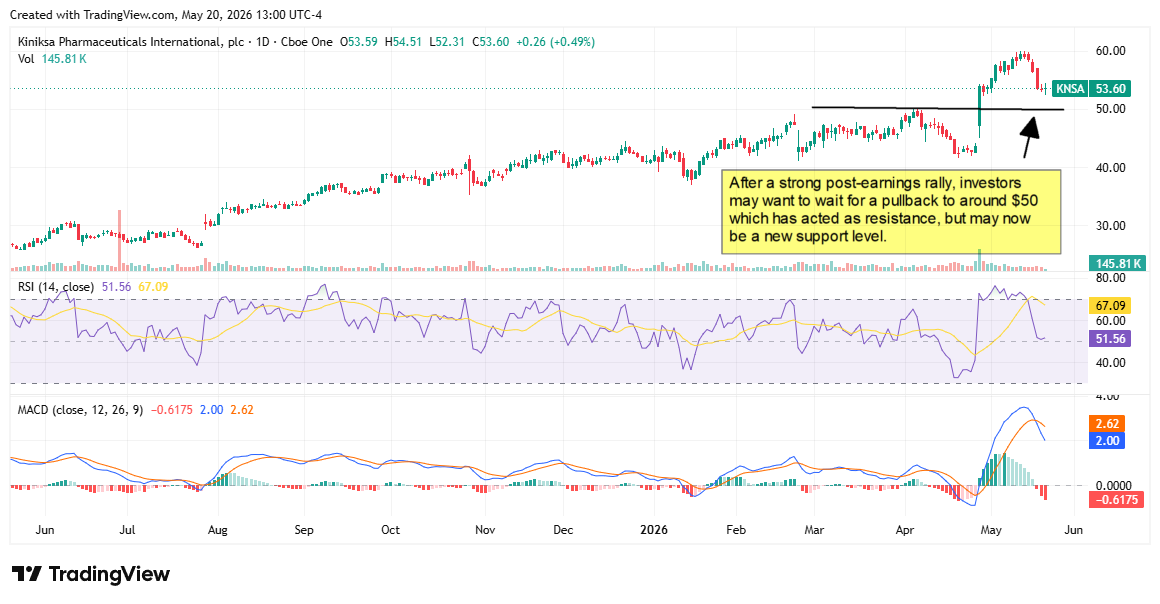
Investors looking for a more defined entry point may want to watch the 50-day simple moving average, currently tracking in the $47-$49 range. A successful test of that level—particularly if the MACD turns positive on the retest—would confirm the broader uptrend remains intact and offer a more favorable risk-reward setup ahead of the anticipated KPL-387 Phase 2 data in the second half of 2026.
Before you consider Kiniksa Pharmaceuticals International, you'll want to hear this.
MarketBeat keeps track of Wall Street's top-rated and best performing research analysts and the stocks they recommend to their clients on a daily basis. MarketBeat has identified the five stocks that top analysts are quietly whispering to their clients to buy now before the broader market catches on... and Kiniksa Pharmaceuticals International wasn't on the list.
While Kiniksa Pharmaceuticals International currently has a Moderate Buy rating among analysts, top-rated analysts believe these five stocks are better buys.
View The Five Stocks Here
Click the link to see MarketBeat's list of seven stocks and why their long-term outlooks are very promising.
Get This Free Report
Like this article? Share it with a colleague.
Link copied to clipboard.