It’s been another week of relative misery for Microsoft Corp. NASDAQ: MSFT shareholders. For the week of Feb. 16-20, MSFT stock was down 3.28%. That continues the stock’s run of lackluster performance. MSFT stock is:
- Down 17.05% in the 30 days ending Feb. 20.
- Down 18.14% in the last three months.
Microsoft Today
$535.07 +12.46 (+2.38%) As of 04:00 PM Eastern
- 52-Week Range
- $349.20
▼
$553.72 - Dividend Yield
- 0.73%
- P/E Ratio
- 29.79
- Price Target
- $578.73
All of that has turned the Microsoft stock price negative by 5.3% in the last 12 months. It’s a fall from grace that most investors didn’t see coming.
However, pullbacks like this in a blue-chip name like Microsoft are often buying opportunities. That seems to be the case with one of the company’s insiders who recently made a significant purchase of MSFT stock.
John W. Stanton, a director at Microsoft, purchased 5,000 shares of the company’s stock on Feb. 18. It’s one thing for a Member of Congress to buy shares of a company. But insiders buy for one reason; they believe the stock is undervalued. That said, one purchase doesn’t make a trend. But it does provide one data point for the case that MSFT stock could be oversold.
By now, the reasons for the stock’s pullback are well known. In fact, in some ways, Microsoft checks all the boxes for investors who are looking to dump technology stocks.
- The company is one of the leading hyperscalers and has committed billions in capital expenditures (CapEx) to building out its AI infrastructure (i.e., datacenters).
- Microsoft is in the crosshairs of the “AI will eat software” sell-off.
- Analysts are questioning the return on investment for the company’s investment in OpenAI.
All of these concerns require a balanced look to put the MSFT stock sell-off into proper context.
Hyperscaler CapEx Concerns
Microsoft is one of the "big three" hyperscalers, a list that includes Amazon.com Inc. NASDAQ: AMZN and Alphabet Inc. NASDAQ: GOOGL. In Q2 fiscal year 2026, Microsoft spent $37.5 billion in capex.
This level of spending, which isn’t expected to decrease, is becoming problematic for investors who want to know how long it will take to generate returns that justify the spend. Rising energy costs, long construction timelines, and uncertainty about whether AI demand will scale fast enough to absorb all that capacity have compounded the concern.
But it’s worth noting that Microsoft is paying for this CapEx with cash on hand. Despite that, Evercore ISI recently forecast that, among the hyperscalers, only Microsoft will generate positive free cash flow this fiscal year.
The takeaway is that Microsoft’s underlying business is profitable enough to fund this expansion without bleeding cash. That also supports Microsoft’s argument that the AI spending is being committed to meet contracted customer commitments, not as a speculative buildout.
The “AI Will Eat Software Threat”
At its core, Microsoft is a software company, with Windows, Office, and related licensing being the lifeblood of its annual recurring revenue (ARR). The rise of agentic AI is causing analysts to question the long-term viability of Microsoft’s licensing model. Investors worry that even if Microsoft wins the AI race, it could cannibalize its own most profitable businesses in the process.
But that concern assumes that Microsoft is a passive observer to the AI threat. The reality is more nuanced. Copilot, the company’s agentic AI tool, is already deeply embedded across the Microsoft 365 suite. That means revenue is being layered on top of existing revenue at a premium that commands higher per-seat pricing.
This means that enterprise customers are not abandoning Microsoft’s ecosystem; they're paying more to access AI within that system.
The OpenAI Investment Under the Microscope
Microsoft has poured an estimated $13 billion into OpenAI. That investment made enormous strategic sense when OpenAI was the unquestioned leader in the AI frontier. That picture has grown more complicated.
Microsoft MarketRank™ Stock Analysis
- Overall MarketRank™
- 98th Percentile
- Analyst Rating
- Moderate Buy
- Upside/Downside
- 8.3% Upside
- Short Interest Level
- Healthy
- Dividend Strength
- Strong
- News Sentiment
- 0.95

- Insider Trading
- Selling Shares
- Proj. Earnings Growth
- 18.27%
See Full AnalysisDeepSeek's emergence demonstrated that competitive, capable AI models can be built at a fraction of the cost, which raises questions about whether OpenAI's technological moat is as durable as once assumed.
There is also structural awkwardness baked into the partnership: OpenAI is pursuing its own commercial relationships and has ambitions that don't always neatly align with Microsoft's. Analysts are increasingly asking whether Microsoft is getting a fair return on that investment relative to what it could have achieved by building in-house or partnering elsewhere.
However, framing the OpenAI investment purely as a financial bet misses the deeper strategic implications. Microsoft bought deep integration rights, model access, and the ability to embed the world’s most recognized AI brand directly into its products. Plus, Microsoft has been developing its own in-house models in parallel, meaning it is not solely dependent on OpenAI to remain competitive. The partnership gave Microsoft a two- to three-year head start in enterprise AI adoption that competitors cannot buy back overnight.
Selling May Be Nearing Exhaustion
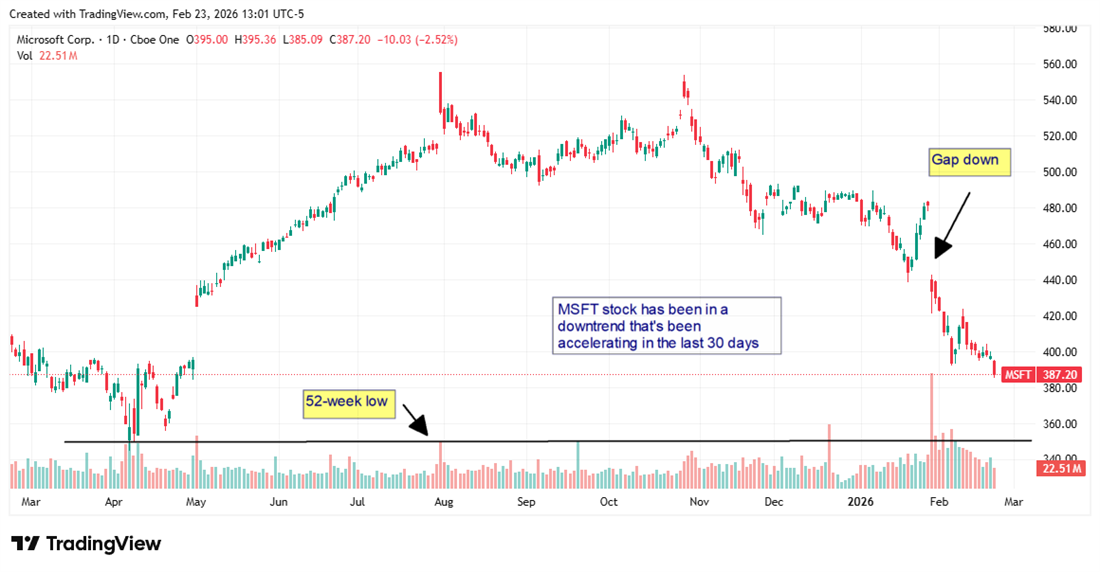
There’s no getting around it; the MSFT stock chart looks ugly. The stock has been in a steady downtrend since November 2025. In fact, it’s within about 10% of giving back all the gains since the rally that started in late April 2025.
However, the Relative Strength Indicator (RSI) is moving into oversold territory, and momentum indicators such as daily volume and the MACD suggest selling pressure may be easing up.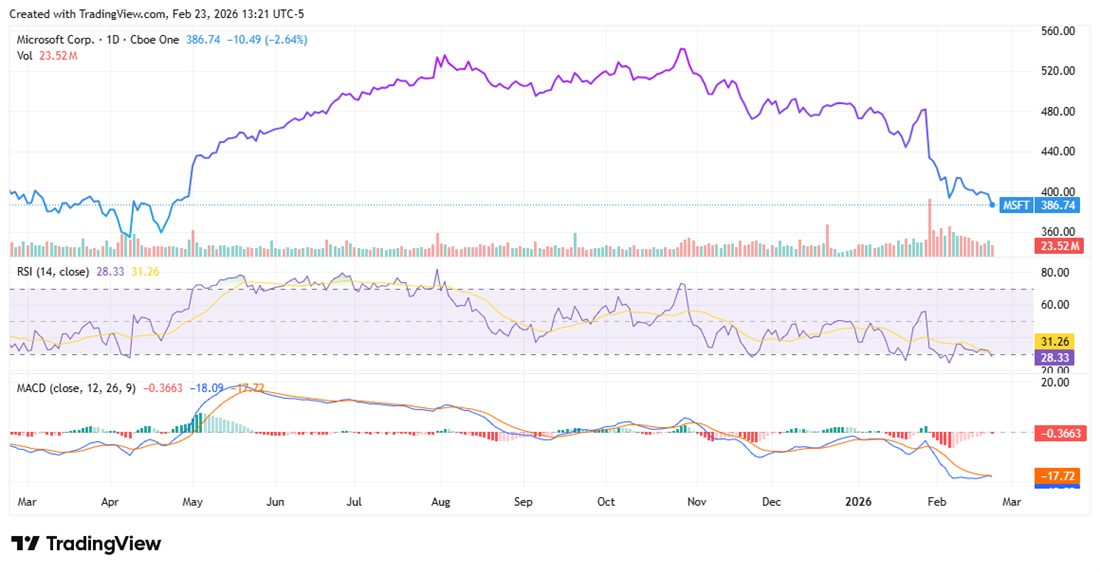
 That said, this is a headline-driven market, and there could be more downside for MSFT stock. Still, with MSFT stock down almost 30% from its all-time high and trading at around 24x earnings, this is a dip to buy.
Before you consider Microsoft, you'll want to hear this.
MarketBeat keeps track of Wall Street's top-rated and best performing research analysts and the stocks they recommend to their clients on a daily basis. MarketBeat has identified the five stocks that top analysts are quietly whispering to their clients to buy now before the broader market catches on... and Microsoft wasn't on the list.
While Microsoft currently has a Moderate Buy rating among analysts, top-rated analysts believe these five stocks are better buys.
View The Five Stocks Here
Robotics and automation are rapidly becoming essential infrastructure across healthcare, manufacturing, logistics, and many other industries. "Physical AI" is coming. Learn which seven companies are most positioned to benefit as intelligent robots enter the workforce.
Get This Free Report
Continue following MarketBeat
Add MarketBeat as your preferred source on Google to see our latest stories in your feed.
