Microsoft Today
$539.44 +5.75 (+1.08%) As of 10/15/2026 04:00 PM Eastern
- 52-Week Range
- $349.20
▼
$553.72 - Dividend Yield
- 0.67%
- P/E Ratio
- 30.89
- Price Target
- $589.71
Microsoft Corporation NASDAQ: MSFT stock is down nearly 9% from its 52-week high, which it reached on Oct. 29. This is despite the company delivering a strong earnings report that showed growth across every sector, including its Azure cloud services business.
Microsoft has even reaffirmed its commitment to capital expenditure (CapEx) spending on building the infrastructure that will power artificial intelligence (AI). That’s leading to concerns about the amount of CapEx spending being pledged by these companies.
Even cash‑rich companies like Microsoft have acknowledged that the scale and pace of AI infrastructure spending are already putting near‑term pressure on margins, even as revenue and cloud demand remain strong. In an internal memo, Microsoft CEO Satya Nadella stated that the company will need to “rapidly rethink the new economics of AI across the company.”
This sets up the ‘physics problem’ for the stock: a powerful secular AI demand story colliding with the very real drag of front‑loaded CapEx and margin compression.
The Immovable Object—AI Infrastructure Is Years Behind
Hyperscalers like Microsoft and Meta Platforms Inc. NASDAQ: META are committing billions of dollars to build out AI infrastructure. In its first-quarter earnings report for fiscal year 2026, the company reiterated its plans to raise its CapEx spending.
Microsoft isn’t alone in making these commitments, even though investors are clearly getting nervous about the billions of dollars being committed. However, these companies don’t have a choice.
The AI buildout is creating a highly competitive, winner‑take‑most race for control of scarce AI infrastructure and platform positioning. In that environment, companies that fail to secure their own infrastructure or substantial cloud partners risk being structurally disadvantaged in the next leg of AI adoption.
However, that’s where the other part of this AI conversation is centered.
The Irresistible Force of AI Demand
If you believe CEOs like Jensen Huang of NVIDIA Corp. NASDAQ: NVDA, demand for AI infrastructure far outpaces supply, and will continue to do so for some time. That’s the bull case for all this CapEx spending. To use a colloquial phrase, “if you build it, they will come.”
But what if they don’t? The risk is not that there is no AI demand, but that the timing and profitability of that demand ultimately fall short of what today’s spending implies.
This is why some investors are talking about an AI bubble. In practice, the recent selling of Microsoft shares appears less like a rejection of AI demand itself and more like a repricing of how much investors are willing to pay today for AI earnings that may arrive later and with more capital-intensive economics than previously expected.
Nadella’s Call to Arms
Nadella’s comment about Microsoft’s need to rethink the new economics of AI is a call to arms of sorts. The CEO believes that the company’s shift into AI is on par with its prior move into the cloud.
Microsoft MarketRank™ Stock Analysis
4.916219400445 of 5 stars- Overall MarketRank™
- 98th Percentile
- Analyst Rating
- Moderate Buy
- Upside/Downside
- 9.3% Upside
- Short Interest Level
- Healthy
- Dividend Strength
- Strong
- News Sentiment
- 0.93

- Insider Trading
- Selling Shares
- Proj. Earnings Growth
- 18.27%
See Full AnalysisThis is about more than CapEx. Nadella’s ‘new economics of AI’ language reflects a belief that Microsoft will have to overhaul how it designs, prices, and delivers products, rather than simply bolting AI features onto existing SKUs. The comparison to the cloud is apt. In the early 2010s, Microsoft had to aggressively pivot away from providing boxed software to hyperscale cloud subscriptions.
The challenge remains unchanged today, and the stakes may be even higher.
To meet that challenge, Nadella has plans to build an “AI factory” with a family of Copilots and agents that sit across the stack as opposed to selling traditional end-user tools. The company is also experimenting with bundled Copilot access across the Microsoft 365 base platform.
Microsoft is also testing pay-as-you-go options for AI agents, aiming to tie pricing more directly to the actual work performed by those agents, rather than to a fixed number of human seats. Over time, that kind of usage‑based model is how the ‘physics problem’ starts to resolve in Microsoft’s favor if AI agents drive more output per dollar of compute.
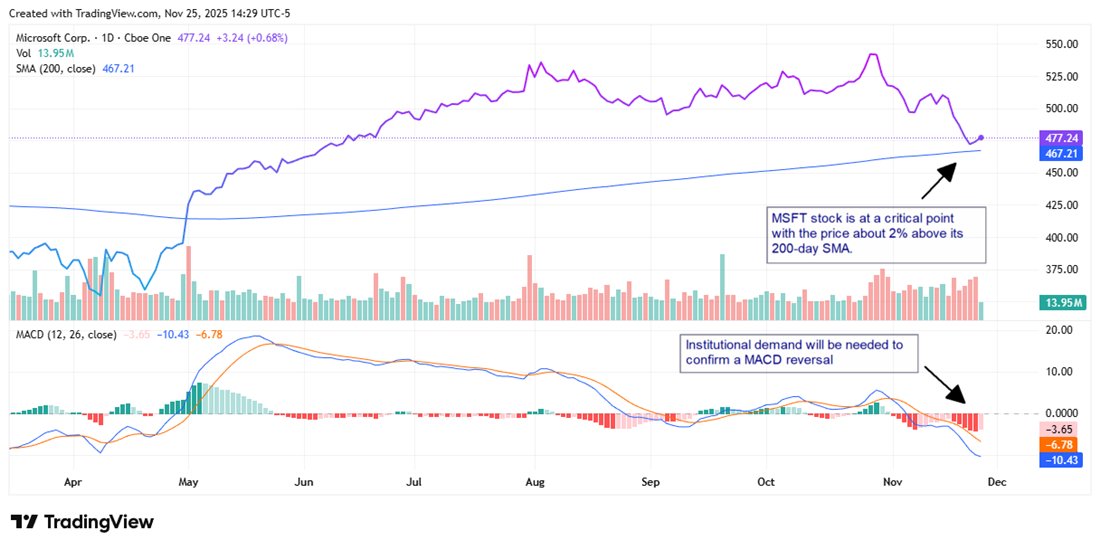
Next Week Could Be a Key for MSFT Stock
The chart setup for MSFT stock suggests a bullish reversal may be in place as institutional investors return to the market after a shortened trading week. The stock is within approximately 2% of its 200-day simple moving average (SMA), which could establish itself as a level of support.
The company also recently bounced off an oversold relative strength indicator (RSI), not shown. That move also appears to have stalled the bearish momentum in the MACD, which is now reversing.
All that may be needed now is volume, which could come as institutional investors seek value in the tech sector as they position their portfolios for year-end gains.
Before you consider Microsoft, you'll want to hear this.
MarketBeat keeps track of Wall Street's top-rated and best performing research analysts and the stocks they recommend to their clients on a daily basis. MarketBeat has identified the five stocks that top analysts are quietly whispering to their clients to buy now before the broader market catches on... and Microsoft wasn't on the list.
While Microsoft currently has a Moderate Buy rating among analysts, top-rated analysts believe these five stocks are better buys.
View The Five Stocks Here
Tesla, Nvidia, and Google helped shape the last era of market growth, but the next wave could come from a new group of companies. Inside this report, you’ll find 7 stocks that could play a major role in the next tech-driven market boom.
Get This Free Report
Continue following MarketBeat
Add MarketBeat as your preferred source on Google to see our latest stories in your feed.
Like this article? Share it with a colleague.
Link copied to clipboard.
