Uber Technologies, Inc. NYSE: UBER has been taking the lead in autonomous vehicle (AV) adoption for several quarters. Recent announcements reveal that the company has entered into deals with over a dozen automotive partners, including Baidu Inc. NASDAQ: BIDU, Rivian Automotive Inc. NASDAQ: RIVN, and Lucid Group (NASDAQ: LCID). In total, the deals mean Uber is committing over $10 billion to AV vehicles, equity stakes, and fleet purchases.
Uber Technologies Today
UBER
Uber Technologies
$68.63 -0.73 (-1.05%) As of 09/30/2026 03:59 PM Eastern
This is a fair market value price provided by Massive. Learn more. - 52-Week Range
- $65.41
▼
$101.29 - P/E Ratio
- 15.08
- Price Target
- $103.03
The deals further emphasize the company’s commitment to becoming the largest facilitator of AV trips in the world by 2029. However, they also move the company away from its asset-light business model that powered Uber’s growth in the last decade.
Uber's asset-light model (i.e., drivers owned the cars, not Uber) served it extraordinarily well. It allowed the company to scale globally with minimal capital expenditure, letting it focus on the platform and marketplace economics that investors love. The question facing UBER, and more significantly, its investors, is what does it mean when that model is replaced?
Gig Work Has Become Big Business
Perhaps autonomous vehicle technology was, or is, inevitable. But to be clear, this is a pivot that Uber is being forced into, not one it chose freely. The company’s ride-hailing model started with a simple premise. That was, individuals would drive as a way to supplement their income. However, those plans didn’t account for a pandemic, a tight labor market and a workforce that increasingly views gig work not as a side hustle but as a primary livelihood.
That’s made the “gig economy” mainstream and has given drivers considerably more leverage. And recent legislation, like California’s Proposition 3, shows that these drivers want to be compensated as employees with protections and benefits. That would make the earnings math more difficult for Uber and, by extension, make UBER less attractive for investors.
In some ways, this mirrors the problem that Netflix NASDAQ: NFLX faced. Netflix created a category, but realized over time that original content, not syndicated content, was the real growth driver. But original content is expensive to produce. That meant pivoting to an ad-supported model, which went away from its foundational premise of uninterrupted viewing. It was an uncomfortable concession that has since become the company’s fastest-growing segment.
Viewed through that lens, Uber’s pivot to AV has similar logic. It’s abandoning the purity of the original model and absorbing near-term pain so that it reduces the risk of being disrupted.
The Earnings Math Is Getting Harder
Investors have seen the short-term pain in the numbers. Analysts forecast Q1 2026 EPS of 71 cents per share on a diluted basis. That’s down roughly 14.5% from 83 cents in the year-ago quarter. For the full fiscal year, analysts expect UBER to report EPS of $3.35, down 36.8% from $5.30 in fiscal 2025.
The decline reflects two pressures colliding at once: driver costs continue to rise as labor dynamics shift, and Uber is simultaneously investing heavily in the AV infrastructure it hopes will eventually replace those costs.
It's a race. The faster AV adoption scales, the more driver expenses can be reduced. But the runway is capital-intensive, and the transition won't happen overnight. The Uber analyst forecasts on MarketBeat show that analysts have noticed.
In each case, analysts are signaling that the bull case remains intact, but the timeline for margin expansion is getting pushed out.
The Trade-Off Investors Need to Understand
The $10 billion AV commitment isn't reckless, and as stated above, is arguably inevitable. Waymo is already operating commercially in multiple U.S. cities. Tesla NASDAQ: TSLA is clearly going all-in on its robotaxi model. Uber's move to host AV fleets at scale is a necessary step to avoid the risk of being disintermediated by the very technology partners it once thought it could remain neutral on.
The Lucid partnership, a $500 million commitment for at least 35,000 vehicles, is the clearest signal that Uber intends to own this transition. Uber shares surged 6.8% when the AV fleet strategy was announced, suggesting the market is willing to reward ambition, even if near-term earnings are the price.
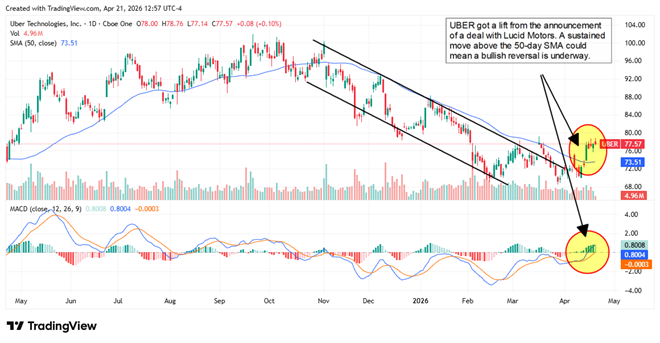
The central tension for investors is straightforward: Uber is spending its way out of one cost problem (gig labor) and into another (fleet capital). The bet is that AV unit economics eventually become dramatically better than human-driver economics.
History suggests that bet is probably right. The question is how long investors are willing to wait, and how much earnings compression they're willing to absorb in the meantime.
Before you consider Uber Technologies, you'll want to hear this.
MarketBeat keeps track of Wall Street's top-rated and best performing research analysts and the stocks they recommend to their clients on a daily basis. MarketBeat has identified the five stocks that top analysts are quietly whispering to their clients to buy now before the broader market catches on... and Uber Technologies wasn't on the list.
While Uber Technologies currently has a Moderate Buy rating among analysts, top-rated analysts believe these five stocks are better buys.
View The Five Stocks Here
Discover the next wave of investment opportunities with our report, 7 Stocks That Will Be Magnificent in 2026. Explore companies poised to replicate the growth, innovation, and value creation of the tech giants dominating today's markets.
Get This Free Report
Continue following MarketBeat
Add MarketBeat as your preferred source on Google to see our latest stories in your feed.
Like this article? Share it with a colleague.
Link copied to clipboard.
