The AI rally is officially wobbling. For the first time in years, the trade's mechanics are changing, and growth at all costs is no longer rewarded. With the 10-year Treasury yield above 5% and markets projecting another interest rate hike in December, borrowing costs are becoming a bigger concern, even as the AI buildout grows more reliant on debt.
Companies in the AI ecosystem are starting to ask two age-old questions: who’s paying for all this, and how much will the capital cost? For example, Meta Platforms Inc. NASDAQ: META beat its Q3 estimates handily on Oct. 21 but also reported its first negative free cash flow quarter as a public company as AI expansion costs skyrocketed. The stock lost nearly 7% the following day, erasing all year-to-date (YTD) gains.
Meta Platforms, Inc. (META) Price Chart for Monday, October, 26, 2026
Another key player in AI infrastructure, Comfort Systems USA Inc. NYSE: FIX, reported Q3 results the following day and also sold off despite record-setting numbers. The company designs and builds customized HVAC systems for data centers, and its backlog is often used as a barometer for AI infrastructure spending. But as capital costs rise, the backlog figure is no longer the most important number.
FIX’s Backlog Hits New Records as Top and Bottom-Line Numbers Beat Estimates
Headline Q3 numbers revealed another impressive quarter for Comfort Systems USA. Revenue grew 53.7% year-over-year (YOY) to $3.77 billion, and earnings per share (EPS) beat estimates for the eighth consecutive quarter. The backlog also grew to $17.81 billion, nearly doubling in just 12 months.
The company booked about $3.8 billion in new business during the period, up 27% sequentially, which outgoing CFO Bill George described as a “really crazy amount of bookings.” Customers are committing to larger projects earlier than usual, and the company’s primary constraint is finding labor to keep up with demand. Operating income totaled $624.6 million, and the company boosted its dividend by 10 cents to $1 per share.
Labor shortages and rising costs have caused management to revise its expected backlog duration. In previous quarters, the backlog was a good proxy for about a year’s worth of demand, but CEO Brian Lane now expects the backlog to convert over an 18-24 month window. Additionally, the company is accepting only high-quality customers who can pay and is turning away work from clients that need looser payment terms. Billings above costs grew to $3.87 billion, suggesting more customers are prepaying.
Post-Earnings Sell-Off Based on Gross Margin Decline
The market liked the news about high-quality customers with reliable payment terms, but the extended backlog window points to the report's truly concerning factor: margins. Q3 gross margins came in at 24.8%, the second straight sequential decline (Q1 26.3%, Q2 25.9%). The number was also flat versus Q3 2025, and the dip hit both the Mechanical and Electrical segments. Operating margin also declined to 16.6% from 17.1% in Q2.
Management blamed costs for the sequential decline, citing material and equipment spending two points above the first-half 2026 share of cost average. Additionally, many Q3 (and upcoming Q4) jobs are early-stage, and the company recognizes more profit as work nears completion.
However, the earnings report did not provide material future estimates. CFO George expects “job maturity to normalize” in the first half of 2027, and predicted 2027 gross margins in ranges similar to recent quarters. The only explicit 2027 number was same-store revenue guidance, which management expects to grow in the mid-20% range, provided labor constraints don’t continue to widen. The market wanted confirmation on whether 25% gross margins were a new floor or the peak of the cycle. Management was vague, and the stock joined the AI panic sell-off.
Sell-off Intensifying While Chart Flashes Oversold Signals
Friday was another day to forget in the AI trade, and FIX shares fell about 9% during the session. The stock is down nearly 30% in the last month alone, and while some technical signs suggest a bottom is in, that doesn’t necessarily mean a rebound will follow. The 50-day moving average was strong support through the first half of the year, but it flipped from support to resistance soon after the stock closed at an all-time high of $2,066 on June 22. Now both the 50-day and 200-day moving averages have broken, and a death cross appears likely as these two indicators collide.
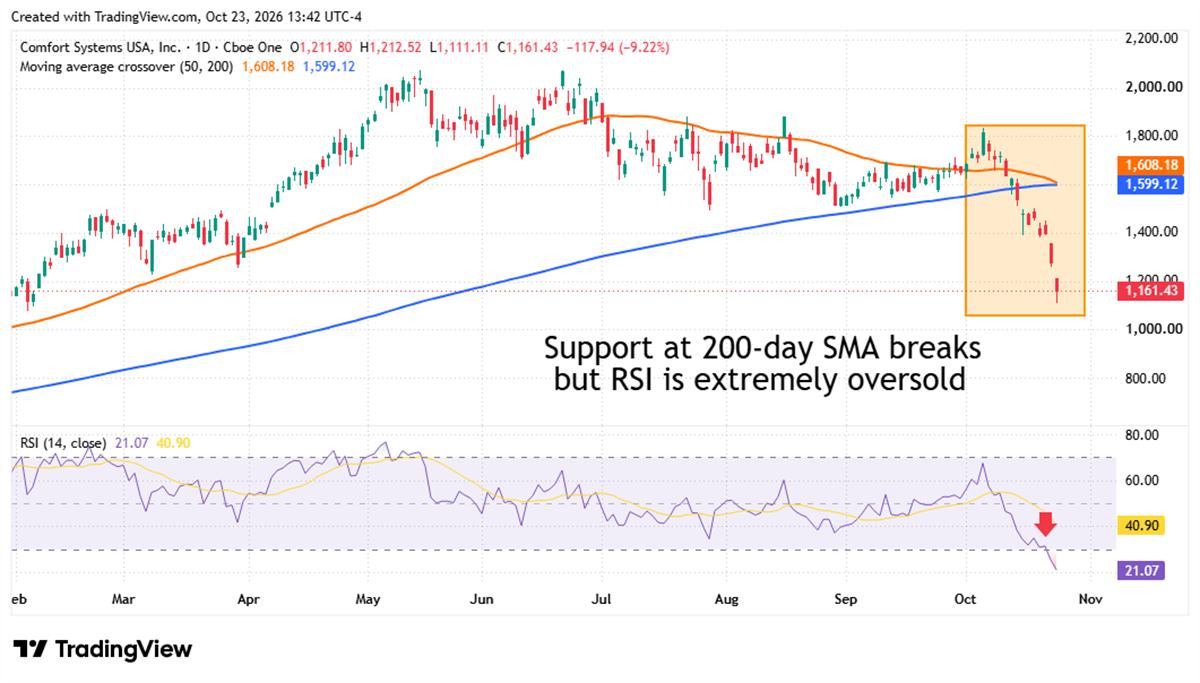
On the other hand, the Relative Strength Index (RSI) shows an extremely oversold stock that likely has the worst of its drawdown in the rearview. The backlog is strong, margins remain within shouting distance of the Q2 high-water mark, and the stock now trades at 24 times forward earnings, much closer to historical norms than the 37x forward Price-to-Earnings (P/E) ratio it traded at in June. But as long as the AI trade keeps wobbling, it's hard to see a meaningful bounce in FIX shares unless it returns to backlog and margin growth.
Before you consider Comfort Systems USA, you'll want to hear this.
MarketBeat keeps track of Wall Street's top-rated and best performing research analysts and the stocks they recommend to their clients on a daily basis. MarketBeat has identified the five stocks that top analysts are quietly whispering to their clients to buy now before the broader market catches on... and Comfort Systems USA wasn't on the list.
While Comfort Systems USA currently has a Moderate Buy rating among analysts, top-rated analysts believe these five stocks are better buys.
View The Five Stocks Here
AI spending is reshaping the market, and the opportunity extends far beyond the biggest chipmakers. Discover 10 stocks set to benefit from powerful trends in AI infrastructure, cloud computing, energy, capital returns, and consumer growth this fall.
Get This Free Report
Continue following MarketBeat
Add MarketBeat as your preferred source on Google to see our latest stories in your feed.
Like this article? Share it with a colleague.
Link copied to clipboard.

