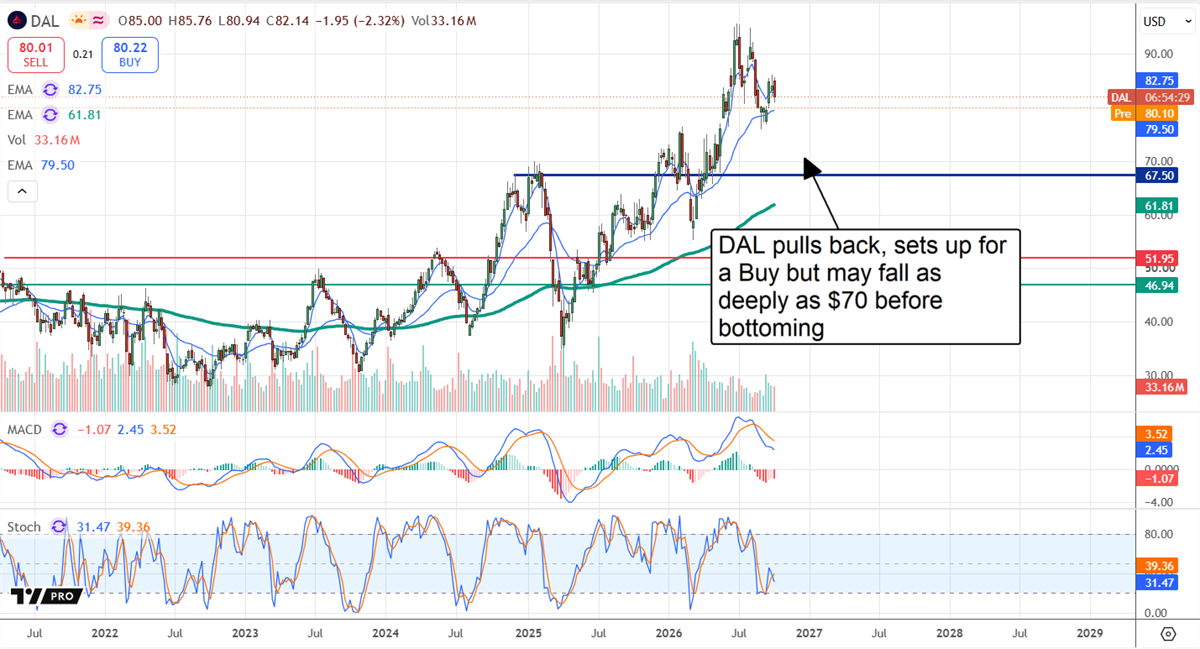
Delta Air Lines NYSE: DAL is set up for a Q4 pullback as rising fuel costs cut into its earnings. The pullback could reach as low as $70 before it bottoms, but once it does, the recovery may be rapid.
Delta Air Lines Today
DAL
Delta Air Lines
$82.32 +0.18 (+0.22%) As of 10/9/2026 03:59 PM Eastern
This is a fair market value price provided by Massive. Learn more. - 52-Week Range
- $55.03
▼
$95.68 - Dividend Yield
- 1.04%
- P/E Ratio
- 13.65
- Price Target
- $100.24
That’s because results, impaired as they are by fuel costs, remain robust. The company produced record Q3 revenue, underpinned by broad-based demand, pointing to a strong Q4 and a high probability that the trend will continue into the next year.
Within this, oil prices are the wild card, potentially high indefinitely, with an equal risk of rapid implosion. The Iran conflict is weighing on oil prices today, but is not expected to do so much longer. Backwardation indicators suggest oil will drop back into the $80 region over the coming months, potentially lower, provided strong catalysts emerge.
Global oil market shifts, improving Western production, and alternative fuels (such as natural gas) are setting the stage for a possible oil glut in 2027.
The takeaway for investors is that Delta’s earnings miss was self-inflicted: the company is absorbing fuel cost increases to sustain and grow market share. However, earnings are sufficient to support strategic improvements while paying dividends.
Delta Air Lines Mixed Results Overshadow Record Quarter
Delta Air Lines had a robust Q3 with GAAP revenue growing by 21% year-over-year (YOY) to over $20 billion. Adjusted revenue increased 16% to $17.6 billion, slightly missing consensus estimates. Broad-based demand and double-digit growth across regions drove strength. Domestic revenue rose 16%, while international revenue increased 12% YOY.
Within the international operations, Latin America was strongest, up 22%, followed by a 13% increase in trans-Pacific and an 11% increase in trans-Atlantic flights. Other signs of strength included the passenger mix. Premium increased by 18%, loyalty by 18%, and corporate by double digits, compounded by a 29% increase in cargo and strength in the maintenance division.
Margin news is not as bad as it sounds, although margins did compress significantly. Key details include flat EBIT and operating income, despite the 21% increase in revenue. The important caveat is that margin compression was due to higher fuel costs, not operational failures, and flat results are still good for cash flow, free cash flow, and balance sheet health. Free cash flow is $1.9 billion year-to-date, enough to keep the company on track to reduce debt by $2 billion annually while paying its dividend.
Debt reduction and dividends are central to Delta’s stock price outlook. Debt grew and the dividend shrank because of the COVID-19 pandemic, but both have since recovered. The narrative today is that Delta regained investment-grade debt ratings, is strengthening its position, and is trending toward aggressive increases. Although reinstated, the payout remains a fraction of what it once was, despite the company’s massive growth. The likely outcome is that DAL sustains annual increases, potentially accelerating them over time as its debt falls and free cash flow improves. Until then, the payment is reliably safe at less than 15% of the earnings forecast.
Analysts Trim Targets: Limit Upside in Q4
Analysts weren't happy with the report, focusing on margin contraction and overlooking market-share strength. The net reaction was a wave of price target reductions, but don’t read too much into it—all aligned with the consensus, which forecasts approximately 20% upside.
Delta Air Lines MarketRank™ Stock Analysis
- Overall MarketRank™
- 98th Percentile
- Analyst Rating
- Moderate Buy
- Upside/Downside
- 21.8% Upside
- Short Interest Level
- Healthy
- Dividend Strength
- Moderate
- News Sentiment
- 0.05

- Insider Trading
- Selling Shares
- Proj. Earnings Growth
- 39.36%
See Full AnalysisThe bad news is that the reductions are likely to undercut market activity and keep this stock under pressure in the near term. However, the consensus of 25 analysts remains Buy, with a 92% Buy-side bias in the data. Analysts are cautious yet still reflect a bullish position, as seen in the institutional trends. Institutions own nearly 70% of DAL stock and have bought on balance every quarter this year.
The market gets it wrong by treating Delta as a run-of-the-mill airline, low-margin and exposed to oil price risks. It is a resilient consumer brand, ranking first in numerous surveys, driving revenue through seat miles, but compounding it and margins with diversified revenue streams.
Premium, add-ons, and loyalty drive revenue and keep consumers coming back. Within this, Delta’s unique position as the only airline with its own refinery helps alleviate some of the fuel crisis. In this scenario, fuel price spikes hurt the industry but enable Delta to gain share and set up for accelerated margin recoveries as oil prices decline.
Delta’s biggest risk is that oil prices remain elevated indefinitely or move to fresh highs, keeping margins under pressure throughout 2027. In that scenario, DAL's share price may stay under pressure through the year’s end or until oil market relief becomes a reality.
Before you consider Delta Air Lines, you'll want to hear this.
MarketBeat keeps track of Wall Street's top-rated and best performing research analysts and the stocks they recommend to their clients on a daily basis. MarketBeat has identified the five stocks that top analysts are quietly whispering to their clients to buy now before the broader market catches on... and Delta Air Lines wasn't on the list.
While Delta Air Lines currently has a Moderate Buy rating among analysts, top-rated analysts believe these five stocks are better buys.
View The Five Stocks Here
AI spending is reshaping the market, and the opportunity extends far beyond the biggest chipmakers. Discover 10 stocks set to benefit from powerful trends in AI infrastructure, cloud computing, energy, capital returns, and consumer growth this fall.
Get This Free Report
Continue following MarketBeat
Add MarketBeat as your preferred source on Google to see our latest stories in your feed.
