The FOMC confirmed market fears and hiked rates in September, the first hike in over three years. While another hike looks likely this year, investors should consider the duration of this cycle before making major moves.
As scary as inflation is, much of the current pressure is being driven by high oil prices, which can reverse quickly. High today, they could fall at the drop of a hat. The FOMC has no real control over oil prices, only demand, and that by proxy. Hiking rates may curb demand and ease inflation, but it could also undermine economic activity, risking a contraction or stagnation.
Hiking rates now, hiking aggressively, only puts the economy at risk when additional risk is the last thing it needs. As it stands, inflation runs at in the mid-3% range and well above target. The risk is that inflation falls faster than anticipated, to below 2% and into the anemic range, with U.S. expansion reverting to nil or even contraction.
In this scenario, the Fed will follow up its hike with a cut, potentially back to nearly zero, as it tries to reinvigorate economic expansion. Meanwhile, the aforementioned structural oil market forces could undermine inflation with a quick drop that is all too likely.
Oil Futures Signal a Sharp Price Drop as Demand Shifts
Oil markets run on futures. Some companies today buy spot oil as they need it, but not many. Most producers sell future production while consumers hedge positions to offset costs. Futures contracts typically become more expensive the further out they are from expiration at the same strike price. This covers storage and other costs, including implied volatility, but that's not the case today.
Today, the oil market is in backwardation—longer-dated oil contracts are less expensive than near-term contracts, revealing a market expecting prices to drop. The curve is highly suggestive, implying as much as a $40 drop by year’s end or in early 2027, putting WTI in the mid-to-low $60s and Brent in the mid-$70s.
What is the market looking at? Demand destruction compounded by rapid market normalization. The International Energy Agency says higher prices are forcing businesses and industries to seek alternative energy sources and move away from oil faster than expected. Notable industries turning to alternative sources include hyperscale data centers, which are leaning on natural gas, catalytic fuel cells from Bloom Energy NASDAQ: BE, and nuclear power. In addition, the transition to electric vehicles continues to progress, undermining demand, while natural gas gains share as an industrial power source.
Natural gas is attractive for many reasons, including its efficiency and cost. It is the cleanest-burning fossil fuel and costs about 80% to 85% less than crude oil per British Thermal Unit (BTU). Its growth is also supported by rapidly expanding capacity along the Gulf of Mexico, enabling export to international markets. Internationally, natural gas demand is underpinned by rapidly improving infrastructure enabling product flow to where it's needed.
Oil Oversupply Looms as Refining Risks Keep Prices Elevated
No one really knows when the Strait of Hormuz will reopen, but it is unlikely to remain shut forever. The economic strain on directly affected nations will lead to some resolution sooner or later. When that happens, oil prices will quickly revert to the low end of their range; until then, any good news will be a catalyst for selling, and other risks to the oil price remain.
Non-OPEC production, including domestic production, Guyana, Brazil, and potentially soon Venezuela, is ramping up to help offset supply constrained by disruptions at Hormuz and in the Red Sea. The key takeaway is that demand destruction and rapidly rising supply will lead to a massive oversupply, forecast for next year.
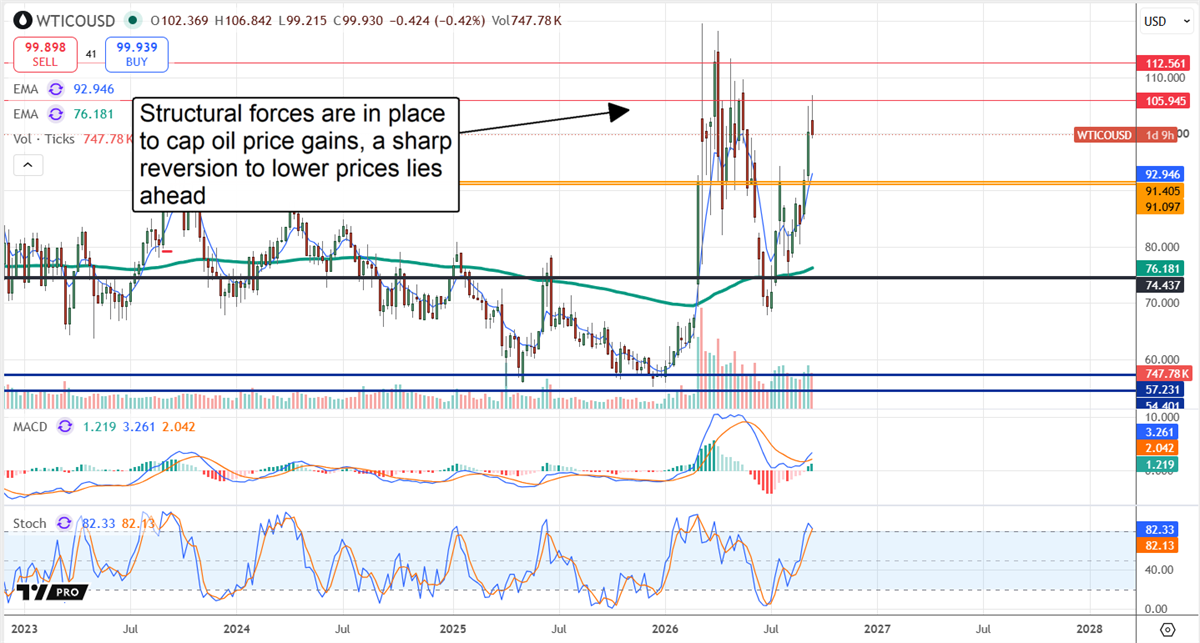
And the oil charts suggest this move is being priced in. WTI shows resistance at $105, well below the existing highs and at the low end of the target range. A move higher is still possible, but unlikely without another capacity blow. Higher interest rates are also bearish for oil, setting the stage for this to become a self-fulfilling prophecy. Higher rates strengthen the dollar, which is negative for oil prices, which are based on dollars—the stronger the dollar, the fewer it takes to buy the same barrel.
The biggest risk for oil isn’t so much capacity or production but refining. The war in Ukraine is knocking out Russian refining capacity, which is vital to the world. Russia accounts for about 6.5% of global refining capacity and is a top-10 refiner, but it focuses on diesel. Russia accounts for more than 10% of global diesel refining, ranking second behind the U.S.
In this scenario, distillates are the bigger issue and will likely keep crack spreads and consumer prices high, regardless of oil supply or the Strait. Ironically, the war in Ukraine also emerges as a factor in demand destruction: it's being fought in the air, by drones, with batteries and joysticks. Another irony is that raising the cost of doing business with higher rates will increase inflation in the near term, before it has the intended effect.
Before you consider United States Oil Fund, you'll want to hear this.
MarketBeat keeps track of Wall Street's top-rated and best performing research analysts and the stocks they recommend to their clients on a daily basis. MarketBeat has identified the five stocks that top analysts are quietly whispering to their clients to buy now before the broader market catches on... and United States Oil Fund wasn't on the list.
While United States Oil Fund currently has a Hold rating among analysts, top-rated analysts believe these five stocks are better buys.
View The Five Stocks Here
Learn the basics of options trading and how to use them to boost returns and manage risk with this free report from MarketBeat. Click the link below to get your free copy.
Get This Free Report
Continue following MarketBeat
Add MarketBeat as your preferred source on Google to see our latest stories in your feed.
