Workday NASDAQ: WDAY was among the hardest hit by SaaS-pocalypse fears—and among the best positioned for a rebound. The takeaway from Q2 reporting is that AI isn’t disrupting its business so much as driving it.
AI modelers aren’t disrupting the business, and neither are the customers, who, it was feared, might develop their own internal human resources automation tools. In reality, businesses and enterprises are turning to Workday in record numbers as it transitions from a legacy operator to a new-age agentic AI enabler.
Workday Today
$187.81 +3.55 (+1.93%) As of 04:00 PM Eastern
- 52-Week Range
- $110.36
▼
$247.40 - P/E Ratio
- 38.10
- Price Target
- $205.55
Reasons why the stock price could continue to rise in 2026 and beyond are record sales, hypergrowth in core agentic AI segments, the deal pipeline, adoption rates, and margins. Unlike AI infrastructure operators, which are heavily burdened with front-end costs, Workday is among the few that are successfully monetizing AI today.
Among the critical details are Workday's cash flow and the capital returns it enables. Workday is a share-buying machine, buying back approximately $1.33 billion in shares during the quarter and issuing a new authorization.
Buybacks helped reduce the share count by about 8.8% from a year earlier. The new authorization is worth $4 billion, or about 8.3% of the late-August market cap.
Workday Is in the Early Stages of an AI Boom
Workday posted a strong quarter, with revenue growth and guidance that exceeded expectations. Revenue grew by 12.8% to $2.65 billion, marginally better than expected, underpinned by subscriptions and AI.
Subscriptions grew 13.9%, while AI accounted for 25% of new contract value as adoption accelerated. Adoption, as indicated by the number of clients using at least one agentic product, grew by 35%. The backlog also grew solidly, up 14.2% on a 12-month basis and 8% overall, pointing to continued strength in the coming quarters.
Margin was the real bright spot. The company widened margins at all levels, driving faster earnings growth despite increased investment. Adjusted operating income margin grew 210 basis points (bps), driving $2.75 in adjusted earnings per share, up 20% from the prior year and nearly 15 cents above expectations.
WDAY Market Underprices Growth Potential
Guidance could be a catalyst for higher stock prices, with Q3 and full-year targets above consensus forecasts, underpinned by new and expanded deals with hyperscalers, including Alphabet’s NASDAQ: GOOGL Google Cloud and Amazon's NASDAQ: AMZN AWS.
The likely outcome is that Workday continues to gain momentum and outperforms its forecast in the subsequent quarter.
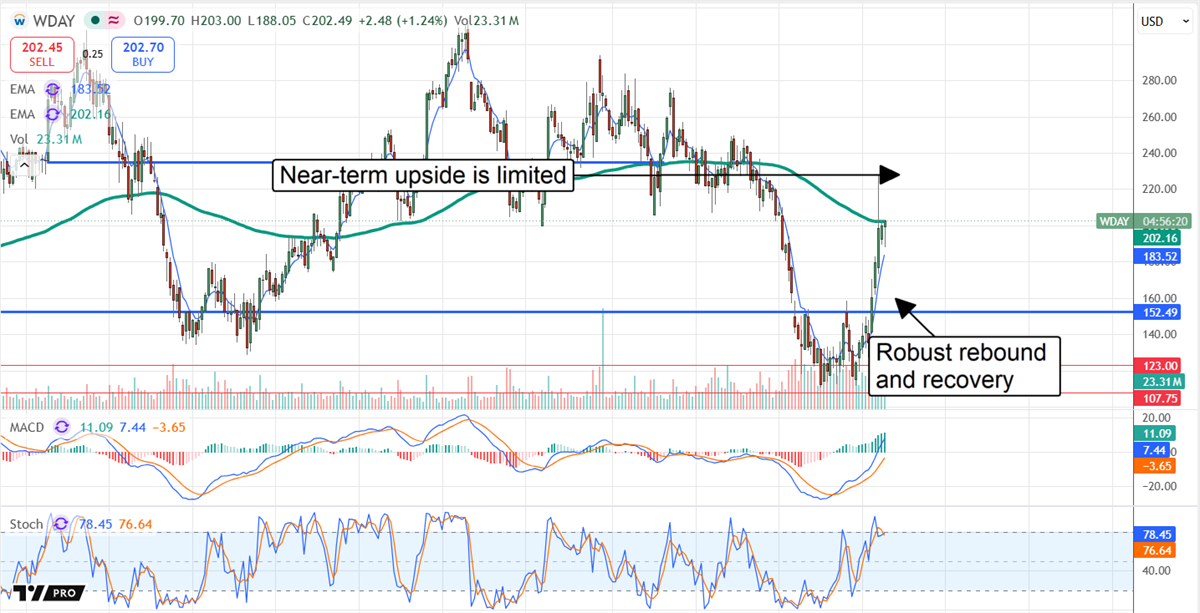
The question now is where the stock price might go before then, and the trends are strongly bullish. The problem is that initial analyst responses to the release, as bullish as they were, only lifted targets to the $220 range. In this scenario, analysts are signaling a bottom in the stock and potential for it to rise over time, but near-term upside is limited.
Long-term, the upside potential is ample. The stock trades at a reasonably low price-to-earnings multiple today, about 17.5x the current-year guidance, which doesn't fully price in the growth trajectory.
Analysts forecast substantial earnings growth in the coming years, which could significantly compress Workday’s forward P/E multiple. In this scenario, WDAY stock could rise by several hundred percentage points over the coming years, exceeding $1,000 within the next few years.
Analysts and institutional data reflect caution, but also an underlying confidence not found in most stocks. Thirty-eight analysts cover WDAY, a high number for any stock, and the consensus is Hold, with a 51.3% Buy-side bias and an uptrend in price targets likely to continue as the year progresses.
Institutions show a more visibly bullish posture, owning nearly 90% of the stock and accumulating quarterly over the trailing 12 months. Their activity conspicuously accelerated in late Q2 and early Q3, coinciding with the stock price rebound, limiting risk in Q3.
Workday has an added tailwind in the short interest. Short interest was falling ahead of the release and will likely accelerate the decline now that guidance is in. The risk is that short sellers will reposition at a higher level, reinforcing the idea that near-term upside may be limited. Lingering SaaS-pocalypse fears add to the risk, setting the stage for volatility in upcoming quarters, if not an outright correction, should weaker-than-expected earnings or bad news emerge.
Chart price action is bullish, signaling the continuation of the trend. The risk, again, is that candlestick action limits near-term upside. The early-August price surge triggered selling and resistance at the long-term 150-week EMA, indicating a price cap near $227.
Before you consider Workday, you'll want to hear this.
MarketBeat keeps track of Wall Street's top-rated and best performing research analysts and the stocks they recommend to their clients on a daily basis. MarketBeat has identified the five stocks that top analysts are quietly whispering to their clients to buy now before the broader market catches on... and Workday wasn't on the list.
While Workday currently has a Hold rating among analysts, top-rated analysts believe these five stocks are better buys.
View The Five Stocks Here
Nuclear energy is entering a new growth cycle as rising power demand, expanding data centers, and renewed policy support bring the sector back into focus. After strong gains in recent years, the most impactful phase of nuclear investment may still be ahead. This report highlights seven nuclear energy stocks positioned across the value chain—combining near-term revenue with long-term upside as next-generation technologies scale. Click the link below to unlock the full list.
Get This Free Report
Continue following MarketBeat
Add MarketBeat as your preferred source on Google to see our latest stories in your feed.
