JPMorgan’s NYSE: JPM earnings report is reshaping the Q3 reporting-cycle narrative. Investment banking activity fell from Q2’s cyclical peak, suggesting weakness could persist in the upcoming months.
JPMorgan Chase & Co. Today
JPM
JPMorgan Chase & Co.
$335.07 +0.77 (+0.23%) As of 12:06 PM Eastern
This is a fair market value price provided by Massive. Learn more. - 52-Week Range
- $279.10
▼
$366.50 - Dividend Yield
- 1.97%
- P/E Ratio
- 14.36
- Price Target
- $362.88
Within this, the company chose to slow its pace of repurchases in favor of hoarding cash, a signal that it values balance sheet health above capital returns, an ominous sign if taken at face value.
Investors should expect to see more of the same from other major banks and S&P 500 companies this earnings season.
The market gets it wrong, however, to think that the banking industry is weak; far from it. JPMorgan has broad-based strengths and sufficient cash flow to sustain its dividend and balance sheet health while redeploying capital and buying back shares.
Redeployment is a key factor, as JPM’s CEO Jamie Dimon believes the money can generate “attractive returns” for shareholders.
JPMorgan Misses Estimates, Reports Broad-Based Growth
JPMorgan posted a decent quarter, with managed net revenue up 8.1% to $50.9 billion, but the report also showed signs of weakness, including sequential slowdowns in many key segments and underperformance relative to MarketBeat’s reported consensus. However, loans were up 10% systemwide, deposits were up 8%, and net interest income (NII) was up 12.8%, driven by year-over-year gains across all segments.
In Consumer & Community banking, deposits rose 4%, investment assets rose 15%, and loans rose 2%, while card volume rose 10% and mobile banking activity rose 7%. Commercial & Investment Banking was also solid, with fees up 14%, market revenue up 15%, and loans up 11%. Asset & Wealth Management was also strong, with assets under management up 13% and loans up 20%.
Margin was another mixed bag, with the sequential slowdown in investment banking undercutting strength in other areas. Net income grew only 6.25% versus the 8.1% top-line gain, weighed down by a one-off loss, while adjusted net income grew faster. Net income is more than sufficient to cover the capital return and improve the balance sheet, but adjusted earnings per share fell short of consensus, prompting analysts to express caution.
Cautious Analysts Reflect Strong Conviction in JPM’s Price Trajectory
Cautious remarks or not, JPM’s Q3 release did not trigger any immediate analyst ratings revisions or price target updates, leaving the otherwise bullish trends intact. They include increased analyst coverage, a firm Moderate Buy rating with a bullish bias, and rising price targets.
JPMorgan Chase & Co. MarketRank™ Stock Analysis
4.364713627385 of 5 stars- Overall MarketRank™
- 87th Percentile
- Analyst Rating
- Moderate Buy
- Upside/Downside
- 9.4% Upside
- Short Interest Level
- Healthy
- Dividend Strength
- Strong
- News Sentiment
- 0.42

- Insider Trading
- Selling Shares
- Proj. Earnings Growth
- 4.43%
See Full AnalysisThe likely outcome is that the uptrend stalls but does not reverse, as analysts shift into a wait-and-see posture. The worst-case scenario is that persistent headwinds sap strength in upcoming quarters, leading the stock into a potentially deep correction. Until then, it remains well-supported but susceptible to volatility.
Institutional trends are supportive, with the group owning more than 70% of the stock. They’ve been buying all year, including in the first weeks of Q4, and are likely buyers on price weakness. Whether the report was spotty or not, it affirmed the company’s robust growth and capital-returning capacity, and that’s what institutions buy into.
Dividends drive most returns: nearly $4.5 billion in Q3, with the stock yielding nearly 2% per share as of mid-October. Share buybacks are smaller in dollar terms, at less than $0.7 billion for the quarter, but they reduced the share count by an aggressive 3% over the trailing 12-month period.
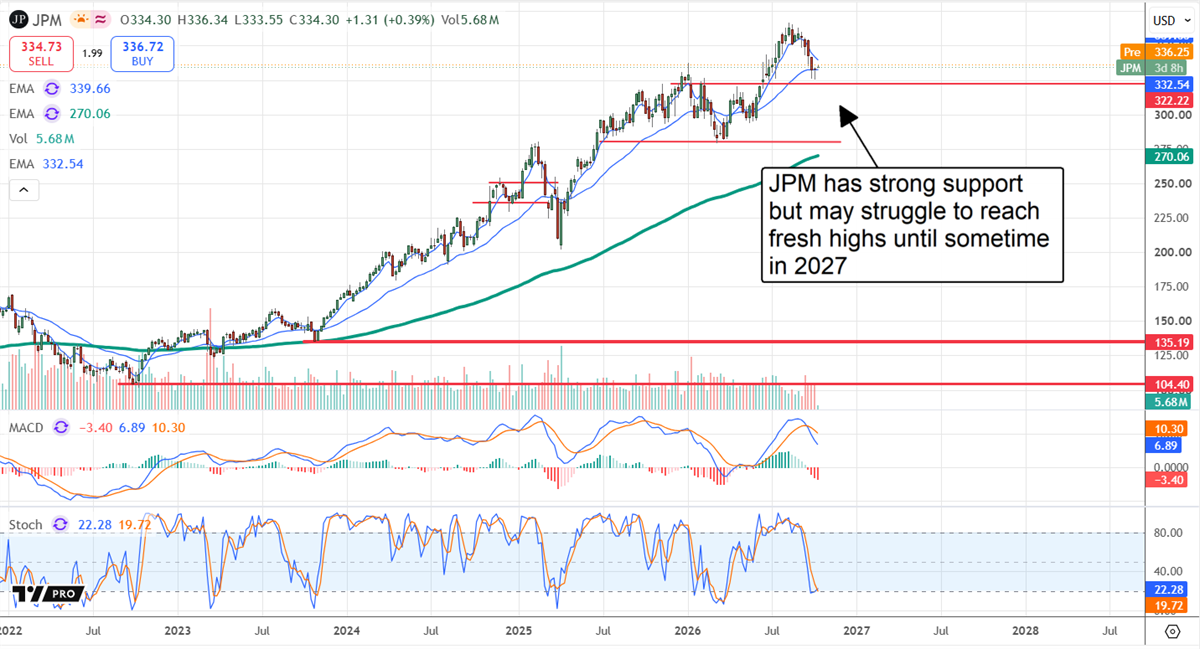
Stock price action was mixed immediately after the earnings release, falling more than 2% in after-hours trading before rebounding to open higher. The move signals caution and concern, but also support, reaffirming the uptrend and the potential for new highs. The question is whether the market can advance and set new highs before year-end or if the rebound will take longer, and the likely answer is longer. JPMorgan is fundamentally sound, but weaker-than-expected results sap near-term market impetus; it will need a strong catalyst to set new highs, and that is unlikely until the next report or later.
Consumer Banking Strength Offsets Rising Cybersecurity Risks
Hidden signs of strength include the Consumer & Community Banking segment and, more specifically, the provision for credit losses. The bank reported better write-off, build and liquidity metrics than it did last year, reflecting an improved consumer position despite the many headwinds. Deposits and loans also improved significantly, underpinning robust net interest income. Looking ahead, net interest income will remain a source of strength until the Fed lowers rates.
The company’s biggest risk, according to its CEO, is cybersecurity. AI poses an existential threat that could bring the financial system to its knees. To address this, the company reclassified AI spending as core infrastructure, increased its IT budget by 10%, and launched an IT security initiative to advance key technologies.
Before you consider JPMorgan Chase & Co., you'll want to hear this.
MarketBeat keeps track of Wall Street's top-rated and best performing research analysts and the stocks they recommend to their clients on a daily basis. MarketBeat has identified the five stocks that top analysts are quietly whispering to their clients to buy now before the broader market catches on... and JPMorgan Chase & Co. wasn't on the list.
While JPMorgan Chase & Co. currently has a Moderate Buy rating among analysts, top-rated analysts believe these five stocks are better buys.
View The Five Stocks Here
A strong long-term portfolio starts with companies that can survive recessions, inflation, changing consumer habits, and shifting market leadership.
This report names seven blue-chip stocks across technology, retail, consumer staples, healthcare, networking, sporting goods, and utilities that offer investors a mix of stability, income, growth, and staying power.
Get This Free Report
Continue following MarketBeat
Add MarketBeat as your preferred source on Google to see our latest stories in your feed.

