PepsiCo’s NASDAQ: PEP Q2 earnings weakness isn’t a problem; it may be more of an opportunity for investors, as near-term hiccups have led to softness in the stock price. In this scenario, softness in the stock price creates a potential buying opportunity in a fundamentally sound, premium play on consumer staples. The critical details coming out of the report aren’t the mixed adjusted earnings-per-share (EPS) comparison, which was roughly in line with expectations, but rather the strong top-line performance, diversification strength, cash flow, and capital return, which remain on track.
PepsiCo Today
$142.20 -2.47 (-1.71%) As of 03:47 PM Eastern
This is a fair market value price provided by Massive. Learn more. - 52-Week Range
- $133.73
▼
$171.48 - Dividend Yield
- 4.16%
- P/E Ratio
- 18.63
- Price Target
- $157.90
For investors, the key point is that PepsiCo’s growth engine improved from the prior year, driving healthy cash flow and enabling management to continue executing strategy while returning capital to shareholders. Strategy includes investing in growth opportunities and margins, which is what really matters. PepsiCo’s margins fuel an impressive capital return, which, at mid-2026 price points, is ultra-cheap. The dividend alone is worth more than 4%, and while the payout ratio is high relative to earnings, coverage is sufficient to keep the balance sheet healthy.
Balance sheet highlights include the use of debt and relatively high levels at that, but all other metrics are healthy. Highly stable cash flow and 16x interest coverage support high investment-grade credit ratings from all agencies, with Q2 results including increased equity. Equity improved by more than 8%, further compounding the leverage from share buybacks. Buyback activity reduced the count by 0.3% in the first six months of the year, with PepsiCo continuing to target approximately $1 billion in repurchases and $7.9 billion in dividends for the full year.
PepsiCo’s Diversified Portfolio Drives Growth in Q2
PepsiCo had a solid Q2, with reported revenue accelerating to 6.4% year over year (YOY). The $24.18 billion in revenue topped consensus estimates, underpinned by strength in international markets.
However, the cleaner read on underlying demand was more modest. Organic revenue increased 2.4%, with PepsiCo Foods North America contracting 2% and PepsiCo Beverages North America growing 1%.
International results were stronger, with International Beverages Franchise and Asia Pacific Foods each growing 9%, Europe, Middle East, and Africa growing 6%, and Latin America Foods growing 4%.
Foreign exchange contributed 2.2 percentage points to reported growth, while acquisitions and divestitures added a net 1.8 percentage points.
Margin is a concern, but only a slight one, given the results. The company experienced margin pressure but was able to mitigate the impact. The good news is that the bottom line, $2.20 in adjusted earnings per share (EPS), is up 4% compared to last year; the bad news is that earnings growth lagged the top line. Either way, earnings are sufficient to sustain the capital return outlook, which matters to long-term holders.
Analysts Look Past Q2 Results: Long-Term Outlook Intact
Among the factors supporting the long-term outlook is PepsiCo’s reaffirmed guidance. The company continues to expect about 3% in organic revenue growth and to return $8.9 billion in capital to shareholders. This will keep analysts and institutions in the market, and their trends reflect cautious optimism.
MarketBeat tracks 20 analysts rating PEP as a consensus of Hold, with one Sell, 11 Hold, and eight Buy ratings. That gives the stock a 40% Buy-side bias, while the average 12-month price target of about $165 still implies double-digit upside from recent levels.
PepsiCo MarketRank™ Stock Analysis
- Overall MarketRank™
- 90th Percentile
- Analyst Rating
- Hold
- Upside/Downside
- 10.9% Upside
- Short Interest Level
- Healthy
- Dividend Strength
- Strong
- News Sentiment
- 0.99

- Insider Trading
- Selling Shares
- Proj. Earnings Growth
- 5.02%
See Full AnalysisThe likely outcome is that this group continues to hold PEP, waiting for the upcoming inflection. It centers on massive cost-cutting, price rationalization, and efficiency improvements and is expected to begin yielding tangible results in the upcoming year. Institutions
are more obviously bullish, owning more than 70% of the stock and buying at an aggressive $ 2.3-$1 pace over the trailing 12 months.
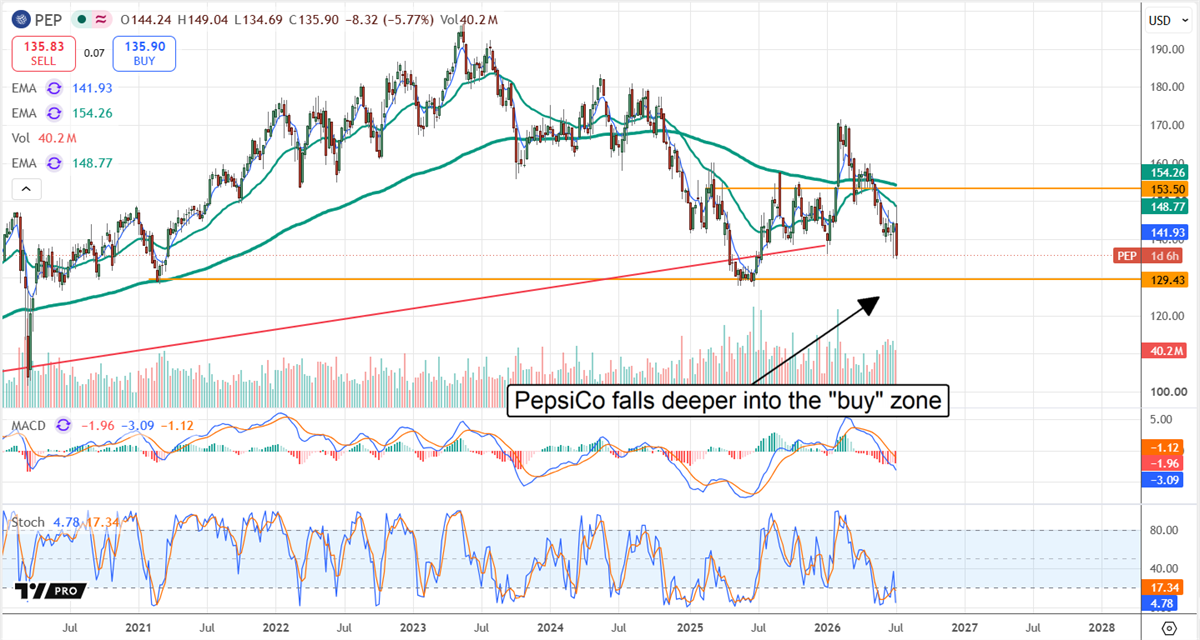
PepsiCo’s stock price shed 5% following the release, but a significantly larger decline is unexpected. The market remains within a consolidation range and well above lows set in 2025, on track to complete a full reversal in time. The biggest risk is the timing of the margin recovery, which may not come until early in 2027 or later. With thin volume in play, PepsiCo stock might wallow within its range for the foreseeable future, giving investors time to establish their positions.
Ultimately, PepsiCo is a value play. This Dividend King trades at a low 16.5x the current-year earnings forecast, about 50% below its historical average. The opportunity is to get into PepsiCo now while the market is mispricing it, and benefit from the dividend payments until the stock price reverts to historical norms. What the market gets wrong about PepsiCo is the impact of activist investors on the outlook, which is profitable, and valuation. PepsiCo isn't the beverage company it once was, but a multinational consumer-staples juggernaut with a considerable moat in high-margin, high-loyalty snack foods.

Continue following MarketBeat
Add MarketBeat as your preferred source on Google to see our latest stories in your feed.
Before you consider PepsiCo, you'll want to hear this.
MarketBeat keeps track of Wall Street's top-rated and best performing research analysts and the stocks they recommend to their clients on a daily basis. MarketBeat has identified the five stocks that top analysts are quietly whispering to their clients to buy now before the broader market catches on... and PepsiCo wasn't on the list.
While PepsiCo currently has a Hold rating among analysts, top-rated analysts believe these five stocks are better buys.
View The Five Stocks Here
The space race is growing fast, and you don’t have to have gotten in early on SpaceX to profit. This report shows seven space stocks you can buy today that may grow as rockets, satellites, defense, space internet, and new space technology become more important.
Get This Free Report
