Fed uncertainty, oil prices, and macro pressures are bringing inflation and interest-rate fears to a head; investors are fleeing to dividends, and for good reason. Dividends provide steady, reliable income and returns regardless of market volatility.
Defensive dividend stocks are even better—these names resist higher interest rates and inflation, and are especially prized. They share several characteristics regardless of sector or end market, including healthy balance sheets, limited debt exposure, and pricing power tied to non-discretionary products and services.
Their stock prices aren’t immune to market malaise; they fall alongside the broader market. However, they tend to decline less during downturns and produce market-beating total returns over time for compounders. Compounding is critical, as dividend reinvestment improves leverage and accelerates annual returns. The best defensive dividend stocks also buy back shares, which supports earnings-per-share growth while giving investors even more leverage.
Casey’s General Stores Is in the Midst of an Inflection
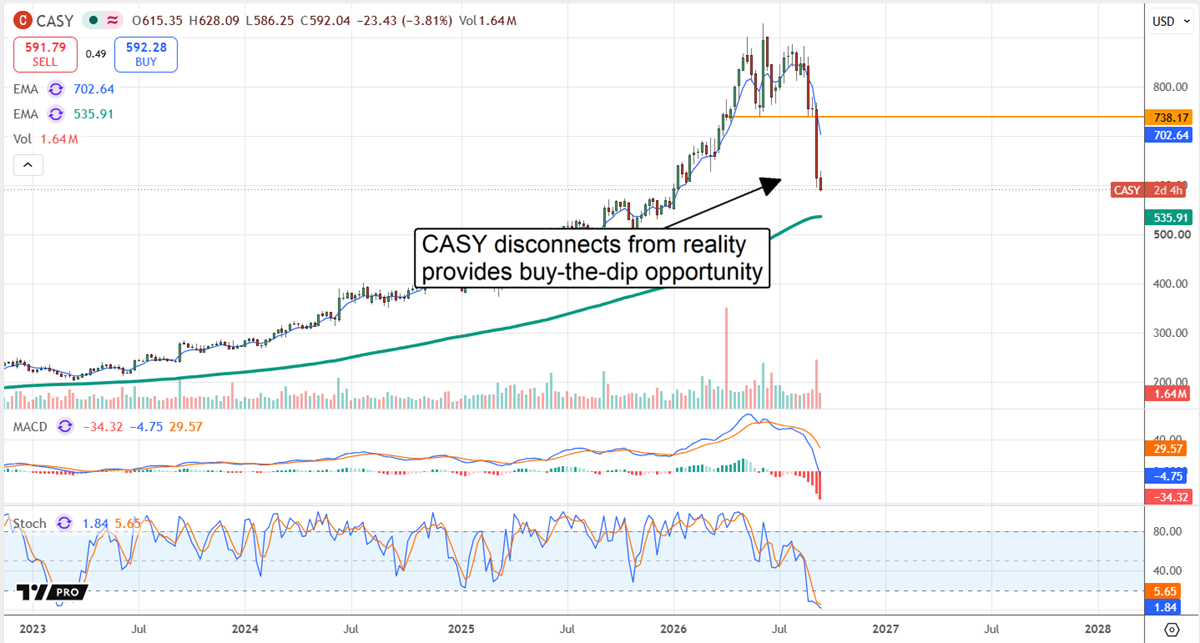
Casey’s General Stores NASDAQ: CASY is a poster child for buy-and-hold stocks. The company is consolidating in highly fractured markets, expanding its convenience store chain organically and through acquisitions, and doing so with very little debt.
Casey's General Stores Today
CASY
Casey's General Stores
$607.45 +18.45 (+3.13%) As of 04:00 PM Eastern
- 52-Week Range
- $497.38
▼
$927.85 - Dividend Yield
- 0.43%
- P/E Ratio
- 29.26
- Price Target
- $840.69
Key details include the ability to self-fund growth, pay dividends, and buy back shares. These factors underpin the 2026 thesis, but they aren't the whole story, because the company is in the midst of a major transition.
Casey’s strategy includes inside sales, specifically food, more specifically hot prepared items like sandwiches and pizza. The store-count expansion and pizza appeal has pushed it to the position of fifth-largest domestic pizza chain, changing its fundamental nature. Casey’s is a convenience store and a gas station, but also a restaurant with solid margins, profitability, cash flow, and growth in a world where others are struggling.
Casey’s dividend isn’t substantial in terms of yield, about 0.4% as of mid-September, but it is a monster of safety, expected to grow at a semi-aggressive pace in upcoming years. As it stands, Casey’s is a Dividend Champion with 27 consecutive increases, a low sub-15% payout ratio, and a double-digit distribution growth rate. Share buybacks are also sustainable, reducing the count incrementally each quarter. The biggest risks are expectations for additional acquisitions and the potential that management will suspend buybacks to help cover the costs.
Johnson & Johnson, a King Among Dividend Payers
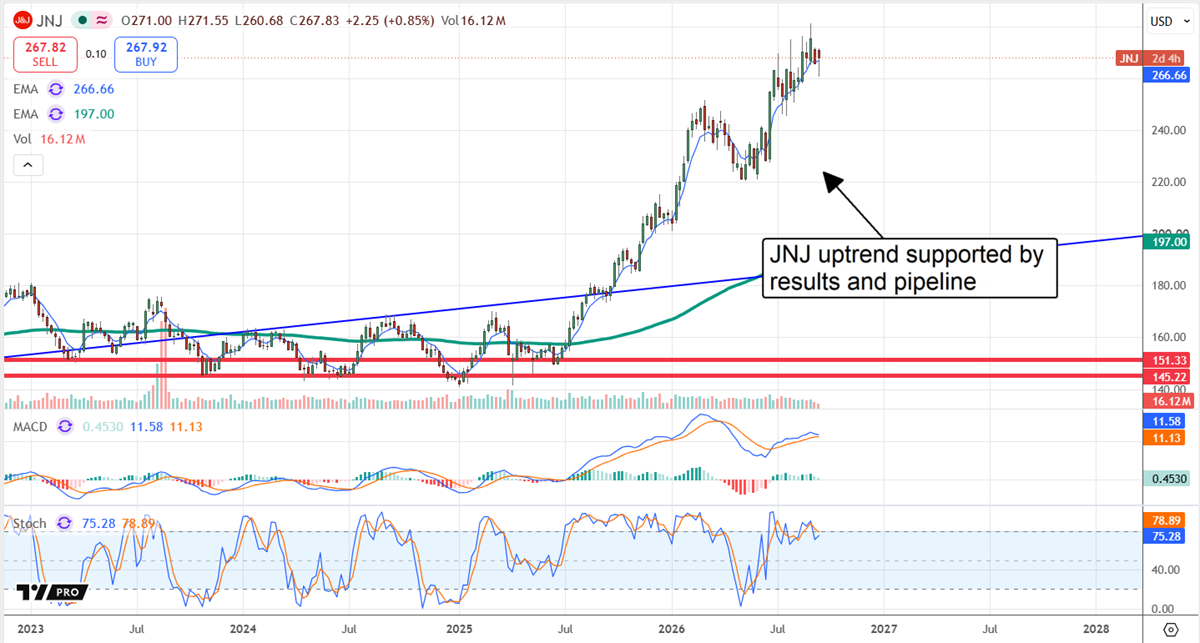
Johnson & Johnson’s NYSE: JNJ stock price has risen in 2026 due to a combination of factors, from Kenvue’s spinoff to its strong pipeline.
Johnson & Johnson Today
JNJ
Johnson & Johnson
$270.65 +3.37 (+1.26%) As of 03:59 PM Eastern
This is a fair market value price provided by Massive. Learn more. - 52-Week Range
- $173.33
▼
$281.07 - Dividend Yield
- 1.98%
- P/E Ratio
- 31.36
- Price Target
- $274.13
The firm is repositioning around Innovative Medicine and MedTech, which is improving margins and accelerating sales of key therapies.
For investors, this means sustained cash flow, capacity for dividends, and the likelihood that semi-aggressive distribution increases will continue indefinitely. Johnson & Johnson is a Dividend King with over 60 consecutive increases and pays out about 60% of earnings, with earnings expected to grow at a modest double-digit pace over the next five years.
The growth outlook has analysts bullish, underpinning the stock price action and the market advance.
While consensus assumes fair value near the late-summer highs, trends are positive, supporting the high end of the range and fresh all-time highs. Catalysts include FDA approval of Icotyde and Imaavy, as well as positive trial results for several compounds treating blood cancers.
Dividend King PepsiCo Down on GLP-1 Inhibitors
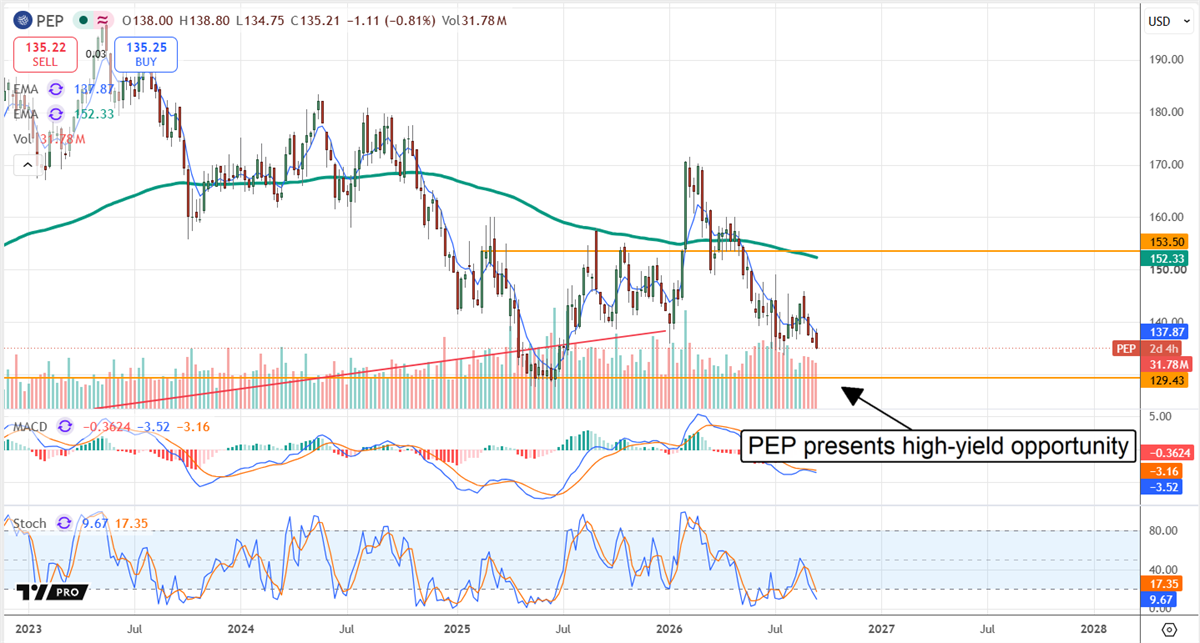
PepsiCo NASDAQ: PEP shares are suffering from GLP-1 shock, with consumers snacking less than before.
PepsiCo Today
$133.66 -0.68 (-0.51%) As of 04:00 PM Eastern
- 52-Week Range
- $132.93
▼
$171.48 - Dividend Yield
- 4.43%
- P/E Ratio
- 17.52
- Price Target
- $157.90
The caveat is that PepsiCo is a well-established consumer giant, the largest staples company in the market, and well-positioned to pivot. Efforts are already underway to realign with snacking trends, including protein-enhanced products to meet the needs of GLP-1 users and modern health trends.
The market gets this company wrong because underlying metrics reveal slow, steady improvements with strengths in key areas such as International.
Key details: 2026 results are sufficient to sustain financial health, pay dividends, buy back shares, and invest in growth.
PepsiCo uses debt as part of its strategy, but mitigates this with its strong balance sheet, with most debt at fixed rates and unaffected by rate increases.
PepsiCo’s dividend is very attractive. The 2026 price weakness created a deep-value, high-yield opportunity, with PEP at the low end of its historical valuation range and the high end of its yield range. Trading at a mid-teens price multiple, PepsiCo’s stock price could rise about 65% on valuation alone while paying its 4.3% dividend yield.
Buybacks aren’t robust, but reduce the share count quarterly, aiding earnings per share growth. PepsiCo’s risks include rising commodity costs, including PET resin, a critical bottling component. To address this, PepsiCo, in line with Elliot Management’s recommendations, is cutting costs, rationalizing stock-keeping units (SKUs), and investing in AI efficiencies.
Before you consider Casey's General Stores, you'll want to hear this.
MarketBeat keeps track of Wall Street's top-rated and best performing research analysts and the stocks they recommend to their clients on a daily basis. MarketBeat has identified the five stocks that top analysts are quietly whispering to their clients to buy now before the broader market catches on... and Casey's General Stores wasn't on the list.
While Casey's General Stores currently has a Moderate Buy rating among analysts, top-rated analysts believe these five stocks are better buys.
View The Five Stocks Here
Nuclear energy is entering a new growth cycle as rising power demand, expanding data centers, and renewed policy support bring the sector back into focus. After strong gains in recent years, the most impactful phase of nuclear investment may still be ahead. This report highlights seven nuclear energy stocks positioned across the value chain—combining near-term revenue with long-term upside as next-generation technologies scale. Click the link below to unlock the full list.
Get This Free Report
Continue following MarketBeat
Add MarketBeat as your preferred source on Google to see our latest stories in your feed.
