Uber Technologies NYSE: UBER stock price action is depressed relative to 2025 highs and may not recover soon. The company’s changes to its business model are impacting its growth and weighing on sentiment, giving the market ample reason to sit on the sidelines.
Uber Technologies Today
UBER
Uber Technologies
$74.94 +4.48 (+6.35%) As of 08/7/2026 03:59 PM Eastern
This is a fair market value price provided by Massive. Learn more. - 52-Week Range
- $65.41
▼
$101.99 - P/E Ratio
- 16.47
- Price Target
- $104.23
Though tepid, Q2 revenue and Q3 guidance are better than they look. The company is changing how it recognizes revenue, not its fundamental position, which remains strong. More to the point, Uber continues to unlock profitability; it drove accelerated growth in Q2, and that’s what counts.
Uber’s near-term headwinds aside, the long-term opportunity is robust, centered on it becoming the platform of choice for autonomous fleet operators. The company is a cash-generating machine, engaged in an aggressive share buyback program.
Uber targets returning 50% of its free cash flow to shareholders through buybacks. Free cash flow topped $10 billion on a trailing 12-month basis for the first time in Q2, up 13% year-over-year (YOY).
As it stands, Q2 buyback activity led to a 7.5% reduction in the average count, a pace expected to continue. While share prices are expected to advance, so too is the free cash flow.
Uber Outperforms in Q2, Issues Cautious Guidance
Uber had a solid Q2, growing revenue by 12% to a record $14.19 billion. The top line missed expectations by a slim margin, but it's the bookings that matter. Bookings, the net total of logged transactions, grew by 24%, driven by an 18% increase in total trips.
Trip strength was underpinned by a 16% increase in user base and a 2% increase in trips per user. Uber's CEO said first-time user growth is the strongest it's been in a decade. Segmentally, Mobility grew by 22%, Delivery by 25%, and Freight by 25%.
Margin was another strength from the report. Uber widened its margin at all levels, driving a 40% increase in adjusted operating income and a 35% gain in adjusted earnings per share. Looking ahead, the company expects these strengths to continue, as does the market. The bad news is that guidance was met with tepid reception; the upshot is that booking growth and margin forecasts support the capital return.
Uber’s balance sheet reflects the strength of its position. The company’s cash and current assets are down on a year-to-date basis, impacted by share buybacks and accelerated investment in autonomous driving technology, but liabilities were controlled, and equity is up.
Although marginal, the 1% equity gain came despite a more than 7% reduction in share count, affirming the company's strategy. In this scenario, Uber can continue to execute while reducing its share count and building shareholder leverage.
Analyst Sentiment Firms, 40% Upside Indicated
The initial analyst response to the release was mixed, including both reaffirmed price targets and a price target reduction within the first few hours.
However, the actions aligned with the consensus rating, which is a Moderate Buy with 82.5% Buy-side bias and about 40% upside. Analyst chatter centered on the long-term opportunity, including the cash flow, but cited near-term headwinds as reasons for caution.
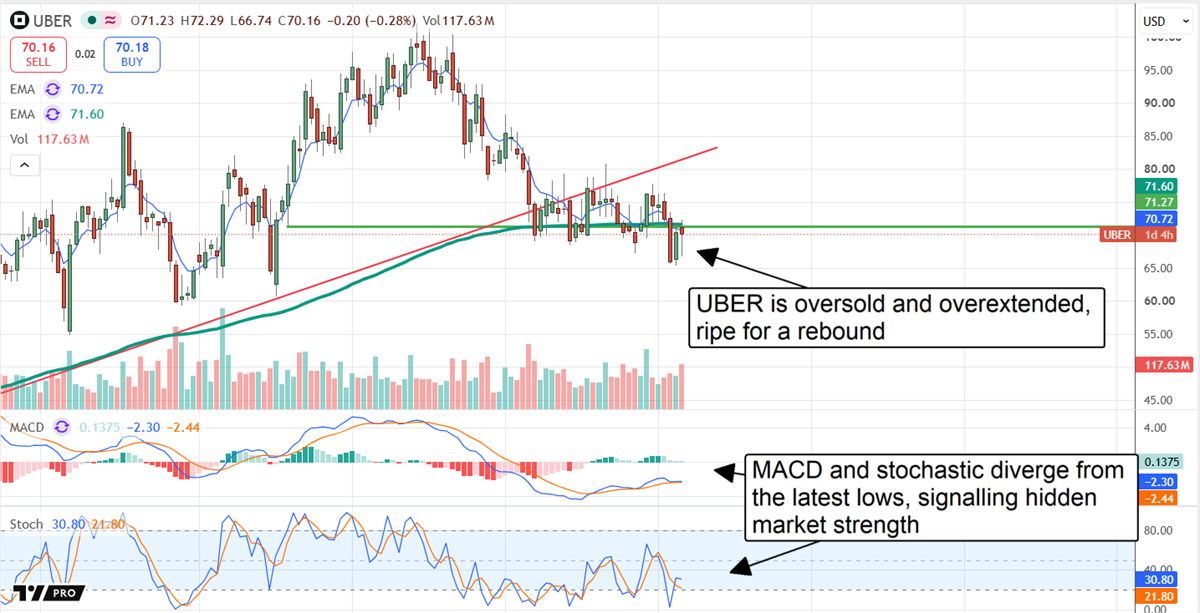
The likely outcome is that Uber stock continues to move sideways at mid-2026’s lows, but the upside potential is building. A catalyst may emerge as soon as the next earnings report, and downside risk is limited by the sentiment trend.
Institutional activity also limits downside, with the group owning 80% of the shares, buying on balance over the trailing 12 months, and buying more than $2 for every $1 sold in early Q3.
Uber’s biggest risk is regulatory. Its operations span borders, requiring it to navigate numerous, ever-changing regulatory environments, and there is an existential threat as well. Courts may force Uber to treat its independent contractor drivers as W-2 employees, requiring it to pay significantly more in wages, taxes, and benefits. The silver lining is that autonomous vehicles could render the issue moot.
Uber has committed to $10 billion in multiyear investment, focusing on three avenues. Direct equity stakes in leading players, fleet and hardware commitments, and its NVIDIA NASDAQ: NVDA partnership aim to secure the market, establishing early market dominance with a ready-to-go fleet as soon as regulations allow.
In this scenario, up-front AI investment would pay off in spades on the back end, setting the stage for surging cash flow and profitability as AV gains traction. As it stands, industry leaders forecast mainstream robotaxi use by 2030 and widespread adoption by 2035. In 2026, AV is expanding to nearly two dozen cities, with ramping expected in 2028.

Continue following MarketBeat
Add MarketBeat as your preferred source on Google to see our latest stories in your feed.
Before you consider Uber Technologies, you'll want to hear this.
MarketBeat keeps track of Wall Street's top-rated and best performing research analysts and the stocks they recommend to their clients on a daily basis. MarketBeat has identified the five stocks that top analysts are quietly whispering to their clients to buy now before the broader market catches on... and Uber Technologies wasn't on the list.
While Uber Technologies currently has a Moderate Buy rating among analysts, top-rated analysts believe these five stocks are better buys.
View The Five Stocks Here
The AI boom extends far beyond the biggest tech names. Discover 10 companies supplying the memory, storage, networking, semiconductor manufacturing, and power infrastructure that make AI possible. Learn where the next wave of AI investment opportunities may emerge—and the key risks investors should watch as the global AI buildout accelerates.
Get This Free Report
