Hewlett Packard Enterprise (NYSE:HPE - Get Free Report) had its price objective decreased by equities research analysts at Morgan Stanley from $69.00 to $67.00 in a report released on Thursday, Benzinga reports. The brokerage currently has an "overweight" rating on the technology company's stock. Morgan Stanley's price target indicates a potential upside of 39.37% from the stock's previous close.
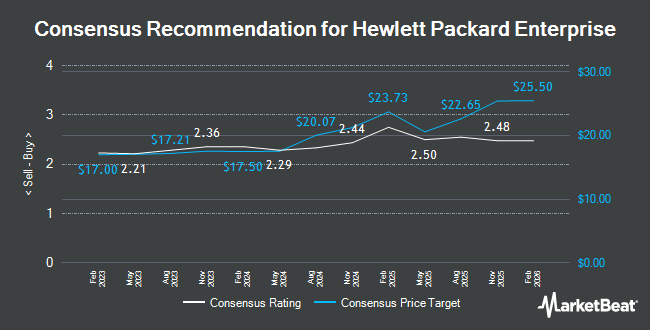
HPE has been the subject of several other research reports. Raymond James Financial upped their price objective on Hewlett Packard Enterprise from $29.00 to $74.00 and gave the company an "outperform" rating in a research note on Tuesday, June 2nd. Weiss Ratings raised Hewlett Packard Enterprise from a "hold (c+)" rating to a "buy (b-)" rating in a report on Monday, June 29th. Wall Street Zen raised Hewlett Packard Enterprise from a "buy" rating to a "strong-buy" rating in a research note on Sunday. Wells Fargo & Company lowered their price objective on Hewlett Packard Enterprise from $67.00 to $54.00 and set an "equal weight" rating for the company in a research report on Thursday. Finally, JPMorgan Chase & Co. lifted their price objective on Hewlett Packard Enterprise from $37.00 to $68.00 and gave the stock an "overweight" rating in a research note on Tuesday, June 2nd. Twelve equities research analysts have rated the stock with a Buy rating and six have assigned a Hold rating to the stock. According to MarketBeat, Hewlett Packard Enterprise has an average rating of "Moderate Buy" and an average price target of $69.25.
View Our Latest Report on HPE
Hewlett Packard Enterprise Stock Performance
Shares of NYSE:HPE traded down $3.75 during trading on Thursday, reaching $48.08. 16,910,477 shares of the stock were exchanged, compared to its average volume of 20,743,398. The stock has a 50-day moving average price of $49.63 and a 200-day moving average price of $37.46. The firm has a market cap of $63.66 billion, a PE ratio of 45.06, a PEG ratio of 0.54 and a beta of 1.43. Hewlett Packard Enterprise has a 12 month low of $19.84 and a 12 month high of $64.25. The company has a current ratio of 1.09, a quick ratio of 0.75 and a debt-to-equity ratio of 0.72.
Hewlett Packard Enterprise (NYSE:HPE - Get Free Report) last issued its quarterly earnings data on Wednesday, September 2nd. The technology company reported $1.11 earnings per share for the quarter, topping the consensus estimate of $0.93 by $0.18. Hewlett Packard Enterprise had a net margin of 3.94% and a return on equity of 11.91%. The business had revenue of $12.21 billion during the quarter, compared to analysts' expectations of $11.97 billion. During the same quarter in the previous year, the company earned $0.44 EPS. The business's revenue was up 33.7% on a year-over-year basis. Hewlett Packard Enterprise has set its Q4 2026 guidance at 1.200-1.300 EPS and its FY 2026 guidance at 3.750-3.850 EPS. Research analysts expect that Hewlett Packard Enterprise will post 2.92 EPS for the current fiscal year.
Insider Transactions at Hewlett Packard Enterprise
In other Hewlett Packard Enterprise news, SVP Kirt P. Karros sold 18,785 shares of the business's stock in a transaction that occurred on Monday, June 22nd. The stock was sold at an average price of $48.50, for a total value of $911,072.50. The sale was disclosed in a document filed with the SEC, which is available through the SEC website. The transaction was executed under a pre-arranged Rule 10b5-1 trading plan. Company insiders own 0.44% of the company's stock.
Institutional Inflows and Outflows
Several institutional investors and hedge funds have recently bought and sold shares of HPE. Headlands Technologies LLC bought a new stake in Hewlett Packard Enterprise in the second quarter valued at $26,000. Delos Wealth Advisors LLC bought a new position in Hewlett Packard Enterprise in the second quarter worth approximately $27,000. SJS Investment Consulting Inc. increased its holdings in shares of Hewlett Packard Enterprise by 159.5% during the first quarter. SJS Investment Consulting Inc. now owns 1,165 shares of the technology company's stock valued at $28,000 after acquiring an additional 716 shares in the last quarter. Union Savings Bank acquired a new stake in Hewlett Packard Enterprise in the 4th quarter valued at $30,000. Finally, First Bancorp Inc ME bought a new stake in Hewlett Packard Enterprise during the 2nd quarter valued at $30,000. 80.78% of the stock is owned by institutional investors.
Hewlett Packard Enterprise News Summary
Here are the key news stories impacting Hewlett Packard Enterprise this week:
- Positive Sentiment: Results and guidance beat expectations: HPE reported fiscal Q3 revenue of $12.21 billion, up 33.7% year over year, and adjusted EPS of $1.11 versus the roughly $0.93 consensus. The company raised fiscal 2026 EPS guidance to $3.75-$3.85 and revenue guidance to $46-$47 billion, both above analyst estimates. Q4 guidance also exceeded expectations. HPE Reports Fiscal 2026 Third Quarter Results
- Positive Sentiment: AI demand is driving growth: Strong demand for AI infrastructure lifted server and networking sales, helping produce record revenue, orders and profitability. HPE also outlined potential fiscal 2027 revenue growth of 13%-17% and at least $5 billion in free cash flow. HPE raises annual forecasts as AI and networking demand lifts revenue
- Positive Sentiment: Oracle networking collaboration expanded: HPE will deploy Juniper Networking technology across Oracle’s AI data centers, potentially strengthening its position in large-scale AI infrastructure and creating additional networking demand. HPE and Oracle deepen networking collaboration
- Neutral Sentiment: Networking Investor Day scheduled: HPE will hold an investor event on September 30 to discuss the Networking segment’s strategy, portfolio differentiation and growth opportunities. The event could provide further detail on the Juniper integration and AI-related demand. HPE to webcast Networking Investor Day event
- Negative Sentiment: Supply constraints remain a concern: Investors appear worried that limited availability of components and systems could restrict HPE’s ability to fulfill AI-related orders. Shares declined despite the earnings beat and raised outlook. Why is HPE stock falling despite stronger results?
- Negative Sentiment: Margin sustainability is under scrutiny: As AI systems become a larger portion of sales, investors are assessing whether HPE can maintain recent margin gains and convert strong demand into durable, profitable growth.
Hewlett Packard Enterprise Company Profile
(
Get Free Report)
Hewlett Packard Enterprise (HPE) is an enterprise technology company that designs, develops and sells IT infrastructure, software and services for business and government customers. Its core offerings span servers, storage, networking, and related software, together with consulting, integration and support services aimed at modernizing and managing enterprise IT environments. HPE's product portfolio includes systems for traditional data centers as well as solutions for high-performance computing, edge computing and telecommunications infrastructure.
A major focus for HPE is hybrid cloud and consumption-based IT.
Featured Stories
This instant news alert was generated by narrative science technology and financial data from MarketBeat in order to provide readers with the fastest reporting and unbiased coverage. Please send any questions or comments about this story to contact@marketbeat.com.

Continue following MarketBeat
Add MarketBeat as your preferred source on Google to see our latest stories in your feed.
Before you consider Hewlett Packard Enterprise, you'll want to hear this.
MarketBeat keeps track of Wall Street's top-rated and best performing research analysts and the stocks they recommend to their clients on a daily basis. MarketBeat has identified the five stocks that top analysts are quietly whispering to their clients to buy now before the broader market catches on... and Hewlett Packard Enterprise wasn't on the list.
While Hewlett Packard Enterprise currently has a Moderate Buy rating among analysts, top-rated analysts believe these five stocks are better buys.
View The Five Stocks Here
A strong long-term portfolio starts with companies that can survive recessions, inflation, changing consumer habits, and shifting market leadership.
This report names seven blue-chip stocks across technology, retail, consumer staples, healthcare, networking, sporting goods, and utilities that offer investors a mix of stability, income, growth, and staying power.
Get This Free Report
Like this article? Share it with a colleague.
Link copied to clipboard.
