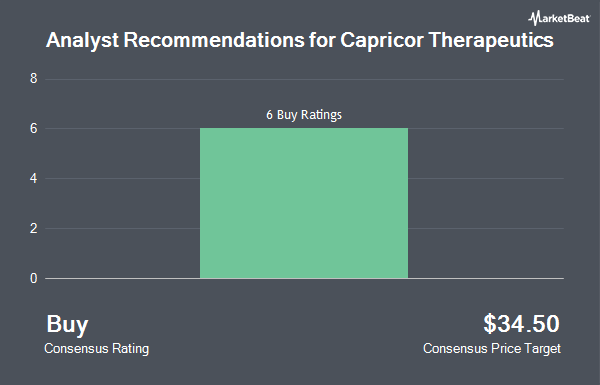
Shares of Capricor Therapeutics, Inc. (NASDAQ:CAPR - Get Free Report) have been given a consensus rating of "Hold" by the eleven ratings firms that are presently covering the company, MarketBeat reports. One investment analyst has rated the stock with a sell rating, seven have issued a hold rating and three have assigned a buy rating to the company. The average 12-month target price among analysts that have issued a report on the stock in the last year is $29.15.
Several brokerages have recently commented on CAPR. Oppenheimer raised Capricor Therapeutics from a "market perform" rating to an "outperform" rating in a research report on Tuesday, August 25th. Roth Capital downgraded Capricor Therapeutics from a "buy" rating to a "neutral" rating and set a $7.00 price objective for the company. in a research note on Monday, July 27th. Cantor Fitzgerald upgraded Capricor Therapeutics from a "neutral" rating to an "overweight" rating in a research report on Friday, August 14th. Wall Street Zen lowered Capricor Therapeutics from a "sell" rating to a "strong sell" rating in a research report on Saturday, August 1st. Finally, LADENBURG THALM/SH SH cut Capricor Therapeutics from a "buy" rating to a "neutral" rating in a research note on Thursday, July 30th.
Check Out Our Latest Analysis on CAPR
Trending Headlines about Capricor Therapeutics
Here are the key news stories impacting Capricor Therapeutics this week:
- Positive Sentiment: No new positive corporate or clinical development was reported in the provided articles that would offset the legal and regulatory concerns.
- Neutral Sentiment: Multiple law firms reminded investors that September 28, 2026 is the deadline to seek appointment as lead plaintiff in a proposed class action covering investors who acquired Capricor securities from December 17, 2025, through July 26, 2026. The notices are largely duplicative and do not represent separate lawsuits or new operational developments. Kaplan Fox class action notice
- Negative Sentiment: The litigation alleges that Capricor failed to disclose that it changed the prespecified statistical analysis plan for its Phase 3 HOPE-3 trial without FDA agreement, leaving portions of the results characterized by the agency as “post-hoc and exploratory.” These allegations raise risks involving potential damages, legal expenses, management distraction, and reputational damage. Capricor shareholder alert
- Negative Sentiment: The FDA’s decision to extend its review of deramiocel’s BLA adds uncertainty around the timing and potential outcome of approval for Capricor’s key product candidate. The extended review is the central regulatory issue cited in the investor alerts and likely contributes to continued volatility. Hagens Berman FDA review extension alert
- Negative Sentiment: The legal overhang is particularly significant for a development-stage biotechnology company with continuing losses. CAPR remains well below its 50-day and 200-day moving averages, indicating sustained bearish momentum, although the supplied short-interest data appears inconsistent and provides no reliable additional signal.
Insider Activity at Capricor Therapeutics
In related news, CFO Anthony Bergmann sold 24,100 shares of the firm's stock in a transaction that occurred on Thursday, June 25th. The shares were sold at an average price of $30.38, for a total transaction of $732,158.00. Following the completion of the sale, the chief financial officer directly owned 11,223 shares in the company, valued at approximately $340,954.74. This trade represents a 68.23% decrease in their ownership of the stock. The transaction was disclosed in a document filed with the SEC, which can be accessed through the SEC website. Insiders have sold 25,000 shares of company stock worth $759,158 in the last ninety days. Company insiders own 9.20% of the company's stock.
Institutional Investors Weigh In On Capricor Therapeutics
A number of hedge funds and other institutional investors have recently added to or reduced their stakes in CAPR. Walleye Capital LLC purchased a new position in shares of Capricor Therapeutics during the 1st quarter valued at $5,397,000. Creek Drive Management Group LLC acquired a new position in shares of Capricor Therapeutics in the fourth quarter worth $1,039,000. Bank of America Corp DE raised its holdings in shares of Capricor Therapeutics by 672.0% during the first quarter. Bank of America Corp DE now owns 415,483 shares of the biotechnology company's stock worth $12,631,000 after acquiring an additional 361,664 shares in the last quarter. Montanova Capital LLC raised its holdings in shares of Capricor Therapeutics by 7.2% during the second quarter. Montanova Capital LLC now owns 4,092,784 shares of the biotechnology company's stock worth $98,554,000 after acquiring an additional 274,184 shares in the last quarter. Finally, UBS Group AG boosted its position in Capricor Therapeutics by 91.0% during the fourth quarter. UBS Group AG now owns 238,216 shares of the biotechnology company's stock valued at $6,875,000 after purchasing an additional 113,499 shares during the last quarter. Hedge funds and other institutional investors own 21.68% of the company's stock.
Capricor Therapeutics Stock Performance
Shares of NASDAQ:CAPR opened at $8.37 on Friday. The company has a market cap of $486.63 million, a PE ratio of -3.42 and a beta of 0.72. Capricor Therapeutics has a 52 week low of $2.96 and a 52 week high of $40.37. The firm has a 50 day simple moving average of $11.05 and a 200 day simple moving average of $23.21.
Capricor Therapeutics (NASDAQ:CAPR - Get Free Report) last posted its quarterly earnings data on Thursday, August 13th. The biotechnology company reported ($0.70) earnings per share for the quarter, missing the consensus estimate of ($0.59) by ($0.11). On average, equities analysts predict that Capricor Therapeutics will post -1.71 earnings per share for the current year.
About Capricor Therapeutics
(
Get Free Report)
Capricor Therapeutics, Inc is a clinical-stage biotechnology company focused on the development of cell and exosome-based therapeutics for cardiovascular and rare diseases. Headquartered in Beverly Hills, California, the company leverages proprietary cardiosphere-derived cell (CDC) technology to address conditions characterized by inflammation, fibrosis, and tissue degeneration. Since its founding, Capricor has advanced its lead candidate through multiple clinical trials and has built a pipeline that spans both cell therapy and extracellular vesicle (exosome) platforms.
The company's leading product candidate, CAP-1002, comprises allogeneic CDCs and is being evaluated in indications such as Duchenne muscular dystrophy (DMD) and COVID-19-related heart injury.
Recommended Stories
This instant news alert was generated by narrative science technology and financial data from MarketBeat in order to provide readers with the fastest reporting and unbiased coverage. Please send any questions or comments about this story to contact@marketbeat.com.
Before you consider Capricor Therapeutics, you'll want to hear this.
MarketBeat keeps track of Wall Street's top-rated and best performing research analysts and the stocks they recommend to their clients on a daily basis. MarketBeat has identified the five stocks that top analysts are quietly whispering to their clients to buy now before the broader market catches on... and Capricor Therapeutics wasn't on the list.
While Capricor Therapeutics currently has a Hold rating among analysts, top-rated analysts believe these five stocks are better buys.
View The Five Stocks Here
The AI boom is creating opportunities across semiconductors, cloud computing, enterprise software, infrastructure, cybersecurity, and automation.
Inside this report, you’ll find 10 companies positioned to benefit as artificial intelligence moves from hype to real-world deployment and becomes a core growth driver for corporate America.
Get This Free Report
Continue following MarketBeat
Add MarketBeat as your preferred source on Google to see our latest stories in your feed.
Like this article? Share it with a colleague.
Link copied to clipboard.
