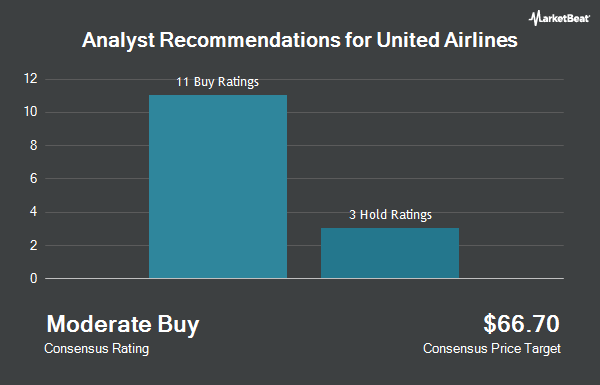
United Airlines Holdings Inc (NASDAQ:UAL - Get Free Report) has been given a consensus rating of "Moderate Buy" by the eighteen brokerages that are currently covering the firm, Marketbeat reports. One investment analyst has rated the stock with a sell rating, one has issued a hold rating and sixteen have issued a buy rating on the company. The average 1 year price target among analysts that have updated their coverage on the stock in the last year is $156.19.
Several equities analysts recently commented on UAL shares. Susquehanna dropped their target price on United Airlines from $150.00 to $130.00 and set a "positive" rating for the company in a research note on Thursday, October 22nd. Barclays decreased their price target on United Airlines from $175.00 to $160.00 and set an "overweight" rating on the stock in a research note on Friday, September 11th. Jefferies Financial Group restated a "buy" rating and issued a $142.00 price target on shares of United Airlines in a report on Wednesday, October 21st. Wells Fargo & Company dropped their price objective on shares of United Airlines from $160.00 to $155.00 and set an "overweight" rating for the company in a research note on Thursday, October 22nd. Finally, Rothschild & Co Redburn cut their price objective on shares of United Airlines from $165.00 to $150.00 and set a "buy" rating on the stock in a report on Friday, September 18th.
Read Our Latest Report on UAL
United Airlines Trading Down 0.9%
Shares of United Airlines stock opened at $104.24 on Friday. The company has a debt-to-equity ratio of 1.38, a current ratio of 0.75 and a quick ratio of 0.68. United Airlines has a 1 year low of $84.64 and a 1 year high of $138.77. The company has a market capitalization of $33.87 billion, a P/E ratio of 9.54, a P/E/G ratio of 1.33 and a beta of 1.30. The business has a 50 day moving average price of $107.65 and a 200 day moving average price of $108.27.
United Airlines (NASDAQ:UAL - Get Free Report) last released its quarterly earnings results on Tuesday, October 20th. The transportation company reported $2.54 earnings per share for the quarter, missing the consensus estimate of $2.57 by ($0.03). United Airlines had a return on equity of 17.59% and a net margin of 5.46%. The company had revenue of $17.88 billion for the quarter, compared to analysts' expectations of $17.89 billion. During the same period in the previous year, the business posted $2.78 EPS. The business's quarterly revenue was up 17.4% on a year-over-year basis. Sell-side analysts anticipate that United Airlines will post 7.17 EPS for the current fiscal year.
Insiders Place Their Bets
In other United Airlines news, EVP Andrew Nocella sold 5,000 shares of the business's stock in a transaction dated Tuesday, August 25th. The stock was sold at an average price of $117.00, for a total transaction of $585,000.00. Following the completion of the sale, the executive vice president owned 214,955 shares of the company's stock, valued at approximately $25,149,735. The trade was a 2.27% decrease in their ownership of the stock. The transaction was disclosed in a legal filing with the Securities & Exchange Commission, which is accessible through this hyperlink. Insiders own 0.86% of the company's stock.
Institutional Inflows and Outflows
Several hedge funds have recently bought and sold shares of UAL. Royal Bank of Canada increased its position in United Airlines by 11.2% in the first quarter. Royal Bank of Canada now owns 418,647 shares of the transportation company's stock worth $38,544,000 after buying an additional 42,111 shares during the period. Sanctuary Advisors LLC acquired a new stake in shares of United Airlines in the 2nd quarter worth about $7,671,000. State Street Corp lifted its position in United Airlines by 1.4% in the 2nd quarter. State Street Corp now owns 11,788,111 shares of the transportation company's stock valued at $1,603,065,000 after purchasing an additional 162,283 shares during the last quarter. Junto Capital Management LP bought a new position in United Airlines in the 2nd quarter worth about $37,460,000. Finally, Y Intercept Hong Kong Ltd grew its position in United Airlines by 432.2% in the 1st quarter. Y Intercept Hong Kong Ltd now owns 96,592 shares of the transportation company's stock worth $8,893,000 after purchasing an additional 78,442 shares during the last quarter. Hedge funds and other institutional investors own 69.69% of the company's stock.
United Airlines Company Profile
(
Get Free Report)
United Airlines Holdings, Inc is the parent company of United Airlines, a major U.S. commercial airline headquartered in Chicago, Illinois. The company provides scheduled passenger air transportation and air cargo services, connecting customers across the United States and to international destinations.
United operates a broad network serving North America, Latin America, Europe, Asia, Africa and Oceania. Its operations are supported by hubs in major U.S. cities, including Chicago, Denver, Houston, Los Angeles, Newark, San Francisco and Washington, DC, as well as an extensive network of regional carriers operating under the United Express brand.
The company offers several travel classes and related services, including premium-cabin seating, onboard amenities, airport lounges and the MileagePlus customer loyalty program.
Recommended Stories
This instant news alert was generated by narrative science technology and financial data from MarketBeat in order to provide readers with the fastest reporting and unbiased coverage. Please send any questions or comments about this story to contact@marketbeat.com.
Before you consider United Airlines, you'll want to hear this.
MarketBeat keeps track of Wall Street's top-rated and best performing research analysts and the stocks they recommend to their clients on a daily basis. MarketBeat has identified the five stocks that top analysts are quietly whispering to their clients to buy now before the broader market catches on... and United Airlines wasn't on the list.
While United Airlines currently has a Moderate Buy rating among analysts, top-rated analysts believe these five stocks are better buys.
View The Five Stocks Here
A strong long-term portfolio starts with companies that can survive recessions, inflation, changing consumer habits, and shifting market leadership.
This report names seven blue-chip stocks across technology, retail, consumer staples, healthcare, networking, sporting goods, and utilities that offer investors a mix of stability, income, growth, and staying power.
Get This Free Report
Continue following MarketBeat
Add MarketBeat as your preferred source on Google to see our latest stories in your feed.
Like this article? Share it with a colleague.
Link copied to clipboard.
