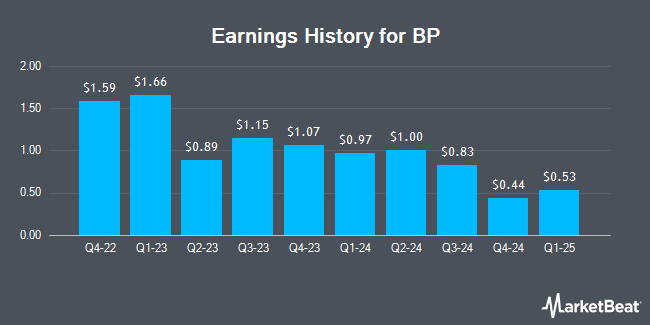
BP (NYSE:BP - Get Free Report) announced its quarterly earnings results on Friday. The oil and gas exploration company reported $3.26 earnings per share for the quarter, topping the consensus estimate of $2.66 by $0.60, FiscalAI reports. BP had a net margin of 2.49% and a return on equity of 16.63%. The company had revenue of $68.40 billion for the quarter, compared to analysts' expectations of $63.14 billion. During the same quarter in the previous year, the business posted $0.85 earnings per share. BP's quarterly revenue was up 41.8% on a year-over-year basis.
Here are the key takeaways from BP's conference call:
- Strong third-quarter performance: Upstream production held near 2.2 million boe/d, while improved reliability, strong refining utilization and higher trading contributions supported earnings and cash flow.
- Net debt fell below BP’s target range, and management said structural cost reductions are now within the targeted range. The company also expects further benefit from the Castrol and Gelsenkirchen exits by 2027.
- BP plans to prioritize excess cash toward settling its remaining Deepwater Horizon state and federal liabilities, which could improve long-term financial resilience but may limit near-term shareholder distributions such as buybacks.
- BP recorded approximately $4 billion of further impairments, primarily related to Lightsource bp and offshore wind, underscoring management’s concerns about past investment decisions and the need for stricter project screening.
- Management reaffirmed its commitment to an integrated upstream, downstream and trading model, while portfolio simplification continues through proposed disposals including Lightsource bp, the U.K. North Sea business and Archaea; the strategic and financial framework will be updated in December.
BP Price Performance
BP stock traded up $0.17 during trading hours on Friday, reaching $50.52. 9,865,945 shares of the stock were exchanged, compared to its average volume of 10,737,398. The company has a current ratio of 1.27, a quick ratio of 0.95 and a debt-to-equity ratio of 0.69. BP has a twelve month low of $33.22 and a twelve month high of $51.49. The company has a market cap of $132.35 billion, a P/E ratio of 24.64, a price-to-earnings-growth ratio of 0.45 and a beta of 0.20. The stock has a 50 day moving average of $45.86 and a two-hundred day moving average of $42.82.
BP Increases Dividend
The company also recently disclosed a quarterly dividend, which was paid on Friday, September 18th. Shareholders of record on Friday, August 14th were paid a dividend of $0.5196 per share. The ex-dividend date was Friday, August 14th. This is a positive change from BP's previous quarterly dividend of $0.4992. This represents a $2.08 dividend on an annualized basis and a yield of 4.1%. BP's dividend payout ratio is currently 100.49%.
BP News Roundup
Here are the key news stories impacting BP this week:
- Positive Sentiment: Major earnings beat: BP reported third-quarter adjusted replacement-cost profit of approximately $8.46 billion, nearly quadrupling from $2.21 billion a year earlier. Reported EPS of $3.26 exceeded the $2.66 consensus, while revenue of $68.40 billion topped the $63.14 billion estimate and increased 41.8% year over year. BP's third-quarter profit nearly quadruples to $8.5 billion as refining margins surge
- Positive Sentiment: Refining and oil-market tailwinds: Conflict involving Iran and broader Middle East supply disruptions pushed oil prices higher and drove refining margins sharply upward. BP’s unaffected refineries and trading operations benefited from tighter global supplies, supporting near-term cash generation. BP Quadruples Profit to Record as War Boosts Refining and Trading
- Positive Sentiment: Balance-sheet improvement: Net debt fell by about $8.4 billion to $13.9 billion, strengthening BP’s financial flexibility and potentially improving its ability to return capital to shareholders. BP Slashes Net Debt as Earnings Soar
- Neutral Sentiment: Strategy update ahead: Management is expected to provide further details on BP’s strategy in December. Investors will focus on capital allocation, production growth, shareholder returns and the balance between traditional energy and lower-carbon investments. BP Q3 2026 Earnings Call Transcript
- Negative Sentiment: Geopolitical and sustainability risks remain: The earnings surge is partly tied to conflict-driven prices and refining margins, which may reverse if supply conditions normalize. BP also faced an approximately $4 billion loss tied to green investments, highlighting execution and capital-allocation concerns. BP profits hit 18-year high despite $4bn net zero loss
Analysts Set New Price Targets
A number of research analysts recently issued reports on the company. DA Davidson set a $49.00 price target on BP in a report on Tuesday, October 20th. TD Cowen increased their price target on BP from $47.00 to $49.00 and gave the company a "hold" rating in a research note on Tuesday, October 20th. Weiss Ratings raised shares of BP from a "hold (c)" rating to a "hold (c+)" rating in a research note on Thursday, October 22nd. JPMorgan Chase & Co. raised BP from a "neutral" rating to an "overweight" rating in a research report on Wednesday, September 23rd. Finally, Barclays reaffirmed an "overweight" rating on shares of BP in a research note on Monday, October 5th. One investment analyst has rated the stock with a Strong Buy rating, fifteen have issued a Buy rating, eight have assigned a Hold rating and two have given a Sell rating to the stock. Based on data from MarketBeat.com, the stock currently has an average rating of "Moderate Buy" and a consensus target price of $49.44.
Check Out Our Latest Stock Analysis on BP
About BP
(
Get Free Report)
BP p.l.c. is a global integrated energy company headquartered in London, United Kingdom. Its operations span the exploration, development and production of oil and natural gas, as well as the processing, refining, transportation and marketing of energy products.
Through its businesses, BP supplies fuels for road transportation, aviation and marine use, along with lubricants marketed under the Castrol brand. The company also operates retail fuel and convenience locations and provides energy products and services to commercial and industrial customers.
BP has expanded its activities beyond traditional hydrocarbons to include lower-carbon businesses such as renewable power, bioenergy, electric-vehicle charging and hydrogen.
Featured Stories
This instant news alert was generated by narrative science technology and financial data from MarketBeat in order to provide readers with the fastest reporting and unbiased coverage. Please send any questions or comments about this story to contact@marketbeat.com.
Before you consider BP, you'll want to hear this.
MarketBeat keeps track of Wall Street's top-rated and best performing research analysts and the stocks they recommend to their clients on a daily basis. MarketBeat has identified the five stocks that top analysts are quietly whispering to their clients to buy now before the broader market catches on... and BP wasn't on the list.
While BP currently has a Moderate Buy rating among analysts, top-rated analysts believe these five stocks are better buys.
View The Five Stocks Here
Nuclear energy is entering a new growth cycle as rising power demand, expanding data centers, and renewed policy support bring the sector back into focus. After strong gains in recent years, the most impactful phase of nuclear investment may still be ahead. This report highlights seven nuclear energy stocks positioned across the value chain—combining near-term revenue with long-term upside as next-generation technologies scale. Click the link below to unlock the full list.
Get This Free Report
Continue following MarketBeat
Add MarketBeat as your preferred source on Google to see our latest stories in your feed.
Like this article? Share it with a colleague.
Link copied to clipboard.
