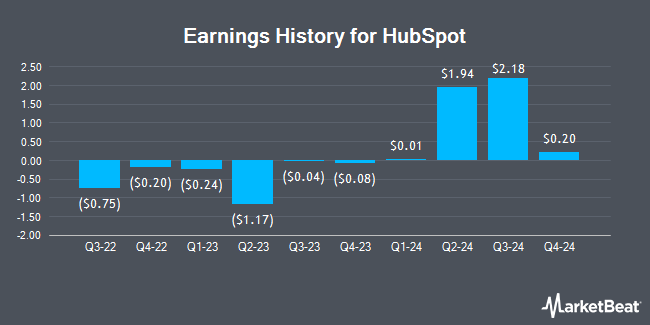
HubSpot (NYSE:HUBS - Get Free Report) released its quarterly earnings data on Wednesday. The software maker reported $3.81 earnings per share (EPS) for the quarter, topping the consensus estimate of $3.27 by $0.54, FiscalAI reports. HubSpot had a return on equity of 8.66% and a net margin of 4.26%. The business had revenue of $947.57 million during the quarter, compared to analysts' expectations of $925.50 million. During the same period in the prior year, the firm posted $2.66 EPS. The business's quarterly revenue was up 17.1% compared to the same quarter last year.
Here are the key takeaways from HubSpot's conference call:
- Q3 revenue grew 17% year over year, while non-GAAP operating margin expanded three points to 23%. Free cash flow was $188 million, or 20% of revenue.
- Customer budget sensitivity and longer buying cycles intensified, particularly among smaller customers and in larger, more complex deals. HubSpot expects Q4 net additions to be below Q3’s 5,300, full-year net new ARR to decline year over year, and 2026 net revenue retention to fall about two points year over year.
- HubSpot reported rising AI engagement: Pro+ customer use of agents reached 20%, monthly agentic actions increased fivefold since the start of the year, and credit consumption rose nearly 2.5 times. Management said trials are growing, but converting them to paid adoption requires more customer support and time.
- The company is piloting simpler seats-and-credits pricing, which has brought higher Pro+ customer volume and two to three times more credit usage in pilot regions, but lower average selling prices. HubSpot is expanding the pilot across EMEA for new customers before deciding on broader rollout.
HubSpot Price Performance
Shares of HUBS traded down $9.01 during midday trading on Wednesday, reaching $217.16. 4,246,198 shares of the stock were exchanged, compared to its average volume of 1,050,416. The business's 50-day moving average price is $233.82 and its 200 day moving average price is $230.93. HubSpot has a twelve month low of $169.63 and a twelve month high of $476.64. The company has a market capitalization of $10.83 billion, a price-to-earnings ratio of 71.12, a PEG ratio of 2.30 and a beta of 1.14.
Insider Activity
In related news, Director Brian Halligan sold 8,500 shares of the company's stock in a transaction dated Tuesday, October 20th. The stock was sold at an average price of $239.57, for a total value of $2,036,345.00. Following the completion of the sale, the director directly owned 59,500 shares of the company's stock, valued at $14,254,415. This represents a 12.50% decrease in their position. The sale was disclosed in a document filed with the Securities & Exchange Commission, which is available through the SEC website. Also, Director Gerald Dischler bought 925 shares of the firm's stock in a transaction that occurred on Monday, August 10th. The stock was purchased at an average cost of $215.93 per share, with a total value of $199,735.25. Following the completion of the transaction, the director owned 1,940 shares in the company, valued at approximately $418,904.20. This trade represents a 91.13% increase in their ownership of the stock. The disclosure for this purchase is available in the SEC filing. Insiders sold a total of 25,500 shares of company stock valued at $5,990,035 over the last three months. Company insiders own 3.70% of the company's stock.
HubSpot News Summary
Here are the key news stories impacting HubSpot this week:
Analysts Set New Price Targets
Several research firms recently weighed in on HUBS. FBN Securities began coverage on HubSpot in a research note on Wednesday, September 23rd. They set a "sector perform" rating and a $230.00 target price for the company. Cantor Fitzgerald upped their price target on HubSpot from $200.00 to $265.00 and gave the company a "neutral" rating in a report on Friday, October 30th. Truist Financial increased their price target on shares of HubSpot from $230.00 to $275.00 and gave the company a "buy" rating in a research note on Monday, September 21st. TD Cowen cut their price objective on shares of HubSpot from $285.00 to $260.00 and set a "hold" rating on the stock in a report on Friday, September 18th. Finally, Citigroup raised their price objective on shares of HubSpot from $210.00 to $287.00 and gave the stock a "neutral" rating in a report on Tuesday, October 27th. Eleven analysts have rated the stock with a Buy rating, twenty-one have given a Hold rating and two have assigned a Sell rating to the company. Based on data from MarketBeat.com, the stock presently has a consensus rating of "Hold" and an average target price of $272.77.
Check Out Our Latest Stock Analysis on HUBS
HubSpot Company Profile
(
Get Free Report)
HubSpot, Inc is a cloud-based customer relationship management (CRM) platform provider serving businesses that want to attract, engage and retain customers. Its platform brings together tools for marketing, sales, customer service, content management, operations and commerce, helping organizations manage customer interactions across the customer lifecycle.
The company's offerings include marketing automation, email marketing, lead generation, website and content management, sales pipeline and engagement tools, customer support and help-desk capabilities, reporting and analytics, and payment and commerce features.
Further Reading
This instant news alert was generated by narrative science technology and financial data from MarketBeat in order to provide readers with the fastest reporting and unbiased coverage. Please send any questions or comments about this story to contact@marketbeat.com.
Before you consider HubSpot, you'll want to hear this.
MarketBeat keeps track of Wall Street's top-rated and best performing research analysts and the stocks they recommend to their clients on a daily basis. MarketBeat has identified the five stocks that top analysts are quietly whispering to their clients to buy now before the broader market catches on... and HubSpot wasn't on the list.
While HubSpot currently has a Hold rating among analysts, top-rated analysts believe these five stocks are better buys.
View The Five Stocks Here
Robotics and automation are rapidly becoming essential infrastructure across healthcare, manufacturing, logistics, and many other industries. "Physical AI" is coming. Learn which seven companies are most positioned to benefit as intelligent robots enter the workforce.
Get This Free Report
Continue following MarketBeat
Add MarketBeat as your preferred source on Google to see our latest stories in your feed.
Like this article? Share it with a colleague.
Link copied to clipboard.
