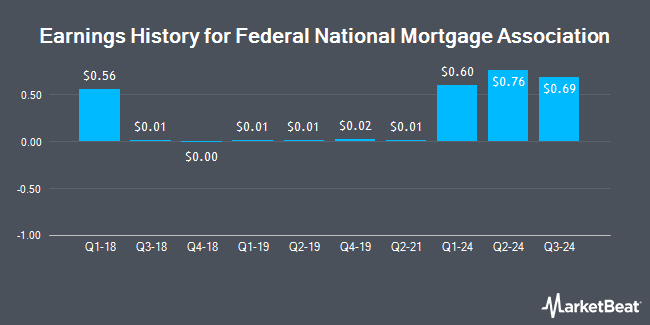
Fannie Mae (OTCMKTS:FNMA - Get Free Report) issued its quarterly earnings data on Wednesday. The financial services provider reported $0.68 earnings per share (EPS) for the quarter, topping analysts' consensus estimates of $0.63 by $0.05, Zacks reports. Fannie Mae had a net margin of 4.53% and a negative return on equity of 65.94%.
Here are the key takeaways from Fannie Mae's conference call:
- Strong quarterly performance: Net income rose 7% quarter-over-quarter and 20% year-over-year to $4.0 billion, while net revenues increased 4% to $7.6 billion. The company said its $4.1 trillion guaranty book and disciplined expense management supported results.
- Net worth surpassed $116 billion, further reducing Fannie Mae’s regulatory capital deficit and strengthening its ability to provide housing-market liquidity. The company supplied $125 billion in second-quarter liquidity, supporting approximately 417,000 households.
- Cost efficiency continued to improve: Non-interest expense declined 5% quarter-over-quarter and 11% year-over-year, while the administrative expense ratio remained below 11%. Management also cited technology and AI investments as potential longer-term productivity drivers.
- Credit costs increased, particularly in multifamily. The total allowance rose $161 million, including a $102 million multifamily increase driven by weaker property valuations, slower net operating income growth, and newly serious delinquencies; management expects multifamily market challenges to produce additional delinquencies.
- Interest-rate risk management affected comprehensive income: Fannie Mae increased longer-term rate exposure, including U.S. Treasury securities, and recorded $150 million in net unrealized losses on its available-for-sale portfolio due to higher long-term rates.
Fannie Mae Stock Performance
Fannie Mae stock traded down $0.11 during mid-day trading on Wednesday, reaching $6.00. The company's stock had a trading volume of 2,086,355 shares, compared to its average volume of 5,750,028. The company has a market capitalization of $6.95 billion, a P/E ratio of 600.60 and a beta of 1.62. The firm's fifty day moving average price is $6.51 and its two-hundred day moving average price is $7.21. Fannie Mae has a 12-month low of $3.60 and a 12-month high of $15.99.
Analyst Ratings Changes
A number of equities research analysts have recently commented on FNMA shares. Keefe, Bruyette & Woods lowered their target price on Fannie Mae from $10.00 to $8.50 and set an "underperform" rating on the stock in a research note on Monday, April 20th. BTIG Research lowered shares of Fannie Mae from a "buy" rating to a "neutral" rating in a research report on Tuesday, June 16th. Mizuho started coverage on shares of Fannie Mae in a report on Monday, May 4th. They set an "outperform" rating and a $10.00 price objective for the company. Zacks Research raised shares of Fannie Mae from a "strong sell" rating to a "hold" rating in a research report on Tuesday, April 21st. Finally, Wedbush cut shares of Fannie Mae from an "outperform" rating to a "neutral" rating and set a $8.00 target price on the stock. in a research note on Friday, May 1st. One equities research analyst has rated the stock with a Strong Buy rating, one has given a Buy rating, four have issued a Hold rating and one has assigned a Sell rating to the company. Based on data from MarketBeat, the company presently has an average rating of "Hold" and a consensus price target of $12.75.
View Our Latest Stock Report on Fannie Mae
About Fannie Mae
(
Get Free Report)
The Federal National Mortgage Association, commonly known as Fannie Mae OTCMKTS: FNMA, is a government-sponsored enterprise established by Congress in 1938 as part of the New Deal to support the U.S. housing market. Headquartered in Washington, DC, Fannie Mae's mission is to promote liquidity, stability and affordability in the mortgage market. The company operates by purchasing residential mortgage loans from financial institutions, pooling them into mortgage-backed securities (MBS), and providing guarantees to investors against borrower default.
In its core business, Fannie Mae works with mortgage lenders across the United States—including banks, credit unions and mortgage finance companies—to ensure a steady flow of capital for homebuyers and homeowners seeking refinancing.
Featured Stories
This instant news alert was generated by narrative science technology and financial data from MarketBeat in order to provide readers with the fastest reporting and unbiased coverage. Please send any questions or comments about this story to contact@marketbeat.com.
Before you consider Fannie Mae, you'll want to hear this.
MarketBeat keeps track of Wall Street's top-rated and best performing research analysts and the stocks they recommend to their clients on a daily basis. MarketBeat has identified the five stocks that top analysts are quietly whispering to their clients to buy now before the broader market catches on... and Fannie Mae wasn't on the list.
While Fannie Mae currently has a Hold rating among analysts, top-rated analysts believe these five stocks are better buys.
View The Five Stocks Here
Looking to profit from the electric vehicle mega-trend? Click the link to see our list of which EV stocks show the most long-term potential.
Get This Free Report
Like this article? Share it with a colleague.
Link copied to clipboard.
