LifeGoal Investments LLC grew its stake in shares of Taiwan Semiconductor Manufacturing Company Ltd. (NYSE:TSM - Free Report) by 976.9% during the third quarter, according to the company in its most recent disclosure with the SEC. The fund owned 5,923 shares of the semiconductor company's stock after buying an additional 5,373 shares during the quarter. Taiwan Semiconductor Manufacturing makes up 0.8% of LifeGoal Investments LLC's holdings, making the stock its 29th biggest holding. LifeGoal Investments LLC's holdings in Taiwan Semiconductor Manufacturing were worth $2,702,000 as of its most recent filing with the SEC.
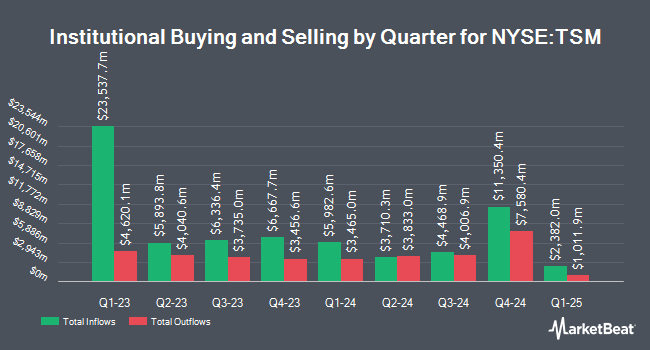
A number of other large investors also recently modified their holdings of TSM. Cooper Financial Group boosted its holdings in shares of Taiwan Semiconductor Manufacturing by 0.3% during the 3rd quarter. Cooper Financial Group now owns 6,313 shares of the semiconductor company's stock valued at $2,880,000 after acquiring an additional 22 shares in the last quarter. Dickmeyer Boyce Financial Management Inc. increased its holdings in Taiwan Semiconductor Manufacturing by 0.7% in the 3rd quarter. Dickmeyer Boyce Financial Management Inc. now owns 3,459 shares of the semiconductor company's stock worth $1,578,000 after purchasing an additional 23 shares in the last quarter. Plan A Wealth LLC raised its position in Taiwan Semiconductor Manufacturing by 0.9% in the third quarter. Plan A Wealth LLC now owns 2,735 shares of the semiconductor company's stock valued at $1,248,000 after purchasing an additional 24 shares during the last quarter. Twin City Private Wealth LLC boosted its stake in shares of Taiwan Semiconductor Manufacturing by 0.3% during the first quarter. Twin City Private Wealth LLC now owns 7,315 shares of the semiconductor company's stock valued at $2,479,000 after purchasing an additional 25 shares in the last quarter. Finally, Graves Light Lenhart Wealth Inc. boosted its stake in shares of Taiwan Semiconductor Manufacturing by 3.4% during the second quarter. Graves Light Lenhart Wealth Inc. now owns 752 shares of the semiconductor company's stock valued at $359,000 after purchasing an additional 25 shares in the last quarter. 16.51% of the stock is currently owned by institutional investors.
Wall Street Analysts Forecast Growth
A number of brokerages recently issued reports on TSM. Barclays raised their price objective on shares of Taiwan Semiconductor Manufacturing from $650.00 to $665.00 and gave the company an "overweight" rating in a report on Tuesday. Zacks Research upgraded shares of Taiwan Semiconductor Manufacturing from a "hold" rating to a "strong-buy" rating in a research report on Thursday, July 16th. Weiss Ratings downgraded shares of Taiwan Semiconductor Manufacturing from a "buy (b-)" rating to a "hold (c+)" rating in a research note on Tuesday. DA Davidson lifted their price target on shares of Taiwan Semiconductor Manufacturing from $450.00 to $500.00 and gave the stock a "buy" rating in a report on Friday, July 17th. Finally, TD Cowen boosted their price objective on shares of Taiwan Semiconductor Manufacturing from $400.00 to $440.00 and gave the stock a "hold" rating in a research note on Friday, July 17th. Three analysts have rated the stock with a Strong Buy rating, eleven have given a Buy rating and two have assigned a Hold rating to the company. Based on data from MarketBeat.com, the stock presently has a consensus rating of "Buy" and a consensus target price of $524.89.
Check Out Our Latest Research Report on TSM
Insider Activity at Taiwan Semiconductor Manufacturing
In other Taiwan Semiconductor Manufacturing news, VP Bor-Zen Tien bought 3,000 shares of the business's stock in a transaction that occurred on Tuesday, July 21st. The shares were bought at an average price of $74.39 per share, for a total transaction of $223,170.00. Following the transaction, the vice president directly owned 4,000 shares in the company, valued at approximately $297,560. This trade represents a 300.00% increase in their ownership of the stock. The purchase was disclosed in a legal filing with the Securities & Exchange Commission, which is available at this hyperlink. Also, VP Shyue-Shyh Lin bought 2,000 shares of the stock in a transaction on Sunday, July 19th. The stock was acquired at an average price of $71.71 per share, with a total value of $143,420.00. Following the completion of the acquisition, the vice president owned 28,269 shares of the company's stock, valued at $2,027,169.99. This represents a 7.61% increase in their position. The disclosure for this purchase is available in the SEC filing. Insiders have bought a total of 16,043 shares of company stock worth $1,185,746 over the last quarter. Company insiders own 1.11% of the company's stock.
Taiwan Semiconductor Manufacturing Price Performance
Taiwan Semiconductor Manufacturing stock opened at $457.94 on Friday. The stock's 50 day moving average is $432.16 and its 200 day moving average is $413.53. The company has a debt-to-equity ratio of 0.14, a current ratio of 2.46 and a quick ratio of 2.25. The firm has a market cap of $2.38 trillion, a P/E ratio of 33.04, a P/E/G ratio of 1.05 and a beta of 1.37. Taiwan Semiconductor Manufacturing Company Ltd. has a one year low of $266.82 and a one year high of $487.47.
Taiwan Semiconductor Manufacturing (NYSE:TSM - Get Free Report) last released its earnings results on Tuesday, June 30th. The semiconductor company reported $4.28 earnings per share for the quarter. The business had revenue of $39.89 billion during the quarter. Taiwan Semiconductor Manufacturing had a net margin of 50.31% and a return on equity of 39.25%. As a group, research analysts expect that Taiwan Semiconductor Manufacturing Company Ltd. will post 16.56 EPS for the current year.
Taiwan Semiconductor Manufacturing Cuts Dividend
The company also recently announced a quarterly dividend, which will be paid on Thursday, January 7th. Investors of record on Thursday, December 10th will be paid a dividend of $1.0854 per share. This is a drop from Taiwan Semiconductor Manufacturing's previous quarterly dividend of $1.1136. This represents a $4.34 dividend on an annualized basis and a yield of 0.9%. The ex-dividend date of this dividend is Thursday, December 10th. Taiwan Semiconductor Manufacturing's payout ratio is 24.75%.
Key Stories Impacting Taiwan Semiconductor Manufacturing
Here are the key news stories impacting Taiwan Semiconductor Manufacturing this week:
- Positive Sentiment: AI demand remains exceptionally strong: TSMC reported record third-quarter revenue of approximately $46.7 billion, up 50% year over year and ahead of forecasts. September sales increased 54.6% year over year to NT$511.86 billion, reinforcing expectations for continued demand for advanced chips used in artificial intelligence and high-performance computing. TSMC's third-quarter revenue surges to record, beating market forecast
- Positive Sentiment: Advanced-packaging capacity is expanding: TSMC agreed to a multiyear, $2 billion arrangement with GlobalFoundries to manufacture U.S.-made silicon interposers for its CoWoS packaging ecosystem. The deal supports future AI and high-performance-computing growth, although volume production is not expected to ramp until the first half of 2028. GlobalFoundries Lands $2 Billion TSMC Deal to Expand US AI Chip Packaging
- Neutral Sentiment: Insider buying provides a modest confidence signal: CEO Che-Chia Wei purchased 144 shares, while numerous other executives and vice presidents also reported small purchases. The transactions suggest confidence, but their limited dollar value makes them unlikely to materially affect TSM’s valuation. Taiwan Semiconductor Manufacturing insider buying
- Negative Sentiment: Excellent results may already be priced in: TSM trades near its 52-week high at a premium earnings multiple. Investors are questioning how much additional upside remains after the stock’s substantial rally, creating a “sell the news” reaction despite the revenue beat. TSMC's $46.7 billion quarter leaves one question for investors
- Negative Sentiment: Macro and Terafab uncertainty added pressure: Higher oil prices and Treasury yields weighed on technology stocks. Separately, Elon Musk indicated Tesla and SpaceX would operate Terafab themselves, with TSMC potentially serving only as a subtenant or supplier, reducing the certainty of a major TSMC contract. Intel CEO discusses Terafab and TSMC
About Taiwan Semiconductor Manufacturing
(
Free Report)
Taiwan Semiconductor Manufacturing Company Limited NYSE: TSM, commonly known as TSMC, is a Taiwan-based semiconductor manufacturer and the world's largest dedicated semiconductor foundry. Founded in 1987 by Morris Chang, the company pioneered the pure-play foundry model, producing chips designed by other companies rather than selling products under its own semiconductor brand.
TSMC manufactures a broad range of integrated circuits, including advanced logic chips used in high-performance computing, smartphones, automotive systems, communications equipment, and consumer electronics.
Further Reading
Want to see what other hedge funds are holding TSM? Visit HoldingsChannel.com to get the latest 13F filings and insider trades for Taiwan Semiconductor Manufacturing Company Ltd. (NYSE:TSM - Free Report).
This instant news alert was generated by narrative science technology and financial data from MarketBeat in order to provide readers with the fastest reporting and unbiased coverage. Please send any questions or comments about this story to contact@marketbeat.com.
Before you consider Taiwan Semiconductor Manufacturing, you'll want to hear this.
MarketBeat keeps track of Wall Street's top-rated and best performing research analysts and the stocks they recommend to their clients on a daily basis. MarketBeat has identified the five stocks that top analysts are quietly whispering to their clients to buy now before the broader market catches on... and Taiwan Semiconductor Manufacturing wasn't on the list.
While Taiwan Semiconductor Manufacturing currently has a Buy rating among analysts, top-rated analysts believe these five stocks are better buys.
View The Five Stocks Here
Robotics and automation are rapidly becoming essential infrastructure across healthcare, manufacturing, logistics, and many other industries. "Physical AI" is coming. Learn which seven companies are most positioned to benefit as intelligent robots enter the workforce.
Get This Free Report
Continue following MarketBeat
Add MarketBeat as your preferred source on Google to see our latest stories in your feed.
