Levi’s NYSE: LEVI Q3 results left something to be desired, with revenue growth below forecast and margins impacted by headwinds. However, tepid as the results may be, the company continues to grow, profit, and drive cash flow, which is what matters.
Levi Strauss & Co. Today
LEVI
Levi Strauss & Co.
$19.02 -0.50 (-2.54%) As of 02:49 PM Eastern
This is a fair market value price provided by Massive. Learn more. - 52-Week Range
- $17.72
▼
$25.70 - Dividend Yield
- 3.37%
- P/E Ratio
- 11.69
- Price Target
- $26.23
The opportunity today is value and yield, with consumer headwinds pushing the stock price to long-term lows and disconnecting it from its value. The value lies in the brand, which is iconic and well-entrenched with a loyal following, and the strategic shift toward direct-to-consumer (DTC) channels. DTC is a much-needed lifeline, reinvigorating the business by enabling higher-margin capture, reducing working capital needs, and driving growth.
Levi’s strengths are reflected in the capital return. The company has been publicly traded for less than a decade but has paid dividends nearly the entire time, pausing only during the COVID-19 peak when uncertainty was highest. Since then, distributions have increased annually, compounded by share buybacks.
The company initiated a $100 million accelerated buyback program in Q3, aiming to reduce the share count by more than 1% within the next few months. Trailing 12-month activity reduced the count by more than 2.2% year over year in Q3. The dividend yields 3.4% with shares trading at rock bottom, less than 50% of the fiscal year earnings forecast, and is expected to increase at a modest double-digit pace over the coming years.
Tariff Refunds Offset Q3 Headwinds, Levi’s Gets Punished
Levi’s posted a decent Q3, despite missing the consensus estimate, with revenue up 4% to just over $1.6 billion. Growth was driven by 5% organic growth, offset by foreign exchange (FX) impacts. Regionally, Asia was strongest, growing by 10% organically, followed by a 5% gain in Europe, a 2% increase in the Americas, and a 9% increase in Beyond Yoga. Within this, the key market, the United States, contracted by 1%.
Margin news was mixed, with reported figures well above consensus estimates but impacted by tariff refunds. The good news is that tariff refunds boosted the bottom line and improved cash flow and the balance sheet, enabling accelerated repurchases, but there is also bad news. The bad news is that core margins contracted, leaving adjusted earnings ex-tariff below expectations. However, the market expected worse, and core profitability metrics underpin dividend health.
Guidance is also a headwind, but the market is misinterpreting the results. Levi's reduced its forecast for reported revenue, citing FX headwinds, but improved the outlook for organic growth by 50 basis points. In addition, the company raised its full-year earnings forecast to include the tariff threat, but not enough to fully account for it, sapping market appetite. What the market gets wrong is that Q3 weakness and its impact on guidance aren't a sign of brand decay, but rather a self-inflicted wound already corrected.
CEO Michelle Gass says Q3 results were impacted by a fashion misstep, as the company leaned into baggy back-to-school clothing while the consumer turned to different styles. Turnaround efforts are already showing in the DTC channel, which improved significantly in early Q4.
Levi’s Strengthens Balance Sheet in Q3
Levi’s cash flow and tariff refund did more than enable its accelerated share repurchase plan; the company also improved its balance sheet. Highlights include higher assets, stable debt, lower liabilities, and stronger equity. Shareholder equity increased by 6% year to date, compounding the leverage gained by share count reduction, and is expected to continue growing. Headwinds or not, Levi’s is on track to sustain mid-single-digit revenue growth over the next three to five years and to accelerate earnings growth with operational quality and share buybacks.
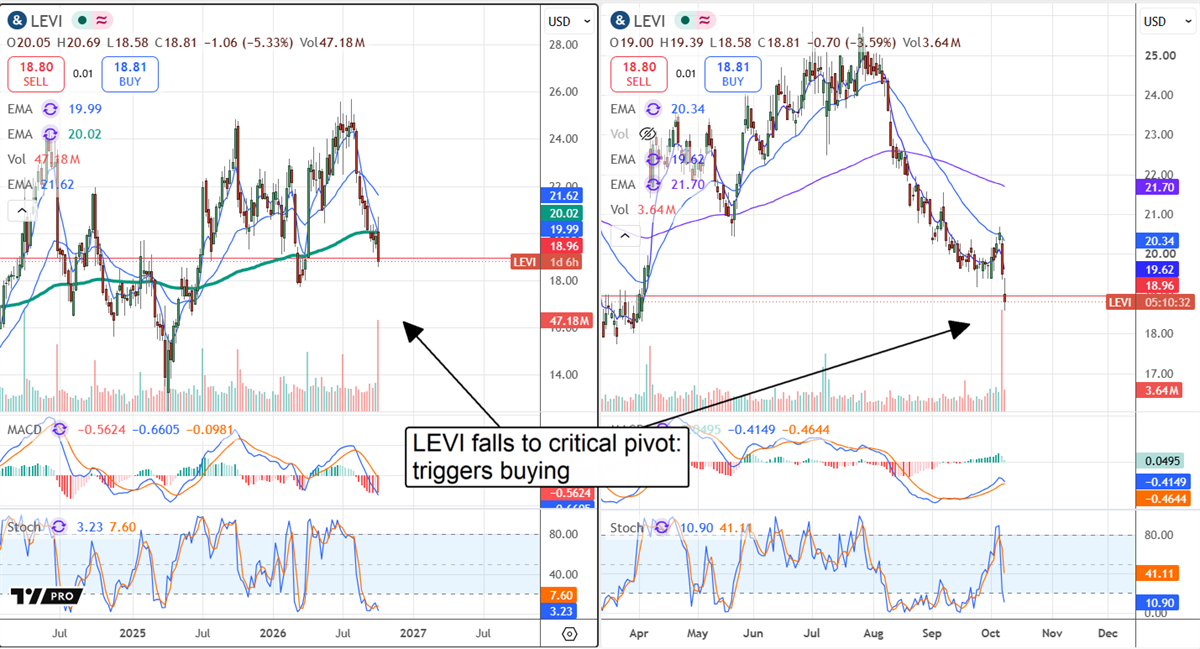
Chart price action following the release was not immediately bullish, with shares falling more than 3% afterwards, but it highlights the value opportunity. The share price plunge triggered buying, with support evident near a critical inflection point. LEVI has traded around $19 since its IPO and may not fall far below it. Analysts rate the stock a consensus Moderate Buy, set a price floor at $20 (their lowest target), and forecast about 40% upside over the next 12 months. Additionally, analyst revisions after the release have largely aligned with the trend, reaffirming bullish ratings and above-consensus price targets.
Levi’s biggest risks are its geographic concentration, primarily in the United States, which represents over half its revenue, and its turnaround efforts. Turnaround efforts include a warehouse and distribution overhaul that can easily create quarterly friction and show up in results. This sets the stage for volatility, which is not uncommon in this stock. It has a 1.3 beta, suggesting it is more likely to fall on macroeconomic news than the average stock.
Before you consider Levi Strauss & Co., you'll want to hear this.
MarketBeat keeps track of Wall Street's top-rated and best performing research analysts and the stocks they recommend to their clients on a daily basis. MarketBeat has identified the five stocks that top analysts are quietly whispering to their clients to buy now before the broader market catches on... and Levi Strauss & Co. wasn't on the list.
While Levi Strauss & Co. currently has a Moderate Buy rating among analysts, top-rated analysts believe these five stocks are better buys.
View The Five Stocks Here
Looking to profit from the electric vehicle mega-trend? Click the link to see our list of which EV stocks show the most long-term potential.
Get This Free Report
Continue following MarketBeat
Add MarketBeat as your preferred source on Google to see our latest stories in your feed.
