Choreo LLC decreased its holdings in shares of Microsoft Corporation (NASDAQ:MSFT - Free Report) by 1.3% in the 2nd quarter, according to its most recent disclosure with the Securities and Exchange Commission. The fund owned 306,090 shares of the software giant's stock after selling 4,115 shares during the quarter. Microsoft makes up about 1.2% of Choreo LLC's investment portfolio, making the stock its 11th biggest holding. Choreo LLC's holdings in Microsoft were worth $114,145,000 at the end of the most recent quarter.
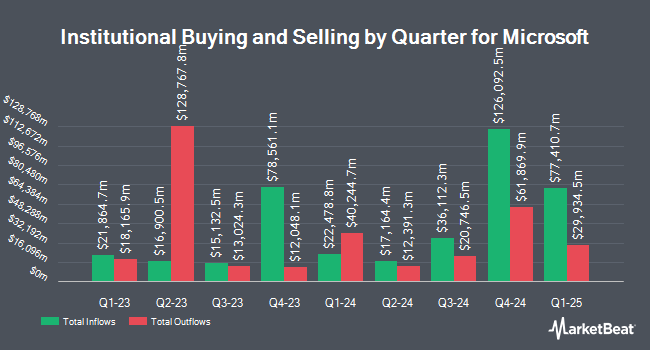
Several other hedge funds and other institutional investors have also recently added to or reduced their stakes in the business. Auto Owners Insurance Co grew its holdings in shares of Microsoft by 56,160.8% in the 4th quarter. Auto Owners Insurance Co now owns 60,116,384 shares of the software giant's stock valued at $29,073,486,000 after acquiring an additional 60,009,531 shares in the last quarter. Corient Private Wealth LLC raised its holdings in Microsoft by 234.5% during the fourth quarter. Corient Private Wealth LLC now owns 17,822,280 shares of the software giant's stock worth $8,619,211,000 after acquiring an additional 12,493,786 shares in the last quarter. Amundi boosted its position in Microsoft by 30.8% during the first quarter. Amundi now owns 41,675,076 shares of the software giant's stock valued at $15,426,862,000 after purchasing an additional 9,814,598 shares during the last quarter. Arrowstreet Capital Limited Partnership boosted its position in Microsoft by 64.3% during the first quarter. Arrowstreet Capital Limited Partnership now owns 24,264,779 shares of the software giant's stock valued at $8,982,083,000 after purchasing an additional 9,493,778 shares during the last quarter. Finally, Diamant Asset Management Inc. grew its stake in Microsoft by 38,442.1% in the first quarter. Diamant Asset Management Inc. now owns 6,810,388 shares of the software giant's stock valued at $2,521,001,000 after purchasing an additional 6,792,718 shares in the last quarter. 71.13% of the stock is currently owned by institutional investors and hedge funds.
Analysts Set New Price Targets
Several research firms have weighed in on MSFT. Tigress Financial boosted their price target on Microsoft from $680.00 to $690.00 and gave the stock a "buy" rating in a research report on Wednesday, August 5th. Argus decreased their target price on shares of Microsoft from $620.00 to $510.00 and set a "buy" rating for the company in a research note on Friday, July 10th. Citigroup restated a "market outperform" rating on shares of Microsoft in a report on Monday, September 21st. Jefferies Financial Group reaffirmed a "buy" rating on shares of Microsoft in a research report on Monday, September 21st. Finally, The Goldman Sachs Group reiterated a "buy" rating and issued a $640.00 price target on shares of Microsoft in a research note on Thursday, July 30th. Forty-three research analysts have rated the stock with a Buy rating, four have issued a Hold rating and one has issued a Sell rating to the company's stock. Based on data from MarketBeat.com, the company has a consensus rating of "Moderate Buy" and a consensus price target of $569.29.
Get Our Latest Stock Report on MSFT
More Microsoft News
Here are the key news stories impacting Microsoft this week:
- Positive Sentiment: Copilot remains the primary catalyst. Jefferies reiterated its bullish view, citing Microsoft’s redesigned Copilot, new usage-based revenue opportunities and potential for paid Copilot seats to double over the next year. Enterprise AI adoption, however, is expected to build gradually. Jefferies Doubles Down on Microsoft's Copilot Opportunity
- Positive Sentiment: Analysts see further upside. JPMorgan maintained a Buy rating with a $625 target, while RBC reportedly set a $640 target, supported by Azure growth, Copilot adoption and Microsoft’s expanding AI infrastructure. The stock is also on track for its strongest quarterly performance in decades, reflecting a market “flight to quality.” Microsoft Stock Surges Past $500
- Positive Sentiment: Azure and enterprise demand support the long-term case. Recent commentary points to Azure growth above 40%, rapidly increasing Copilot seats and a commercial backlog approaching $700 billion. Microsoft is also bringing OpenAI’s autonomous “Dots” AI workers into its enterprise security ecosystem, potentially expanding cloud and software consumption. Microsoft Brings OpenAI's Autonomous Dots AI Workers Into the Enterprise
- Neutral Sentiment: AI policy developments remain mixed. President Trump reaffirmed support for data centers and announced voluntary AI controls with Microsoft and other technology companies, potentially easing regulatory concerns while leaving uncertainty over whether voluntary safeguards will be sufficient. At A.I. Event, Trump Asks Meta, OpenAI and Microsoft to Make Safety Decisions Themselves
- Negative Sentiment: Privacy and competitive risks are weighing on sentiment. Reports that humans may review some Copilot prompts have raised data-privacy concerns. OpenAI is also launching workplace features that increasingly resemble Microsoft Office, intensifying the risk that a key partner could compete directly with Microsoft’s software franchise. OpenAI Takes on Microsoft With a ChatGPT Office Suite
- Negative Sentiment: Investors are questioning the cost and valuation of the AI buildout. Microsoft is reducing staff while committing heavily to data centers, and some analysts argue that cash-flow benefits may take longer to materialize. After its rally, elevated expectations leave less room for execution setbacks.
Microsoft Stock Down 0.1%
MSFT stock opened at $508.96 on Wednesday. Microsoft Corporation has a 1-year low of $349.20 and a 1-year high of $553.72. The business's 50 day simple moving average is $482.29 and its 200 day simple moving average is $427.75. The company has a current ratio of 1.23, a quick ratio of 1.22 and a debt-to-equity ratio of 0.07. The firm has a market capitalization of $3.78 trillion, a PE ratio of 28.34, a PEG ratio of 1.64 and a beta of 1.11.
Microsoft (NASDAQ:MSFT - Get Free Report) last announced its quarterly earnings results on Wednesday, July 29th. The software giant reported $4.74 earnings per share (EPS) for the quarter, beating the consensus estimate of $4.24 by $0.50. Microsoft had a return on equity of 31.98% and a net margin of 40.31%.The business had revenue of $90.01 billion during the quarter, compared to the consensus estimate of $87.62 billion. During the same quarter last year, the firm posted $3.65 EPS. The company's quarterly revenue was up 17.7% on a year-over-year basis. As a group, research analysts anticipate that Microsoft Corporation will post 19.62 EPS for the current year.
Microsoft Increases Dividend
The business also recently announced a quarterly dividend, which will be paid on Thursday, December 10th. Stockholders of record on Thursday, November 19th will be paid a dividend of $0.98 per share. The ex-dividend date is Thursday, November 19th. This represents a $3.92 dividend on an annualized basis and a dividend yield of 0.8%. This is a boost from Microsoft's previous quarterly dividend of $0.91. Microsoft's dividend payout ratio is 20.27%.
Insider Activity at Microsoft
In related news, CEO Satya Nadella sold 86,525 shares of Microsoft stock in a transaction dated Tuesday, September 1st. The shares were sold at an average price of $501.46, for a total transaction of $43,388,826.50. Following the completion of the sale, the chief executive officer owned 486,763 shares of the company's stock, valued at approximately $244,092,173.98. The trade was a 15.09% decrease in their position. The sale was disclosed in a filing with the SEC, which is accessible through the SEC website. The transaction was executed under a pre-arranged Rule 10b5-1 trading plan. Also, EVP Takeshi Numoto sold 4,810 shares of the company's stock in a transaction dated Tuesday, August 4th. The shares were sold at an average price of $496.48, for a total transaction of $2,388,068.80. Following the completion of the transaction, the executive vice president owned 42,677 shares in the company, valued at approximately $21,188,276.96. This trade represents a 10.13% decrease in their position. The disclosure for this sale is available in the SEC filing. Over the last 90 days, insiders sold 143,009 shares of company stock worth $71,420,699. 0.03% of the stock is currently owned by corporate insiders.
Microsoft Profile
(
Free Report)
Microsoft Corporation is a global technology company that develops software, cloud services, devices, gaming products and business solutions. Founded in 1975 by Bill Gates and Paul Allen, the company is best known for the Windows operating system and Microsoft Office productivity software. Microsoft is headquartered in Redmond, Washington, and serves consumers, businesses, governments and educational institutions worldwide.
Microsoft's productivity and business offerings include Microsoft 365 applications such as Word, Excel, PowerPoint and Outlook, along with collaboration tools including Teams.
Featured Articles
Want to see what other hedge funds are holding MSFT? Visit HoldingsChannel.com to get the latest 13F filings and insider trades for Microsoft Corporation (NASDAQ:MSFT - Free Report).
This instant news alert was generated by narrative science technology and financial data from MarketBeat in order to provide readers with the fastest reporting and unbiased coverage. Please send any questions or comments about this story to contact@marketbeat.com.
Before you consider Microsoft, you'll want to hear this.
MarketBeat keeps track of Wall Street's top-rated and best performing research analysts and the stocks they recommend to their clients on a daily basis. MarketBeat has identified the five stocks that top analysts are quietly whispering to their clients to buy now before the broader market catches on... and Microsoft wasn't on the list.
While Microsoft currently has a Moderate Buy rating among analysts, top-rated analysts believe these five stocks are better buys.
View The Five Stocks Here
The AI boom extends far beyond the biggest tech names. Discover 10 companies supplying the memory, storage, networking, semiconductor manufacturing, and power infrastructure that make AI possible. Learn where the next wave of AI investment opportunities may emerge—and the key risks investors should watch as the global AI buildout accelerates.
Get This Free Report
Continue following MarketBeat
Add MarketBeat as your preferred source on Google to see our latest stories in your feed.
