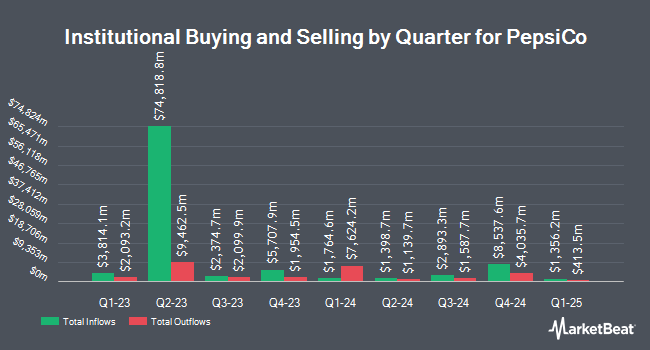
Global Retirement Partners LLC boosted its holdings in PepsiCo, Inc. (NASDAQ:PEP - Free Report) by 48.9% in the fourth quarter, according to the company in its most recent Form 13F filing with the SEC. The institutional investor owned 29,451 shares of the company's stock after purchasing an additional 9,671 shares during the quarter. Global Retirement Partners LLC's holdings in PepsiCo were worth $4,227,000 at the end of the most recent quarter.
A number of other hedge funds have also added to or reduced their stakes in PEP. Blackston Financial Advisory Group LLC bought a new stake in shares of PepsiCo during the fourth quarter valued at approximately $203,000. KDT Advisors LLC increased its holdings in shares of PepsiCo by 63.5% during the fourth quarter. KDT Advisors LLC now owns 2,807 shares of the company's stock valued at $403,000 after acquiring an additional 1,090 shares in the last quarter. Twin Capital Management Inc. increased its holdings in shares of PepsiCo by 10.3% during the fourth quarter. Twin Capital Management Inc. now owns 19,802 shares of the company's stock valued at $2,842,000 after acquiring an additional 1,850 shares in the last quarter. Mach 1 Financial Group LLC increased its holdings in shares of PepsiCo by 83.8% during the fourth quarter. Mach 1 Financial Group LLC now owns 2,726 shares of the company's stock valued at $391,000 after acquiring an additional 1,243 shares in the last quarter. Finally, Fortis Group Advisors LLC increased its holdings in shares of PepsiCo by 1.0% during the fourth quarter. Fortis Group Advisors LLC now owns 10,402 shares of the company's stock valued at $1,598,000 after acquiring an additional 101 shares in the last quarter. 73.07% of the stock is currently owned by institutional investors.
Trending Headlines about PepsiCo
Here are the key news stories impacting PepsiCo this week:
- Positive Sentiment: PepsiCo and Varun Beverages extended their exclusive bottling agreement in India through 2049, giving PepsiCo greater distribution stability and more flexibility to grow in a key international market.
- Positive Sentiment: PepsiCo announced new growth initiatives in Asia-Pacific and a regenerated agriculture partnership with LDC, both of which support the company’s sustainability efforts and supply-chain resilience.
- Positive Sentiment: PepsiCo continues to push product innovation, including a new functional ready-to-drink tea, which may help offset slowing demand in some core snack categories.
- Neutral Sentiment: PepsiCo India plans to invest about Rs 5,700 crore by 2030 to expand capacity, a sign of confidence in demand but also a longer-term capital commitment.
- Neutral Sentiment: Analyst commentary and recent features suggest PepsiCo still has a credible growth story thanks to pricing power, distribution scale, and expansion into better-for-you products, but these articles do not point to a near-term earnings surprise.
- Negative Sentiment: Reports that PepsiCo is raising prices on smaller chip bags highlight rising costs in the business and could increase consumer pushback, potentially pressuring volume growth.
- Negative Sentiment: Cost inflation remains a concern, and the need for selective price increases suggests PepsiCo is still facing margin pressure in its U.S. snack business.
PepsiCo Stock Down 0.3%
Shares of NASDAQ:PEP opened at $148.85 on Friday. The stock has a market cap of $203.44 billion, a price-to-earnings ratio of 23.37, a PEG ratio of 2.71 and a beta of 0.38. The company has a quick ratio of 0.72, a current ratio of 0.90 and a debt-to-equity ratio of 1.98. PepsiCo, Inc. has a 12-month low of $127.60 and a 12-month high of $171.48. The business's 50 day moving average is $154.36 and its 200 day moving average is $152.47.
PepsiCo (NASDAQ:PEP - Get Free Report) last posted its quarterly earnings data on Wednesday, April 15th. The company reported $1.61 earnings per share for the quarter, topping the consensus estimate of $1.55 by $0.06. PepsiCo had a return on equity of 56.61% and a net margin of 9.15%.The business had revenue of $19.44 billion for the quarter, compared to analysts' expectations of $18.89 billion. During the same quarter in the previous year, the firm earned $1.48 earnings per share. The business's revenue was up 8.5% on a year-over-year basis. On average, sell-side analysts forecast that PepsiCo, Inc. will post 8.63 earnings per share for the current fiscal year.
PepsiCo declared that its board has authorized a stock buyback program on Tuesday, February 3rd that allows the company to repurchase $10.00 billion in outstanding shares. This repurchase authorization allows the company to buy up to 4.7% of its shares through open market purchases. Shares repurchase programs are typically an indication that the company's management believes its shares are undervalued.
PepsiCo Increases Dividend
The firm also recently disclosed a quarterly dividend, which will be paid on Tuesday, June 30th. Shareholders of record on Friday, June 5th will be given a $1.48 dividend. This is an increase from PepsiCo's previous quarterly dividend of $1.42. This represents a $5.92 annualized dividend and a yield of 4.0%. The ex-dividend date of this dividend is Friday, June 5th. PepsiCo's payout ratio is presently 89.32%.
Analyst Upgrades and Downgrades
Several equities research analysts have recently commented on the company. TD Cowen boosted their price objective on PepsiCo from $162.00 to $165.00 and gave the company a "hold" rating in a report on Friday, February 20th. BNP Paribas Exane lifted their target price on PepsiCo from $191.00 to $195.00 and gave the company an "outperform" rating in a research report on Friday, April 17th. Wells Fargo & Company cut their target price on PepsiCo from $165.00 to $160.00 and set an "equal weight" rating on the stock in a research report on Monday. JPMorgan Chase & Co. lifted their target price on PepsiCo from $172.00 to $178.00 and gave the company an "overweight" rating in a research report on Friday, April 17th. Finally, UBS Group cut their target price on PepsiCo from $190.00 to $186.00 and set a "buy" rating on the stock in a research report on Tuesday, April 7th. Eight investment analysts have rated the stock with a Buy rating, ten have issued a Hold rating and one has given a Sell rating to the stock. According to data from MarketBeat, PepsiCo currently has a consensus rating of "Hold" and an average target price of $170.11.
Get Our Latest Stock Analysis on PEP
About PepsiCo
(
Free Report)
PepsiCo, Inc NASDAQ: PEP is a multinational food and beverage company headquartered in Purchase, New York. The company develops, manufactures, markets and sells a broad portfolio of branded food and beverage products, including carbonated and noncarbonated soft drinks, bottled water, sports drinks, juices, ready-to-drink teas and coffees, salty snacks, cereals, and other convenient foods. Its leading consumer brands include Pepsi, Mountain Dew, Gatorade, Tropicana, Quaker, Lay's, Doritos and Cheetos, among others.
Formed through the 1965 merger of Pepsi-Cola and Frito-Lay, PepsiCo has grown into a global business with integrated manufacturing, distribution and marketing operations.
Featured Stories
This instant news alert was generated by narrative science technology and financial data from MarketBeat in order to provide readers with the fastest reporting and unbiased coverage. Please send any questions or comments about this story to contact@marketbeat.com.
Before you consider PepsiCo, you'll want to hear this.
MarketBeat keeps track of Wall Street's top-rated and best performing research analysts and the stocks they recommend to their clients on a daily basis. MarketBeat has identified the five stocks that top analysts are quietly whispering to their clients to buy now before the broader market catches on... and PepsiCo wasn't on the list.
While PepsiCo currently has a Hold rating among analysts, top-rated analysts believe these five stocks are better buys.
View The Five Stocks Here
Discover the 10 Best High-Yield Dividend Stocks for 2026 and secure reliable income in uncertain markets. Download the report now to identify top dividend payers and avoid common yield traps.
Get This Free Report
Like this article? Share it with a colleague.
Link copied to clipboard.
