Greenland Capital Management LP lessened its stake in shares of Microsoft Corporation (NASDAQ:MSFT - Free Report) by 36.9% in the 2nd quarter, according to the company in its most recent Form 13F filing with the Securities and Exchange Commission (SEC). The firm owned 2,225 shares of the software giant's stock after selling 1,300 shares during the quarter. Greenland Capital Management LP's holdings in Microsoft were worth $830,000 as of its most recent SEC filing.
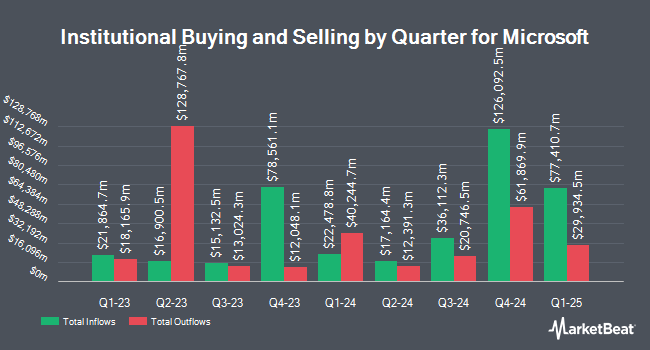
A number of other institutional investors have also made changes to their positions in MSFT. Washington Trust Advisors Inc. grew its stake in shares of Microsoft by 1.0% during the second quarter. Washington Trust Advisors Inc. now owns 51,895 shares of the software giant's stock worth $19,358,000 after purchasing an additional 526 shares in the last quarter. Ameritas Advisory Services LLC increased its holdings in Microsoft by 40.9% in the second quarter. Ameritas Advisory Services LLC now owns 99,483 shares of the software giant's stock valued at $37,109,000 after buying an additional 28,872 shares during the last quarter. Guardian Wealth Advisors LLC NC raised its stake in Microsoft by 0.3% in the second quarter. Guardian Wealth Advisors LLC NC now owns 41,054 shares of the software giant's stock valued at $15,314,000 after buying an additional 110 shares in the last quarter. Trevian Wealth Management LLC raised its stake in Microsoft by 1.6% in the second quarter. Trevian Wealth Management LLC now owns 8,424 shares of the software giant's stock valued at $3,142,000 after buying an additional 134 shares in the last quarter. Finally, Henrickson Nauta Wealth Advisors Inc. lifted its holdings in Microsoft by 37.3% during the 2nd quarter. Henrickson Nauta Wealth Advisors Inc. now owns 5,349 shares of the software giant's stock worth $1,995,000 after buying an additional 1,452 shares during the last quarter. 71.13% of the stock is currently owned by institutional investors and hedge funds.
Microsoft Trading Down 1.6%
NASDAQ:MSFT opened at $521.91 on Friday. The stock's 50 day moving average price is $512.91 and its 200 day moving average price is $438.43. The company has a market capitalization of $3.88 trillion, a PE ratio of 27.24, a P/E/G ratio of 1.64 and a beta of 1.10. The company has a quick ratio of 1.22, a current ratio of 1.22 and a debt-to-equity ratio of 0.07. Microsoft Corporation has a 52-week low of $349.20 and a 52-week high of $551.15.
Microsoft (NASDAQ:MSFT - Get Free Report) last issued its quarterly earnings data on Wednesday, October 28th. The software giant reported $4.89 earnings per share for the quarter, beating analysts' consensus estimates of $4.72 by $0.17. The company had revenue of $92.28 billion during the quarter, compared to analysts' expectations of $90.62 billion. Microsoft had a return on equity of 31.28% and a net margin of 41.17%. The firm's revenue for the quarter was up 18.8% on a year-over-year basis. During the same quarter in the previous year, the business earned $4.13 earnings per share. On average, research analysts anticipate that Microsoft Corporation will post 19.79 EPS for the current year.
Microsoft Increases Dividend
The firm also recently announced a quarterly dividend, which will be paid on Thursday, December 10th. Stockholders of record on Thursday, November 19th will be issued a $0.98 dividend. This represents a $3.92 dividend on an annualized basis and a dividend yield of 0.8%. The ex-dividend date of this dividend is Thursday, November 19th. This is a positive change from Microsoft's previous quarterly dividend of $0.91. Microsoft's dividend payout ratio is presently 19.00%.
Insider Buying and Selling at Microsoft
In related news, CEO Judson Althoff sold 10,000 shares of the company's stock in a transaction on Wednesday, August 5th. The shares were sold at an average price of $487.89, for a total value of $4,878,900.00. Following the completion of the sale, the chief executive officer owned 100,447 shares in the company, valued at $49,007,086.83. This represents a 9.05% decrease in their position. The transaction was disclosed in a document filed with the Securities & Exchange Commission, which is available through the SEC website. Also, CEO Satya Nadella sold 86,525 shares of the stock in a transaction on Tuesday, September 1st. The stock was sold at an average price of $501.46, for a total transaction of $43,388,826.50. Following the sale, the chief executive officer owned 486,763 shares of the company's stock, valued at approximately $244,092,173.98. This represents a 15.09% decrease in their position. The disclosure for this sale is available in the SEC filing. The transaction was executed under a pre-arranged Rule 10b5-1 trading plan. Over the last quarter, insiders sold 150,314 shares of company stock valued at $75,404,992. Insiders own 0.03% of the company's stock.
Analyst Ratings Changes
MSFT has been the topic of a number of recent analyst reports. Deutsche Bank Aktiengesellschaft reiterated a "buy" rating and issued a $600.00 price objective on shares of Microsoft in a report on Monday, October 12th. Needham & Company LLC initiated coverage on Microsoft in a research note on Wednesday, September 23rd. They set a "buy" rating for the company. Stifel Nicolaus upped their price target on Microsoft from $575.00 to $650.00 and gave the company a "buy" rating in a report on Thursday. Wells Fargo & Company increased their price target on shares of Microsoft from $725.00 to $750.00 and gave the company an "overweight" rating in a research note on Thursday. Finally, Guggenheim raised their price objective on shares of Microsoft from $586.00 to $595.00 and gave the stock a "buy" rating in a report on Thursday. One equities research analyst has rated the stock with a Strong Buy rating, forty-five have given a Buy rating and four have issued a Hold rating to the company. Based on data from MarketBeat, the company presently has an average rating of "Moderate Buy" and a consensus target price of $609.54.
Get Our Latest Stock Analysis on Microsoft
Microsoft News Summary
Here are the key news stories impacting Microsoft this week:
- Positive Sentiment: Microsoft delivered a strong fiscal first quarter, with revenue of $92.28 billion and EPS of $4.89, both above expectations. Azure revenue surged 48%, while Microsoft Cloud revenue rose 30%, reinforcing the view that AI demand is translating into meaningful cloud growth. Microsoft Earnings Expose a Growing Divide in the Magnificent 7 AI Trade
- Positive Sentiment: Management issued second-quarter revenue guidance of $96.0 billion to $97.1 billion, above the $95.7 billion consensus estimate. Analysts responded with multiple price-target increases, including targets of $630 to $680, and Wolfe Research upgraded the stock to “strong buy.”
- Positive Sentiment: Microsoft’s strong cash generation and diversified enterprise business continue to distinguish it from rivals facing sharper cash-flow concerns. Analysts argue that Azure, Copilot, AI agents and Microsoft’s security products provide several ways to monetize AI. The expanded Estée Lauder partnership, which will extend Copilot to more than 14,000 employees, offers another example of enterprise adoption. Estée Lauder and Microsoft Strategic Partnership
- Neutral Sentiment: Microsoft’s voluntary exit offer for approximately 60,000 employees may improve productivity and redirect resources toward AI, but it also highlights a significant restructuring as the company shifts toward more automated, equipment-intensive operations. Microsoft’s 60,000-Person Buyout Offer
- Negative Sentiment: Investors remain concerned about Microsoft’s capital intensity. The company plans roughly $170 billion of AI-related capital spending, while also arranging a $25 billion bond sale—the first major U.S. debt offering since 2017—to fund its buildout. Rising borrowing costs increase scrutiny of future AI returns. Microsoft Plans to Raise $25 Billion in Debt
- Negative Sentiment: Quarterly capital spending was below analyst expectations because third-party AI-chip and data-center capacity was delayed, pushing some capacity into the first half of 2027. While management described this as a supply issue rather than weaker demand, the miss hurt AI infrastructure suppliers and revived concerns about the pace of expansion.
- Negative Sentiment: Microsoft’s cloud gross margin is reportedly narrowing as chip, power, data-center and labor costs rise. With the Nasdaq 100 down sharply during October amid fears of an AI spending bubble, investors are demanding proof that Microsoft’s large backlog will convert into profitable cash flow—not merely future revenue.
Microsoft Company Profile
(
Free Report)
Microsoft Corporation NASDAQ: MSFT is a global technology company that develops software, cloud services, devices and digital platforms. Its products and services are used by consumers, businesses, governments and educational institutions worldwide.
The company's principal offerings include the Windows operating system; Microsoft 365 productivity applications such as Word, Excel, Teams and Outlook; Azure cloud computing and infrastructure services; Dynamics business applications; and enterprise security solutions.
Featured Stories
This instant news alert was generated by narrative science technology and financial data from MarketBeat in order to provide readers with the fastest reporting and unbiased coverage. Please send any questions or comments about this story to contact@marketbeat.com.
Before you consider Microsoft, you'll want to hear this.
MarketBeat keeps track of Wall Street's top-rated and best performing research analysts and the stocks they recommend to their clients on a daily basis. MarketBeat has identified the five stocks that top analysts are quietly whispering to their clients to buy now before the broader market catches on... and Microsoft wasn't on the list.
While Microsoft currently has a Moderate Buy rating among analysts, top-rated analysts believe these five stocks are better buys.
View The Five Stocks Here
The space race is growing fast, and you don’t have to have gotten in early on SpaceX to profit. This report shows seven space stocks you can buy today that may grow as rockets, satellites, defense, space internet, and new space technology become more important.
Get This Free Report
Continue following MarketBeat
Add MarketBeat as your preferred source on Google to see our latest stories in your feed.
