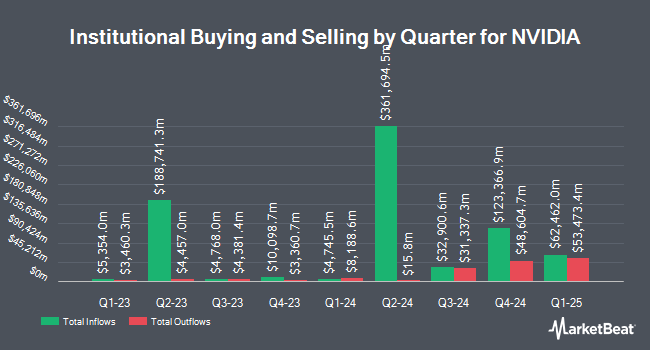
Center For Asset Management LLC lowered its holdings in NVIDIA Corporation (NASDAQ:NVDA - Free Report) by 28.6% in the fourth quarter, according to its most recent disclosure with the SEC. The institutional investor owned 21,456 shares of the computer hardware maker's stock after selling 8,588 shares during the period. NVIDIA makes up 2.1% of Center For Asset Management LLC's holdings, making the stock its 12th biggest holding. Center For Asset Management LLC's holdings in NVIDIA were worth $4,002,000 as of its most recent SEC filing.
A number of other institutional investors have also recently made changes to their positions in the business. State Street Corp grew its holdings in shares of NVIDIA by 1.0% in the second quarter. State Street Corp now owns 978,208,862 shares of the computer hardware maker's stock valued at $154,556,803,000 after purchasing an additional 9,554,857 shares in the last quarter. Geode Capital Management LLC grew its holdings in shares of NVIDIA by 1.5% in the second quarter. Geode Capital Management LLC now owns 579,213,497 shares of the computer hardware maker's stock valued at $91,150,170,000 after purchasing an additional 8,521,936 shares in the last quarter. Norges Bank acquired a new position in shares of NVIDIA in the second quarter valued at approximately $51,386,863,000. Legal & General Group Plc grew its holdings in shares of NVIDIA by 1.5% in the third quarter. Legal & General Group Plc now owns 181,203,035 shares of the computer hardware maker's stock valued at $33,808,862,000 after purchasing an additional 2,609,560 shares in the last quarter. Finally, Capital Research Global Investors increased its holdings in NVIDIA by 16.1% during the 3rd quarter. Capital Research Global Investors now owns 165,377,852 shares of the computer hardware maker's stock worth $30,855,564,000 after purchasing an additional 22,896,705 shares during the period. Institutional investors and hedge funds own 65.27% of the company's stock.
Key Headlines Impacting NVIDIA
Here are the key news stories impacting NVIDIA this week:
- Positive Sentiment: Memory suppliers report blowout AI-driven profits, reinforcing strong GPU demand that supports Nvidia's data-center TAM — SK Hynix posted a five-fold jump in Q1 operating profit and said AI-driven memory demand is expanding across DRAM and NAND. Nvidia supplier SK Hynix Q1 profit rises more than five-fold
- Positive Sentiment: Nvidia is broadening its addressable market beyond GPUs — the company unveiled "Ising," open-source AI models aimed at quantum processor calibration and error correction, signaling new revenue streams (quantum + AI). NVDA Sets Sight on $11B Quantum Opportunity With Ising
- Positive Sentiment: CEO Jensen Huang doubled down on Nvidia's superior "performance per TCO" and disciplined pricing/sales practices — comments that reinforce competitive moat and pricing power in investor eyes. Jensen Huang Says ‘Not One Company’ Can Match NVIDIA’s Performance Per Dollar
- Positive Sentiment: Customer deals highlight continued demand for Nvidia GPUs — a disclosed multi-year enterprise contract to deploy thousands of B300 GPUs (Axe Compute) underscores commercial pull for Nvidia hardware. Axe Compute jumps after unveiling $260M NVIDIA B300 GPU deal
- Neutral Sentiment: Analyst and market notes highlight Nvidia's strong growth and favorable valuation arguments, but also note the stock has paused after a recent rally — mixed signals for short-term traders. Nvidia: Trading At A Rare Discount
- Negative Sentiment: Big-cloud rivals are pushing custom AI silicon — Google announced TPU 8t (training) and TPU 8i (inference), an explicit attempt to reduce hyperscaler spend on GPUs and compete with Nvidia in infrastructure. Investors see this as a medium-term competitive risk. Google Cloud launches two new AI chips to compete with Nvidia
- Negative Sentiment: Geopolitical/market access limits remain a headwind — US Commerce official said Nvidia's H200 chips have not yet been sold to Chinese firms, capping revenue upside from that market for now. Nvidia has not yet sold its H200 AI chips to China
- Negative Sentiment: Management warns manufacturing bottlenecks may persist 2–3 years, a constraint that could limit supply growth and cap near-term revenue upside despite strong demand. Manufacturing bottlenecks are a 2–3 year problem
Insiders Place Their Bets
In other news, EVP Ajay K. Puri sold 300,000 shares of the company's stock in a transaction on Wednesday, March 18th. The shares were sold at an average price of $182.25, for a total value of $54,675,000.00. Following the completion of the transaction, the executive vice president owned 3,018,547 shares in the company, valued at approximately $550,130,190.75. This represents a 9.04% decrease in their position. The sale was disclosed in a filing with the SEC, which is accessible through this link. Also, CFO Colette Kress sold 42,650 shares of the company's stock in a transaction on Friday, March 20th. The shares were sold at an average price of $174.89, for a total transaction of $7,459,058.50. Following the completion of the transaction, the chief financial officer owned 881,387 shares of the company's stock, valued at approximately $154,145,772.43. The trade was a 4.62% decrease in their position. The disclosure for this sale is available in the SEC filing. In the last 90 days, insiders have sold 953,976 shares of company stock worth $171,173,819. 4.17% of the stock is currently owned by company insiders.
NVIDIA Trading Up 1.3%
NASDAQ NVDA opened at $202.50 on Thursday. The company has a quick ratio of 3.24, a current ratio of 3.91 and a debt-to-equity ratio of 0.05. NVIDIA Corporation has a 52 week low of $102.02 and a 52 week high of $212.19. The stock has a market capitalization of $4.92 trillion, a PE ratio of 41.33, a price-to-earnings-growth ratio of 0.66 and a beta of 2.34. The firm has a 50 day moving average of $184.08 and a two-hundred day moving average of $185.28.
NVIDIA (NASDAQ:NVDA - Get Free Report) last posted its quarterly earnings results on Wednesday, February 25th. The computer hardware maker reported $1.62 EPS for the quarter, topping the consensus estimate of $1.54 by $0.08. NVIDIA had a net margin of 55.60% and a return on equity of 97.37%. The company had revenue of $68.13 billion during the quarter, compared to analysts' expectations of $65.56 billion. During the same quarter in the previous year, the business posted $0.89 EPS. The firm's revenue was up 73.2% on a year-over-year basis. As a group, research analysts expect that NVIDIA Corporation will post 7.77 EPS for the current fiscal year.
NVIDIA Announces Dividend
The business also recently announced a quarterly dividend, which was paid on Wednesday, April 1st. Stockholders of record on Wednesday, March 11th were issued a $0.01 dividend. The ex-dividend date was Wednesday, March 11th. This represents a $0.04 annualized dividend and a dividend yield of 0.0%. NVIDIA's dividend payout ratio is presently 0.82%.
Wall Street Analyst Weigh In
A number of equities research analysts have issued reports on the company. Evercore reaffirmed an "outperform" rating on shares of NVIDIA in a research report on Tuesday, January 6th. Royal Bank Of Canada restated an "outperform" rating and set a $250.00 target price on shares of NVIDIA in a research note on Tuesday, March 17th. Wells Fargo & Company restated an "overweight" rating on shares of NVIDIA in a research note on Monday, December 29th. The Goldman Sachs Group set a $250.00 target price on shares of NVIDIA and gave the stock a "buy" rating in a research note on Wednesday, February 25th. Finally, JPMorgan Chase & Co. boosted their price target on shares of NVIDIA from $250.00 to $265.00 and gave the stock an "overweight" rating in a report on Thursday, February 26th. Four investment analysts have rated the stock with a Strong Buy rating, forty-eight have issued a Buy rating and two have issued a Hold rating to the company. According to MarketBeat.com, the company currently has a consensus rating of "Buy" and an average price target of $275.25.
Get Our Latest Report on NVIDIA
NVIDIA Profile
(
Free Report)
NVIDIA Corporation, founded in 1993 and headquartered in Santa Clara, California, is a global technology company that designs and develops graphics processing units (GPUs) and system-on-chip (SoC) technologies. Co-founded by Jensen Huang, who serves as president and chief executive officer, along with Chris Malachowsky and Curtis Priem, NVIDIA has grown from a graphics-focused chipmaker into a broad provider of accelerated computing hardware and software for multiple industries.
The company's product portfolio spans discrete GPUs for gaming and professional visualization (marketed under the GeForce and NVIDIA RTX lines), high-performance data center accelerators used for AI training and inference (including widely adopted platforms such as the A100 and H100 series), and Tegra SoCs for automotive and edge applications.
Further Reading
Want to see what other hedge funds are holding NVDA? Visit HoldingsChannel.com to get the latest 13F filings and insider trades for NVIDIA Corporation (NASDAQ:NVDA - Free Report).
This instant news alert was generated by narrative science technology and financial data from MarketBeat in order to provide readers with the fastest reporting and unbiased coverage. Please send any questions or comments about this story to contact@marketbeat.com.
Before you consider NVIDIA, you'll want to hear this.
MarketBeat keeps track of Wall Street's top-rated and best performing research analysts and the stocks they recommend to their clients on a daily basis. MarketBeat has identified the five stocks that top analysts are quietly whispering to their clients to buy now before the broader market catches on... and NVIDIA wasn't on the list.
While NVIDIA currently has a Buy rating among analysts, top-rated analysts believe these five stocks are better buys.
View The Five Stocks Here

We are about to experience the greatest A.I. boom in stock market history...
Thanks to a pivotal economic catalyst, specific tech stocks will skyrocket just like they did during the "dot com" boom in the 1990s.
That’s why, we’ve hand-selected 7 tiny tech disruptor stocks positioned to surge.
- The first pick is a tiny under-the-radar A.I. stock that's trading for just $3.00. This company already has 98 registered patents for cutting-edge voice and sound recognition technology... And has lined up major partnerships with some of the biggest names in the auto, tech, and music industry... plus many more.
- The second pick presents an affordable avenue to bolster EVs and AI development…. Analysts are calling this stock a “buy” right now and predict a high price target of $19.20, substantially more than its current $6 trading price.
- Our final and favorite pick is generating a brand-new kind of AI. It's believed this tech will be bigger than the current well-known leader in this industry… Analysts predict this innovative tech is gearing up to create a tidal wave of new wealth, fueling a $15.7 TRILLION market boom.
Right now, we’re staring down the barrel of a true once-in-a-lifetime moment. As an investment opportunity, this kind of breakthrough doesn't come along every day.
And the window to get in on the ground-floor — maximizing profit potential from this expected market surge — is closing quickly...
Simply click the link below to get the names and tickers of the 7 small stocks with potential to make investors very, very happy.
Get This Free Report
