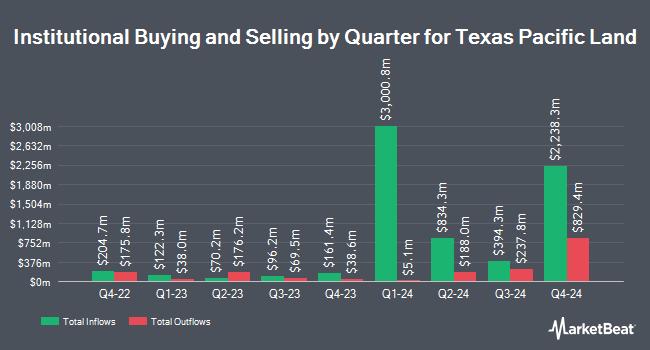
Nykredit A S purchased a new stake in Texas Pacific Land Corporation (NYSE:TPL - Free Report) in the 2nd quarter, according to the company in its most recent Form 13F filing with the SEC. The institutional investor purchased 10,568 shares of the financial services provider's stock, valued at approximately $4,625,000.
A number of other hedge funds and other institutional investors have also recently modified their holdings of the business. EverSource Wealth Advisors LLC boosted its stake in Texas Pacific Land by 21.4% during the second quarter. EverSource Wealth Advisors LLC now owns 68 shares of the financial services provider's stock worth $72,000 after buying an additional 12 shares during the period. Sei Investments Co. grew its stake in shares of Texas Pacific Land by 1.1% in the third quarter. Sei Investments Co. now owns 1,909 shares of the financial services provider's stock worth $1,782,000 after acquiring an additional 20 shares in the last quarter. Larson Financial Group LLC grew its stake in Texas Pacific Land by 5.4% during the 3rd quarter. Larson Financial Group LLC now owns 410 shares of the financial services provider's stock worth $383,000 after purchasing an additional 21 shares in the last quarter. MIRAE ASSET GLOBAL ETFS HOLDINGS Ltd. grew its position in shares of Texas Pacific Land by 1.3% during the third quarter. MIRAE ASSET GLOBAL ETFS HOLDINGS Ltd. now owns 1,916 shares of the financial services provider's stock worth $1,789,000 after buying an additional 24 shares in the last quarter. Finally, Van ECK Associates Corp increased its position in shares of Texas Pacific Land by 0.5% in the 3rd quarter. Van ECK Associates Corp now owns 4,685 shares of the financial services provider's stock valued at $4,374,000 after purchasing an additional 24 shares during the last quarter. 59.94% of the stock is owned by institutional investors and hedge funds.
Analysts Set New Price Targets
TPL has been the topic of a number of recent analyst reports. Weiss Ratings reiterated a "hold (c+)" rating on shares of Texas Pacific Land in a report on Wednesday, July 29th. Zacks Research raised shares of Texas Pacific Land from a "strong sell" rating to a "hold" rating in a research report on Wednesday, July 29th. One research analyst has rated the stock with a Buy rating, two have given a Hold rating and one has assigned a Sell rating to the company's stock. Based on data from MarketBeat.com, the stock has an average rating of "Hold" and an average price target of $639.00.
View Our Latest Report on TPL
Texas Pacific Land Price Performance
TPL opened at $362.47 on Monday. Texas Pacific Land Corporation has a 1-year low of $269.23 and a 1-year high of $547.20. The stock has a market cap of $25.00 billion, a P/E ratio of 46.19 and a beta of 0.61. The stock's 50 day simple moving average is $388.21 and its 200 day simple moving average is $422.29.
Texas Pacific Land (NYSE:TPL - Get Free Report) last released its quarterly earnings results on Wednesday, August 5th. The financial services provider reported $2.23 earnings per share (EPS) for the quarter, topping the consensus estimate of $2.18 by $0.05. The business had revenue of $246.10 million during the quarter, compared to the consensus estimate of $249.50 million. Texas Pacific Land had a return on equity of 35.76% and a net margin of 60.32%. Research analysts expect that Texas Pacific Land Corporation will post 8.88 EPS for the current fiscal year.
Texas Pacific Land Announces Dividend
The business also recently declared a quarterly dividend, which will be paid on Tuesday, September 15th. Shareholders of record on Tuesday, September 1st will be given a dividend of $0.60 per share. The ex-dividend date of this dividend is Tuesday, September 1st. This represents a $2.40 annualized dividend and a yield of 0.7%. Texas Pacific Land's dividend payout ratio (DPR) is presently 30.57%.
Texas Pacific Land Company Profile
(
Free Report)
Texas Pacific Land Corporation NYSE: TPL is a Texas-based land management company that derives revenue from the ownership and stewardship of large tracts of land and associated mineral rights in West Texas. The company's origins trace to 19th century land grants associated with the Texas and Pacific Railway; over time those grant holdings have been retained and managed as a standalone corporate asset base. Texas Pacific Land is publicly listed and operates as a landowner and resource manager rather than as a traditional oil and gas producer.
The company's primary activities include management of surface rights and leasing of land for energy and other commercial uses, administration of mineral royalty interests, and provision of water and related services to industrial customers.
See Also
Want to see what other hedge funds are holding TPL? Visit HoldingsChannel.com to get the latest 13F filings and insider trades for Texas Pacific Land Corporation (NYSE:TPL - Free Report).
This instant news alert was generated by narrative science technology and financial data from MarketBeat in order to provide readers with the fastest reporting and unbiased coverage. Please send any questions or comments about this story to contact@marketbeat.com.
Before you consider Texas Pacific Land, you'll want to hear this.
MarketBeat keeps track of Wall Street's top-rated and best performing research analysts and the stocks they recommend to their clients on a daily basis. MarketBeat has identified the five stocks that top analysts are quietly whispering to their clients to buy now before the broader market catches on... and Texas Pacific Land wasn't on the list.
While Texas Pacific Land currently has a Hold rating among analysts, top-rated analysts believe these five stocks are better buys.
View The Five Stocks Here
MarketBeat just released its list of the 7 hottest IPOs expected to hit Wall Street in 2026. See which companies are preparing to go public and why investors are watching closely.
Get This Free Report
Continue following MarketBeat
Add MarketBeat as your preferred source on Google to see our latest stories in your feed.
Like this article? Share it with a colleague.
Link copied to clipboard.
