Santa Claus might be coming to town, but that hasn’t stopped pouting and crying from seeping into consumer sentiment this holiday season.
The University of Michigan’s Survey of Consumers continues to show that Americans aren’t feeling very optimistic about their finances or the job market. The K-shaped economy has been a hot topic in the market news cycle, and that’s earned the retail sector extra scrutiny.
One area you’d expect to suffer in a K-shaped economy is the department store model, but that hasn’t been the case—at least for these two companies. Let's examine why Dillards Inc. NYSE: DDS and Macy's Inc. NYSE: M are experiencing outsized success in 2025, despite operating in very different ways.
Dillards: A Department Store with a Clear Identity
Dillard's Today
$670.22 +14.88 (+2.27%) As of 10/15/2026 04:00 PM Eastern
- 52-Week Range
- $503.06
▼
$741.97 - Dividend Yield
- 0.18%
- P/E Ratio
- 16.11
- Price Target
- $545.67
Dillards is the last of a dying breed: a traditional brick-and-mortar department store that isn’t getting its clock cleaned by e-commerce.
How has the company managed to stave off the onslaught of online merchants? By leaning into its affluent customer base, maintaining tight inventory, and adopting strategies that aggressively reward shareholders.
Dillard’s appeals to upper- and middle-income consumers, which not only benefits sales in the current economic environment but also helps the company maintain margins through effective inventory management.
Unlike many of its department store peers, Dillard’s doesn’t chase sales and rarely runs promotions. Instead, it carefully matches inventory with demand projections, maintaining high margins and avoiding forced, unprofitable clearance sales.
Dillard’s also has a few shareholder-friendly practices that keep investors’ spirits bright.
First, unlike most department stores that lease their buildings, Dillard’s actually owns a significant portion of its real estate outright. The company’s real estate holdings make it a frequent buyout target, a factor that puts a floor under its share price.
Second, Dillard’s makes share buybacks and dividends a key component of operations. Most retailers initiate buybacks only when cash flow is strong. Still, Dillard’s has built the practice into its long-term strategy, creating constant demand for its stock and preventing EPS from sinking during economic slowdowns.
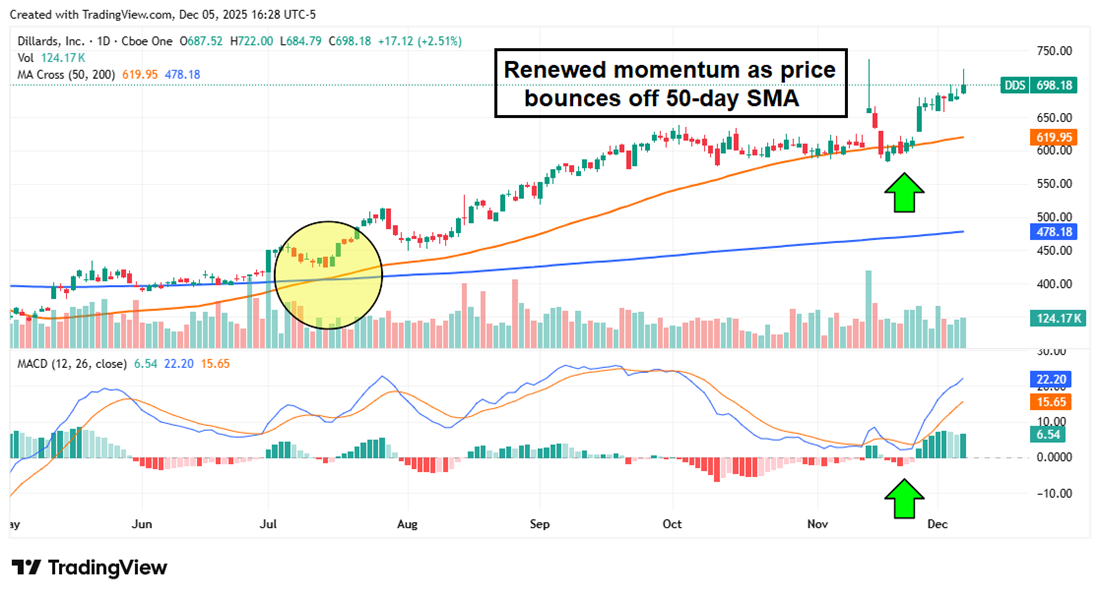
Thanks to these strategies, Dillard’s has consistently beaten earnings expectations in each quarter so far this year, particularly in Q3 2025, when comparable sales (comps) increased 3% year-over-year (YOY), and gross margins rose to 45.3% from 44.5% in Q3 2024. Revenue and earnings per share (EPS) have also posted strong growth throughout the year, driving the stock's year-to-date (YTD) increase by more than 55%.
The stock also received a boost on the technical side recently when shares bounced firmly off the 50-day simple moving average (SMA) and triggered a new wave of upward momentum. DDS is pricey for a department store at 18x earnings, but investors (like Dillard’s customers) are willing to pay up for a quality company.
Macy’s: “Bold New Chapter” Is Rewriting the Narrative
Macy's Today
M
Macy's
$24.17 +1.49 (+6.55%) As of 10/15/2026 03:59 PM Eastern
This is a fair market value price provided by Massive. Learn more. - 52-Week Range
- $16.69
▼
$26.58 - Dividend Yield
- 3.19%
- P/E Ratio
- 8.85
- Price Target
- $22.78
Macy's has been a thorn in the side of retail sector investors for several years, as most department store models have faded into obscurity. And while the former mall anchor still has a winding road ahead, the early returns from its Bold New Chapter initiative appear promising.
Drastic turnarounds often require a slash-and-burn approach from management, and Macy’s has adopted this strategy with its aggressive store rebranding and closure policy. The Reimagine 125 strategy is a key component of the Bold New Chapter initiative, which involves closing underperforming stores and revamping existing outlets.
Macy’s announced plans to close 150 cash-draining locations and focus on rebranding 125 profitable stores to cut costs while increasing comp sales. The company rebranded 50 stores in 2024, with the remaining 75 stores set to undergo facelifts in 2025. Now that this rebrand is in full force, Macy’s earnings show it's been a successful pivot.
On Dec. 3, Macy’s reported its fiscal Q3 2026 earnings, which beat EPS and revenue projections for the fourth consecutive quarter. Comp sales grew 3.2% YOY, a number that was boosted by the Reimagine 125 locations (2.7% comp growth) and Bloomingdale’s (9.0% comp growth).
Stores falling outside the Reimagine or Bloomingdale’s umbrellas reported weaker 2% comp sales. Bloomingdale’s comp sales growth was its highest in 13 quarters, highlighting the continued strength of the upper-income consumer. Additionally, the 20 basis point tariff hit to gross margins was less consequential than expected, and management raised guidance projections across the board, including boosts in total 2025 sales, comps, and adjusted EPS.
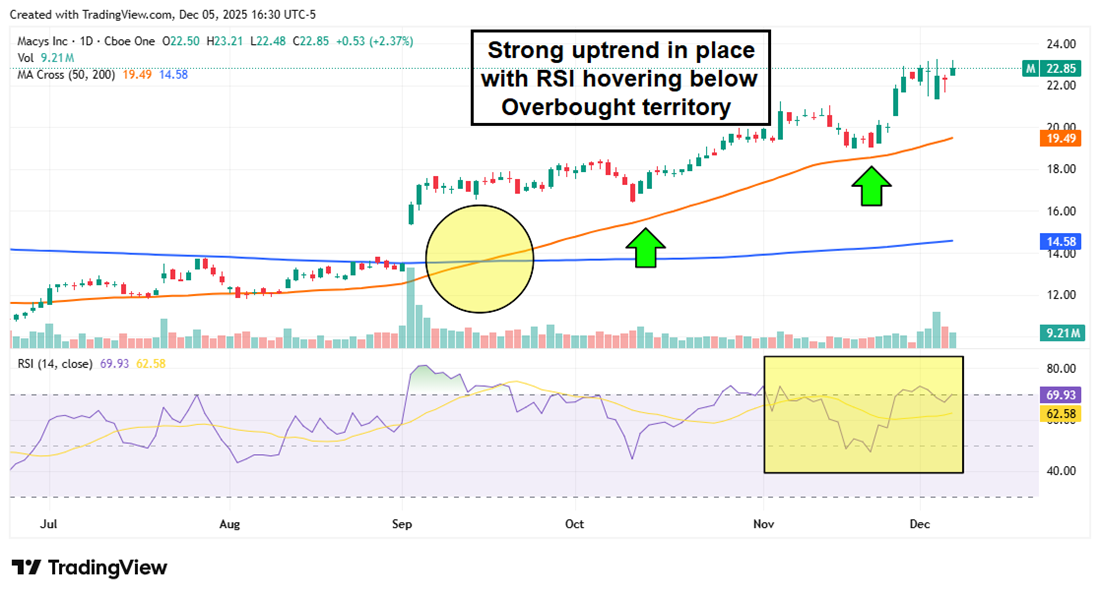
Macy’s lean mean restructuring plan, buoyed by high-margin subsidiaries like Bloomingdale’s and Bluemercury, has been the catalyst for a 30% YTD stock gain. A 30% advance in 2025 would have stunned even the most optimistic executive this time last year, and the stock has fundamental and technical tailwinds in place to keep the rally going.
The stock is trading above its 50-day and 200-day SMAs, and the Relative Strength Index (RSI) isn’t flashing any warning signs just yet. Macy’s demonstrates what investors want to see from a modern retailer: ruthless efficiency, high-end brand appeal, and effective tariff mitigation strategies.
Additionally, a 3.5% dividend yield from a retailer trading at just 9.5x forward earnings is also a notable benefit.
Before you consider Macy's, you'll want to hear this.
MarketBeat keeps track of Wall Street's top-rated and best performing research analysts and the stocks they recommend to their clients on a daily basis. MarketBeat has identified the five stocks that top analysts are quietly whispering to their clients to buy now before the broader market catches on... and Macy's wasn't on the list.
While Macy's currently has a Hold rating among analysts, top-rated analysts believe these five stocks are better buys.
View The Five Stocks Here
Nuclear energy is entering a new growth cycle as rising power demand, expanding data centers, and renewed policy support bring the sector back into focus. After strong gains in recent years, the most impactful phase of nuclear investment may still be ahead. This report highlights seven nuclear energy stocks positioned across the value chain—combining near-term revenue with long-term upside as next-generation technologies scale. Click the link below to unlock the full list.
Get This Free Report
Continue following MarketBeat
Add MarketBeat as your preferred source on Google to see our latest stories in your feed.
