Capital One Financial Today
COF
Capital One Financial
$201.26 -2.17 (-1.07%) As of 10/23/2026 03:59 PM Eastern
This is a fair market value price provided by Massive. Learn more. - 52-Week Range
- $174.24
▼
$259.64 - Dividend Yield
- 1.59%
- P/E Ratio
- 11.88
- Price Target
- $256.32
Capital One Financial Corp. NYSE: COF delivered a solid Q3 2026 earnings report. Adjusted earnings per share (EPS) were $6.69, up 12% from $5.95 a year earlier. Revenue rose 6% year over year to $16.3 billion.
The stock got a lift of about 4% the morning after the report was released on Oct. 20. But it gave back those gains and turned lower that day, reflecting declines across the broader market.
Investors are getting two different messages. The fundamentals say Capital One’s post-merger story is working. The price action says the market isn’t ready to believe it. That gap looks like an opportunity.
Net interest margin rose 40 basis points to 8.41%. Pre-provision earnings jumped 10% from the prior quarter to $7.5 billion. Management also kept returning cash to shareholders, buying back $2.6 billion of stock in the quarter.
The Discover Integration Is Ahead of Schedule
The acquisition of Discover in 2025 came with substantial upfront costs that were certainly a drag on Capital One's earnings growth. But the company has promised more—and that "more" appears to be coming. Adjusted EPS growth was up 12% year over year. That's a signal to long-term investors that the company is delivering on the earnings power it promised when it announced the deal.
The Discover payments network is a big part of that story. Global Payment Network volume reached $190.9 billion, up 25% year over year. Owning the network lets Capital One keep more of the economics on each transaction.
This matters because growth through acquisition is a strategy that only works if the acquiring company can wring out excess costs while keeping the growth engines humming. Just over a year after the acquisition, Capital One appears to be ahead of schedule.
The cost side supports that view. Adjusted non-interest expense fell 2% from the prior quarter. The adjusted efficiency ratio improved to 48.76% from 51.38%. Integration isn’t free, though. Discover integration expenses still totaled $338 million in the quarter.
Rising Credit Delinquencies Weren't a Red Flag
In the category of two things being true, Capital One reported that domestic card delinquencies of 30 days or more rose to 3.74% from 3.39%. That kind of data point feeds other data that show a stressed lower-income consumer.
But context matters. Historically, this is a quarter in which Capital One—and other major card issuers—see an uptick in delinquencies. And the year-over-year comparison, which removes seasonality, shows improvement. Delinquencies were down from 3.89% a year ago.
Capital One also released $225 million from its credit loss reserves, mostly in domestic card. Domestic net charge-offs for credit cards fell to 3.98% from 4.71% in the prior quarter. Companies don’t release reserves when they expect conditions to get worse.
Investments in Technology Relieve Friction and Balance Risk
Of course, AI was a part of the story as well. Capital One's investment in technology is helping it with both ends of the borrower demographic.
One of the more obvious ways is risk management. AI-driven risk assessment is the core of Capital One’s edge in mass-market and subprime lending, where telling good borrowers from bad ones is a key concern.
Capital One also wants high-spending customers, but without drifting into high-balance revolvers who look affluent but carry risk. Underwriting models help the company thread that needle.
Where the company's investments in technology matter most to the premium cardholder is in how they allow Capital One to compete for the experiential dollar (i.e., experience, reward economics, and travel).
Examples of those investments paying off include the Capital One Travel app launched earlier this year, real-time fraud detection and authorization that removes the friction of false declines, and data-driven personalized offers and pricing. One sign supporting this argument is that domestic card purchase volume rose 11% year over year to $250 billion.
Bullish Sentiment Points to a Rally
In the short time following the report, analysts have maintained their Buy or equivalent ratings on COF and are raising their price targets. That bullish sentiment isn't showing up in the stock price, which has given up most of the post-earnings gains.
But much of that can be attributed to the broader sell-off in stocks. At around 10x forward earnings, Capital One isn't overvalued based on its own history or the consumer finance sector.
Management is also putting the company’s money behind that view. Capital One has repurchased $7.9 billion of stock so far in 2026. The share count is down about 5% from a year ago, and the CET1 capital ratio stands at a healthy 13.8%.
COF shares are still down about 7% in the last 12 months and 16% in 2026. Much of that was due to skepticism about how quickly the Discover acquisition would boost earnings.
One earnings report isn’t a trend. But if a trend forms, as analysts seem to believe it will, Capital One has significant upside. A close above the 50-week simple moving average, currently near $207, would be the first sign of a higher floor. The stock tested that level this week, reaching $211.49 before pulling back.
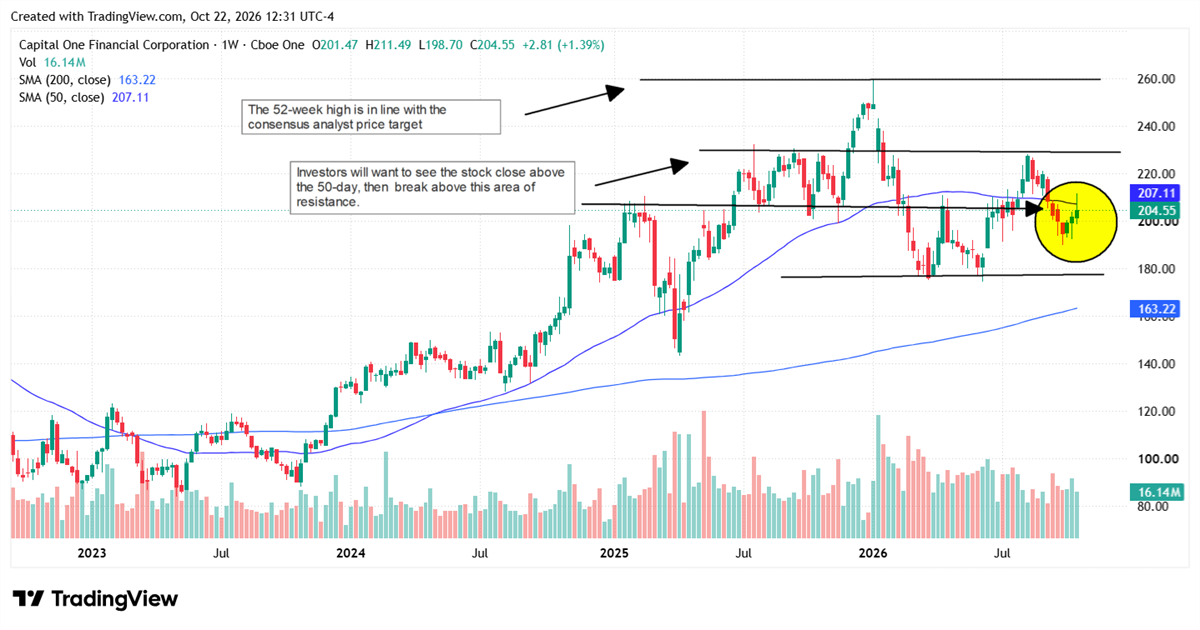
After that, investors will want to see a move above prior resistance around $225, the August high. On the downside, the $175 to $180 range has held as support twice this year. Until the stock breaks higher, the fundamentals are ahead of the price, and patient investors tend to do well on that side of the gap.
Before you consider Capital One Financial, you'll want to hear this.
MarketBeat keeps track of Wall Street's top-rated and best performing research analysts and the stocks they recommend to their clients on a daily basis. MarketBeat has identified the five stocks that top analysts are quietly whispering to their clients to buy now before the broader market catches on... and Capital One Financial wasn't on the list.
While Capital One Financial currently has a Moderate Buy rating among analysts, top-rated analysts believe these five stocks are better buys.
View The Five Stocks Here
Looking for higher dividend income in 2027? Discover seven high-yield dividend stocks with attractive payouts, proven dividend histories and growth potential.
Get This Free Report
Continue following MarketBeat
Add MarketBeat as your preferred source on Google to see our latest stories in your feed.

