Moderna Today
$213.74 -11.26 (-5.00%) As of 04:00 PM Eastern
- 52-Week Range
- $22.28
▼
$227.46 - Price Target
- $78.17
Shares of Moderna NASDAQ: MRNA are behaving like it's 2020. The stock is up nearly 20% since the company’s Science Day event.
At that time, Moderna revealed its strategy for using mRNA to combat cancer and rare diseases. It’s a move beyond vaccines, and investors seem to like it.
Looks, however, can be deceiving. Prior to the event, MRNA had short interest of over 16.5% which required over 10 days for short sellers to cover their positions.
The result? A classic short squeeze that has sent the stock to nearly double its consensus price target of around $37 as of June 30.
However, the price movement by itself isn’t disqualifying. The expansion of mRNA as a treatment for diseases is where the promise has always been. Therefore, investors are left with a decision ahead of its Q2 2026 earnings report, scheduled for July 30.
Why mRNA Still Matters
The promise of mRNA is that it changes how medicine gets made. Traditional drugs are manufactured in factories and injected into the body. mRNA medicines work differently. They deliver genetic instructions, and the body's own cells produce the protein needed to treat the disease.
That matters for two reasons. The same platform can be reprogrammed for different diseases by changing only the instructions. And that flexibility could make drug development faster and more efficient over time.
COVID-19 vaccines proved the platform works in infectious disease. The question Moderna is now trying to answer is whether the same approach can deliver meaningful results for cancer, autoimmune diseases, and rare diseases.
If the answer is yes, the platform becomes far more valuable than its vaccine franchise alone. That's the long-term story driving the recent move.
3 Horizons, 1 Long Runway
At Science Day, Moderna organized its business into three "Horizons" that map how the platform scales over time.
Horizon 1 is Moderna’s commercial engine. It includes four approved vaccines (Spikevax, mRESVIA, mNEXSPIKE, and mCOMBRIAX), the investigational intismeran autogene cancer therapy, and a rare disease franchise led by a propionic acidemia treatment. This accounts for the bulk of the company’s current revenue.
Horizon 2 is the next wave. T-cell engagers targeting multiple myeloma and ovarian cancer, cancer antigen therapies for solid tumors and Lynch syndrome, and a multiple sclerosis therapeutic linked to the Epstein-Barr virus. Most are in Phase 1 or Phase 2 trials. The earliest meaningful readout is mRNA-1195 for multiple sclerosis, which is expected in the second half of 2026.
Horizon 3 is the long-term bet. The headline asset is mRNA-6007, an in vivo CAR-T therapy aimed at lupus. Moderna expects this to enter human trials by the end of 2027.
That’s a whole lot of potential. However, none of Horizon 2 or Horizon 3 will generate revenue until after 2028. Phase 1 and Phase 2 readouts are clinical milestones, not commercial ones. The path from trial to approval to launch takes years.
Why Caution Is Warranted
On June 26, the day after Moderna’s Science Day event, Piper Sandler reiterated its Overweight rating on MRNA and raised its price target to $77 from $69. Even at the former price target, Piper Sandler was already one of the most bullish analysts.
It’s important to note, however, that the new price target doesn’t leave much upside for MRNA after its recent gains. Analysts may be holding off on issuing opinions until the company’s earnings report, especially since there won’t be any revenue or earnings from these new initiatives for several years.
That puts the entire burden on Horizon 1. The four approved vaccines, the intismeran Phase 3 program, and disciplined cash management have to fund the pipeline long enough for the platform story to pay off.
That’s why long-term investors who aren’t in the stock should wait for a better entry point. It’s also a reason for current shareholders to take some risk off the table.
Where the Squeeze Logically Gives Back
The most likely first pullback level is $60. It's a round-number psychological level and represents a healthy give-back of about half the move off the mid-June breakout. Pullbacks of that size are normal after a sharp rally; they are normal profit-taking and leave the bullish structure intact. Anyone trimming into the squeeze would look to add back near this level.
The deeper, higher-conviction support is $55. That was the top of the April-to-June trading range, and the launch point of the Science Day breakout candle. Prior resistance becomes new support, and this is where the squeeze froth fully resets without breaking the thesis.
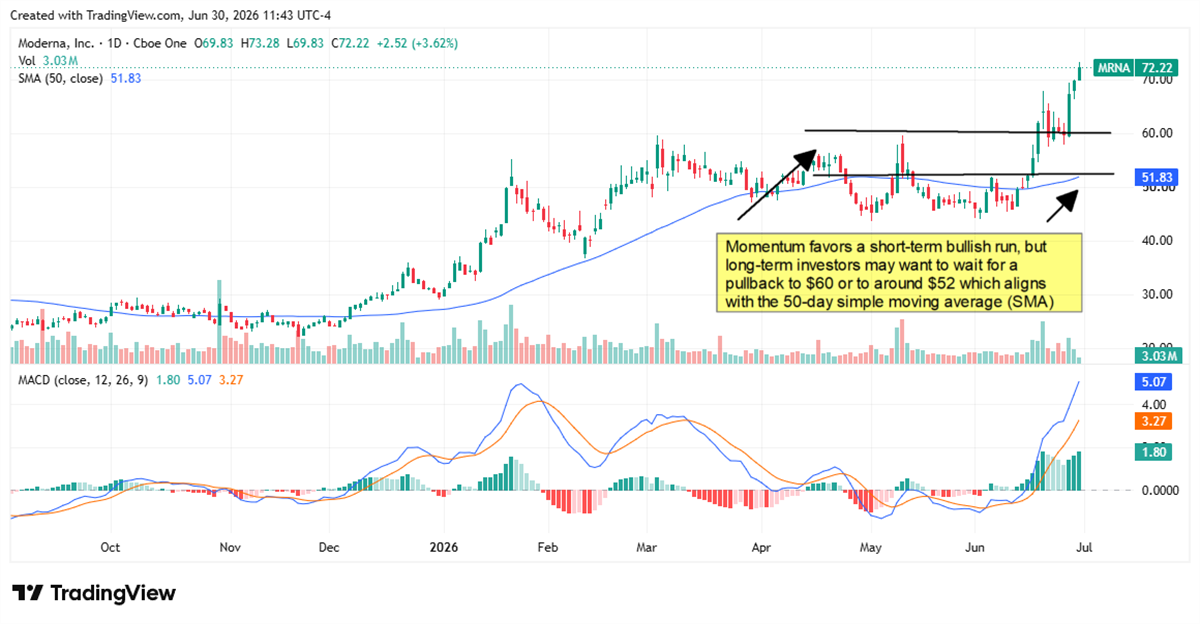
The line in the sand is $52, where the 50-day SMA sits at $51.83. A close below that level would mean the breakout has failed, and the stock has fallen back into the range it traded in before Science Day. At that point, the platform re-rate needs a fresh catalyst, such as the July 30 earnings report, to reassert itself.
Before you consider Moderna, you'll want to hear this.
MarketBeat keeps track of Wall Street's top-rated and best performing research analysts and the stocks they recommend to their clients on a daily basis. MarketBeat has identified the five stocks that top analysts are quietly whispering to their clients to buy now before the broader market catches on... and Moderna wasn't on the list.
While Moderna currently has a Hold rating among analysts, top-rated analysts believe these five stocks are better buys.
View The Five Stocks Here
MarketBeat just released its list of the 7 hottest IPOs expected to hit Wall Street in 2026. See which companies are preparing to go public and why investors are watching closely.
Get This Free Report
Continue following MarketBeat
Add MarketBeat as your preferred source on Google to see our latest stories in your feed.
