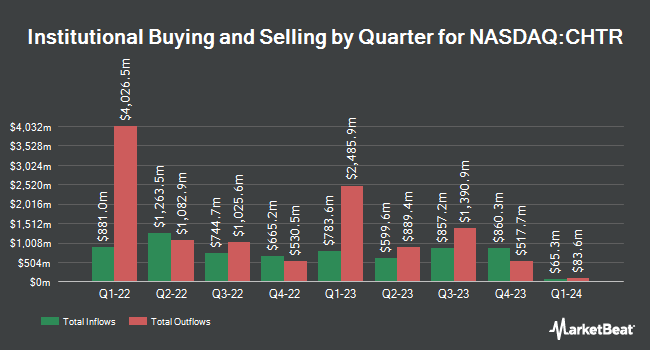
Robeco Institutional Asset Management B.V. raised its position in shares of Charter Communications, Inc. (NASDAQ:CHTR - Free Report) by 562.8% in the third quarter, according to the company in its most recent 13F filing with the SEC. The institutional investor owned 328,457 shares of the company's stock after purchasing an additional 278,898 shares during the quarter. Robeco Institutional Asset Management B.V. owned about 0.28% of Charter Communications worth $36,426,000 as of its most recent SEC filing.
Several other hedge funds also recently modified their holdings of CHTR. Bank of America Corp DE lifted its holdings in shares of Charter Communications by 28.4% in the first quarter. Bank of America Corp DE now owns 731,708 shares of the company's stock valued at $157,961,000 after buying an additional 161,888 shares during the period. State of Michigan Retirement System grew its holdings in Charter Communications by 1,547.4% during the first quarter. State of Michigan Retirement System now owns 431,582 shares of the company's stock worth $93,170,000 after acquiring an additional 405,385 shares during the period. Sei Investments Co. grew its holdings in Charter Communications by 79.2% during the first quarter. Sei Investments Co. now owns 250,497 shares of the company's stock worth $54,078,000 after acquiring an additional 110,684 shares during the period. Swiss National Bank grew its holdings in Charter Communications by 1.5% during the first quarter. Swiss National Bank now owns 246,896 shares of the company's stock worth $53,300,000 after acquiring an additional 3,560 shares during the period. Finally, Assenagon Asset Management S.A. raised its position in Charter Communications by 443.8% in the third quarter. Assenagon Asset Management S.A. now owns 419,881 shares of the company's stock worth $46,565,000 after acquiring an additional 342,668 shares in the last quarter. 81.76% of the stock is currently owned by institutional investors and hedge funds.
Analyst Ratings Changes
CHTR has been the subject of a number of research analyst reports. Morgan Stanley cut their price target on shares of Charter Communications from $150.00 to $140.00 and set an "equal weight" rating for the company in a report on Friday, September 25th. JPMorgan Chase & Co. lowered their price objective on shares of Charter Communications from $200.00 to $150.00 and set a "neutral" rating on the stock in a research note on Wednesday, July 29th. BNP Paribas Exane dropped their target price on shares of Charter Communications from $150.00 to $120.00 and set an "underperform" rating on the stock in a report on Tuesday, July 14th. TD Cowen cut their target price on shares of Charter Communications from $413.00 to $380.00 and set a "buy" rating for the company in a research note on Monday, July 27th. Finally, The Goldman Sachs Group reduced their target price on shares of Charter Communications from $120.00 to $110.00 and set a "sell" rating for the company in a report on Friday, September 25th. Five analysts have rated the stock with a Buy rating, ten have given a Hold rating and seven have assigned a Sell rating to the company's stock. Based on data from MarketBeat, Charter Communications presently has a consensus rating of "Reduce" and an average price target of $202.53.
View Our Latest Stock Analysis on CHTR
Charter Communications Trading Up 4.2%
Shares of NASDAQ CHTR opened at $111.77 on Friday. Charter Communications, Inc. has a 12 month low of $101.63 and a 12 month high of $254.11. The company has a market cap of $13.33 billion, a price-to-earnings ratio of 2.90, a P/E/G ratio of 0.23 and a beta of 0.70. The company has a quick ratio of 0.36, a current ratio of 0.36 and a debt-to-equity ratio of 4.32. The business has a fifty day simple moving average of $129.37 and a 200-day simple moving average of $146.29.
Charter Communications (NASDAQ:CHTR - Get Free Report) last released its quarterly earnings results on Friday, July 24th. The company reported $10.66 earnings per share for the quarter, beating analysts' consensus estimates of $9.98 by $0.68. The business had revenue of $13.53 billion during the quarter, compared to analyst estimates of $13.51 billion. Charter Communications had a return on equity of 23.71% and a net margin of 9.05%. Charter Communications's revenue for the quarter was down 1.7% on a year-over-year basis. During the same quarter last year, the company posted $9.18 EPS. Sell-side analysts predict that Charter Communications, Inc. will post 42.92 EPS for the current year.
Charter Communications Company Profile
(
Free Report)
Charter Communications, Inc is a telecommunications and broadband services company that operates under the Spectrum brand. The company provides internet access, video entertainment, mobile communications and voice services to residential customers, as well as connectivity, data networking, cloud, security and other communications solutions to businesses and government organizations.
Charter operates one of the largest broadband networks in the United States, serving customers across dozens of states.
See Also
This instant news alert was generated by narrative science technology and financial data from MarketBeat in order to provide readers with the fastest reporting and unbiased coverage. Please send any questions or comments about this story to contact@marketbeat.com.
Before you consider Charter Communications, you'll want to hear this.
MarketBeat keeps track of Wall Street's top-rated and best performing research analysts and the stocks they recommend to their clients on a daily basis. MarketBeat has identified the five stocks that top analysts are quietly whispering to their clients to buy now before the broader market catches on... and Charter Communications wasn't on the list.
While Charter Communications currently has a Reduce rating among analysts, top-rated analysts believe these five stocks are better buys.
View The Five Stocks Here
Nuclear energy is entering a new growth cycle as rising power demand, expanding data centers, and renewed policy support bring the sector back into focus. After strong gains in recent years, the most impactful phase of nuclear investment may still be ahead. This report highlights seven nuclear energy stocks positioned across the value chain—combining near-term revenue with long-term upside as next-generation technologies scale. Click the link below to unlock the full list.
Get This Free Report
Continue following MarketBeat
Add MarketBeat as your preferred source on Google to see our latest stories in your feed.
Like this article? Share it with a colleague.
Link copied to clipboard.

