Summit Wealth Partners LLC lifted its position in Microsoft Corporation (NASDAQ:MSFT - Free Report) by 8.7% in the 2nd quarter, according to the company in its most recent 13F filing with the Securities and Exchange Commission (SEC). The institutional investor owned 15,413 shares of the software giant's stock after acquiring an additional 1,233 shares during the quarter. Microsoft makes up approximately 0.8% of Summit Wealth Partners LLC's portfolio, making the stock its 19th largest position. Summit Wealth Partners LLC's holdings in Microsoft were worth $5,749,000 at the end of the most recent reporting period.
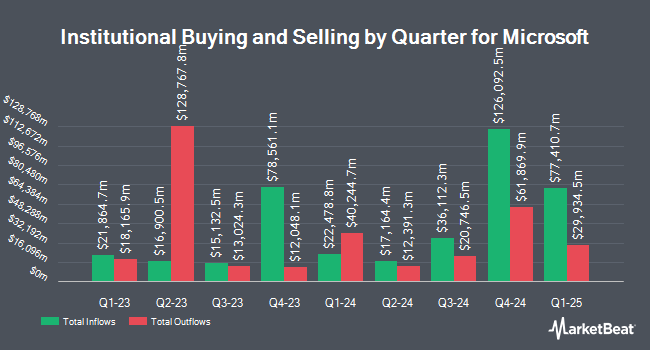
Several other institutional investors and hedge funds also recently made changes to their positions in MSFT. Empirical Financial Services LLC d.b.a. Empirical Wealth Management grew its stake in Microsoft by 4.0% in the 2nd quarter. Empirical Financial Services LLC d.b.a. Empirical Wealth Management now owns 229,490 shares of the software giant's stock valued at $85,604,000 after purchasing an additional 8,773 shares during the period. Markel Group Inc. raised its stake in shares of Microsoft by 0.4% during the 1st quarter. Markel Group Inc. now owns 537,630 shares of the software giant's stock worth $199,014,000 after purchasing an additional 1,950 shares during the period. Bessemer Group Inc. boosted its holdings in shares of Microsoft by 8.4% in the 1st quarter. Bessemer Group Inc. now owns 6,921,677 shares of the software giant's stock worth $2,562,197,000 after buying an additional 537,634 shares during the last quarter. Taylor Securities Services Inc. bought a new position in Microsoft during the fourth quarter valued at about $2,616,000. Finally, Harel Insurance Investments & Financial Services Ltd. increased its holdings in Microsoft by 138.8% during the first quarter. Harel Insurance Investments & Financial Services Ltd. now owns 1,356,359 shares of the software giant's stock worth $502,077,000 after buying an additional 788,297 shares during the last quarter. Hedge funds and other institutional investors own 71.13% of the company's stock.
Analyst Upgrades and Downgrades
A number of research firms have recently weighed in on MSFT. Royal Bank Of Canada reissued an "outperform" rating on shares of Microsoft in a research report on Thursday, September 10th. Phillip Securities downgraded Microsoft from a "strong-buy" rating to a "moderate buy" rating in a research report on Monday, August 3rd. Raymond James Financial lowered Microsoft from a "moderate buy" rating to a "strong sell" rating in a research note on Wednesday, September 23rd. Morgan Stanley reaffirmed an "overweight" rating on shares of Microsoft in a research report on Thursday, July 30th. Finally, Citigroup reiterated a "market outperform" rating on shares of Microsoft in a research note on Monday, September 21st. Forty-three equities research analysts have rated the stock with a Buy rating, four have assigned a Hold rating and one has issued a Sell rating to the stock. According to MarketBeat.com, the stock currently has a consensus rating of "Moderate Buy" and an average price target of $569.29.
View Our Latest Stock Report on MSFT
Microsoft Trading Down 1.3%
NASDAQ:MSFT opened at $509.22 on Tuesday. The stock's fifty day moving average price is $480.07 and its two-hundred day moving average price is $427.02. Microsoft Corporation has a 1 year low of $349.20 and a 1 year high of $553.72. The company has a market cap of $3.78 trillion, a P/E ratio of 28.35, a P/E/G ratio of 1.66 and a beta of 1.11. The company has a debt-to-equity ratio of 0.07, a current ratio of 1.23 and a quick ratio of 1.22.
Microsoft (NASDAQ:MSFT - Get Free Report) last announced its quarterly earnings results on Wednesday, July 29th. The software giant reported $4.74 earnings per share (EPS) for the quarter, topping analysts' consensus estimates of $4.24 by $0.50. The firm had revenue of $90.01 billion for the quarter, compared to the consensus estimate of $87.62 billion. Microsoft had a net margin of 40.31% and a return on equity of 31.98%. The company's revenue for the quarter was up 17.7% on a year-over-year basis. During the same period in the prior year, the firm posted $3.65 earnings per share. As a group, analysts expect that Microsoft Corporation will post 19.62 EPS for the current year.
Microsoft Increases Dividend
The company also recently declared a quarterly dividend, which will be paid on Thursday, December 10th. Stockholders of record on Thursday, November 19th will be issued a $0.98 dividend. The ex-dividend date of this dividend is Thursday, November 19th. This is an increase from Microsoft's previous quarterly dividend of $0.91. This represents a $3.92 annualized dividend and a dividend yield of 0.8%. Microsoft's payout ratio is currently 20.27%.
Insiders Place Their Bets
In related news, CEO Judson Althoff sold 10,000 shares of the company's stock in a transaction that occurred on Wednesday, August 5th. The shares were sold at an average price of $487.89, for a total value of $4,878,900.00. Following the transaction, the chief executive officer directly owned 100,447 shares in the company, valued at approximately $49,007,086.83. This represents a 9.05% decrease in their ownership of the stock. The transaction was disclosed in a document filed with the Securities & Exchange Commission, which is accessible through the SEC website. Also, CEO Satya Nadella sold 86,525 shares of the firm's stock in a transaction that occurred on Tuesday, September 1st. The shares were sold at an average price of $501.46, for a total transaction of $43,388,826.50. Following the completion of the sale, the chief executive officer directly owned 486,763 shares in the company, valued at $244,092,173.98. This represents a 15.09% decrease in their ownership of the stock. The SEC filing for this sale provides additional information. The transaction was executed under a pre-arranged Rule 10b5-1 trading plan. Insiders have sold 143,009 shares of company stock valued at $71,420,699 in the last ninety days. Corporate insiders own 0.03% of the company's stock.
More Microsoft News
Here are the key news stories impacting Microsoft this week:
- Positive Sentiment: Microsoft unveiled a redesigned Copilot experience featuring integrated Office tools, Chat, Cowork and Autopilot capabilities. Jefferies said the products create potential usage-based revenue streams, while analysts expect enterprise adoption to build gradually. Microsoft's Autopilot opens new AI revenue path
- Positive Sentiment: The Copilot overhaul is positioned as a stronger competitive response to Anthropic’s Claude. Microsoft also added GitHub’s coding engine to Copilot, allowing office workers to create applications and dashboards using natural-language instructions, potentially expanding paid AI usage. Microsoft puts GitHub coding engine inside Copilot
- Positive Sentiment: JPMorgan reaffirmed its Buy rating, and William Blair maintained a bullish view based on Copilot monetization potential and Microsoft’s expanding enterprise AI platform. Azure’s reported scale and backlog also support the long-term investment case. Microsoft Buy rating backed by Copilot monetization
- Neutral Sentiment: Microsoft is extending AI partnerships, including a Nokia collaboration that combines Nokia’s telecommunications data with Microsoft Fabric for AI-driven network operations. The opportunity could broaden cloud demand, although financial benefits are not yet quantified. Nokia and Microsoft expand their AI reach
- Neutral Sentiment: TTEC Digital’s 11th consecutive Microsoft AI Business Solutions Inner Circle award highlights the strength of Microsoft’s partner ecosystem, but the recognition is not expected to materially affect near-term revenue. TTEC Digital earns Microsoft AI award
- Negative Sentiment: Reported AI usage shows a sizable regional gap—28.8% in the Global North versus 16.2% in the Global South—raising questions about the pace and breadth of Copilot adoption. Microsoft AI adoption gap
- Negative Sentiment: Meta is moving deeper into enterprise software, creating another competitive threat to Microsoft’s productivity, cloud and AI offerings. Meanwhile, additional layoffs and restructuring may reinforce concerns about execution and workforce disruption. Meta puts Microsoft on notice
- Negative Sentiment: Plans to more than triple data-center capacity by 2032 could support Azure growth but require enormous capital investment, increasing pressure to convert AI demand into cash flow and profits. Investor questions about AI subsidies and regulation add further uncertainty. Microsoft data center expansion
Microsoft Company Profile
(
Free Report)
Microsoft Corporation is a global technology company that develops software, cloud services, devices, gaming products and business solutions. Founded in 1975 by Bill Gates and Paul Allen, the company is best known for the Windows operating system and Microsoft Office productivity software. Microsoft is headquartered in Redmond, Washington, and serves consumers, businesses, governments and educational institutions worldwide.
Microsoft's productivity and business offerings include Microsoft 365 applications such as Word, Excel, PowerPoint and Outlook, along with collaboration tools including Teams.
Featured Articles
This instant news alert was generated by narrative science technology and financial data from MarketBeat in order to provide readers with the fastest reporting and unbiased coverage. Please send any questions or comments about this story to contact@marketbeat.com.
Before you consider Microsoft, you'll want to hear this.
MarketBeat keeps track of Wall Street's top-rated and best performing research analysts and the stocks they recommend to their clients on a daily basis. MarketBeat has identified the five stocks that top analysts are quietly whispering to their clients to buy now before the broader market catches on... and Microsoft wasn't on the list.
While Microsoft currently has a Moderate Buy rating among analysts, top-rated analysts believe these five stocks are better buys.
View The Five Stocks Here
The AI boom extends far beyond the biggest tech names. Discover 10 companies supplying the memory, storage, networking, semiconductor manufacturing, and power infrastructure that make AI possible. Learn where the next wave of AI investment opportunities may emerge—and the key risks investors should watch as the global AI buildout accelerates.
Get This Free Report
Continue following MarketBeat
Add MarketBeat as your preferred source on Google to see our latest stories in your feed.
