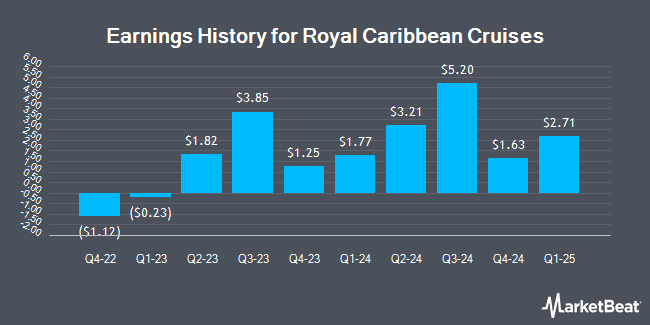
Royal Caribbean Cruises (NYSE:RCL - Get Free Report) issued its quarterly earnings results on Tuesday. The company reported $4.21 earnings per share for the quarter, beating the consensus estimate of $3.98 by $0.23, FiscalAI reports. The firm had revenue of $4.83 billion during the quarter, compared to the consensus estimate of $4.82 billion. Royal Caribbean Cruises had a return on equity of 45.25% and a net margin of 24.36%. Royal Caribbean Cruises updated its FY 2026 guidance to 17.730-17.870 EPS and its Q3 2026 guidance to 6.260-6.360 EPS.
Royal Caribbean Cruises Stock Up 3.9%
RCL stock opened at $304.91 on Tuesday. The company has a market cap of $81.78 billion, a price-to-earnings ratio of 18.60, a P/E/G ratio of 1.04 and a beta of 1.76. The company has a debt-to-equity ratio of 1.96, a quick ratio of 0.17 and a current ratio of 0.20. The business's 50-day moving average is $290.47 and its two-hundred day moving average is $289.25. Royal Caribbean Cruises has a fifty-two week low of $232.10 and a fifty-two week high of $366.50.
Royal Caribbean Cruises Dividend Announcement
The company also recently announced a quarterly dividend, which was paid on Thursday, July 2nd. Shareholders of record on Wednesday, June 3rd were issued a $1.50 dividend. The ex-dividend date of this dividend was Wednesday, June 3rd. This represents a $6.00 dividend on an annualized basis and a yield of 2.0%. Royal Caribbean Cruises's dividend payout ratio is currently 36.61%.
Wall Street Analyst Weigh In
Several analysts recently commented on the stock. Freedom Capital raised shares of Royal Caribbean Cruises to a "strong-buy" rating in a research report on Wednesday, June 3rd. Mizuho set a $380.00 price target on shares of Royal Caribbean Cruises in a report on Friday, May 1st. JPMorgan Chase & Co. reduced their price target on shares of Royal Caribbean Cruises from $376.00 to $341.00 and set an "overweight" rating for the company in a research report on Wednesday, April 8th. Barclays decreased their price objective on shares of Royal Caribbean Cruises from $351.00 to $340.00 and set an "overweight" rating for the company in a report on Friday, May 1st. Finally, UBS Group lowered their price objective on Royal Caribbean Cruises from $321.00 to $309.00 and set a "buy" rating on the stock in a research report on Thursday, May 14th. Two investment analysts have rated the stock with a Strong Buy rating, fourteen have assigned a Buy rating and six have given a Hold rating to the company's stock. Based on data from MarketBeat.com, Royal Caribbean Cruises currently has a consensus rating of "Moderate Buy" and a consensus target price of $345.05.
Read Our Latest Stock Analysis on Royal Caribbean Cruises
Key Stories Impacting Royal Caribbean Cruises
Here are the key news stories impacting Royal Caribbean Cruises this week:
Institutional Investors Weigh In On Royal Caribbean Cruises
Several hedge funds and other institutional investors have recently made changes to their positions in RCL. UBS AM a distinct business unit of UBS ASSET MANAGEMENT AMERICAS LLC boosted its holdings in shares of Royal Caribbean Cruises by 25,747.4% in the fourth quarter. UBS AM a distinct business unit of UBS ASSET MANAGEMENT AMERICAS LLC now owns 1,202,161 shares of the company's stock worth $335,307,000 after buying an additional 1,197,510 shares during the last quarter. Forest Avenue Capital Management LP bought a new position in Royal Caribbean Cruises in the fourth quarter worth approximately $80,848,000. Credit Agricole S A bought a new position in Royal Caribbean Cruises in the third quarter worth approximately $84,992,000. Arrowstreet Capital Limited Partnership raised its position in Royal Caribbean Cruises by 3,725.2% in the third quarter. Arrowstreet Capital Limited Partnership now owns 215,243 shares of the company's stock worth $69,648,000 after acquiring an additional 209,616 shares during the period. Finally, Raymond James Financial Inc. boosted its stake in shares of Royal Caribbean Cruises by 18.0% during the 2nd quarter. Raymond James Financial Inc. now owns 1,046,736 shares of the company's stock worth $327,775,000 after acquiring an additional 159,690 shares during the last quarter. Hedge funds and other institutional investors own 87.53% of the company's stock.
Royal Caribbean Cruises Company Profile
(
Get Free Report)
Royal Caribbean Cruises NYSE: RCL, operating as part of the Royal Caribbean Group, is a global cruise company that develops, markets and operates passenger cruise ships. The company operates multiple consumer-facing cruise brands that offer short- and long-duration itineraries and a range of onboard experiences. Its core activities include itineraries and voyage operations, guest services and hospitality, onboard food and beverage, entertainment and recreation programming, and the commercial activities needed to sell and support cruises through both direct and travel‑agent channels.
Royal Caribbean's ships serve a broad set of geographies worldwide, regularly deploying vessels in the Caribbean, North America (including Alaska), Europe, Asia, Australia and South America.
Featured Stories
This instant news alert was generated by narrative science technology and financial data from MarketBeat in order to provide readers with the fastest reporting and unbiased coverage. Please send any questions or comments about this story to contact@marketbeat.com.
Before you consider Royal Caribbean Cruises, you'll want to hear this.
MarketBeat keeps track of Wall Street's top-rated and best performing research analysts and the stocks they recommend to their clients on a daily basis. MarketBeat has identified the five stocks that top analysts are quietly whispering to their clients to buy now before the broader market catches on... and Royal Caribbean Cruises wasn't on the list.
While Royal Caribbean Cruises currently has a Moderate Buy rating among analysts, top-rated analysts believe these five stocks are better buys.
View The Five Stocks Here
Discover the 10 Best High-Yield Dividend Stocks for 2026 and secure reliable income in uncertain markets. Download the report now to identify top dividend payers and avoid common yield traps.
Get This Free Report
Like this article? Share it with a colleague.
Link copied to clipboard.
