CVS Health Corp. NYSE: CVS delivered a strong earnings report on Aug. 5, but one note revealed on the earnings conference call sent CVS down 5% in trading that day.
CVS Health Today
$96.01 -0.21 (-0.22%) As of 10:12 AM Eastern
This is a fair market value price provided by Massive. Learn more. - 52-Week Range
- $63.30
▼
$110.68 - Dividend Yield
- 2.77%
- P/E Ratio
- 25.35
- Price Target
- $106.46
In the long run, that note shouldn’t impact what was otherwise a strong beat-and-raise quarter. However, CVS is up over 50% in the last 12 months and more than 20% in 2026. There were whispers of the stock being “priced for perfection” heading into the report.
Immediately after the report, CVS climbed in pre-market trading. That changed during the conference call. That was when CEO Brian Newman said, "We expect the previously discussed market dynamics in our 340B business to continue and result in a headwind in 2027. Additionally, we believe we will see membership declines in Caremark next year."
That sent CVS tumbling, but the sell-off raises two questions. First, was this an overreaction to a single data point? Second, at what price should investors consider getting involved?
CVS Delivers a Beat-and-Raise Quarter
Before addressing the two headwinds, the company’s Q2 2026 earnings report was genuinely strong. CVS posted $106.1 billion in total revenue, up from $98.9 billion a year earlier—a 7.3% increase. Adjusted earnings per share (EPS) came in at $2.58, well above last year's $1.81. GAAP EPS more than tripled to $2.31 from 80 cents.
Management also raised full-year guidance. CVS now expects 2026 adjusted EPS of $7.90 to $8.10, up from its prior range of $7.30 to $7.50. Full-year revenue guidance climbed to at least $414 billion, and cash flow from operations guidance rose to at least $11.5 billion.
Every core segment: Health Care Benefits, Health Services and Pharmacy & Consumer Wellness posted higher adjusted operating income year over year. By any conventional measure, this was a beat-and-raise quarter, so it’s important to consider the distinct ways management's comments may be weighing on the stock.
Why a Decline in Caremark Membership Matters
Caremark is CVS's pharmacy benefit manager (PBM). These companies have been under intensifying scrutiny for their role in drug pricing, and Wednesday's remark was a reminder of that scrutiny.
On the call, Newman said Caremark specifically (not the broader Health Services segment) is expected to lose members in 2026. The driver, according to Newman, is that some health plans that pay Caremark to manage prescription drug benefits are exiting the relationship. That's an issue specific to Caremark, not simply a market-wide contraction.
Newman also tied the decline to industry-wide repricing. CVS, "along with the rest of the industry, is changing the way it prices its services," he said, referencing the company's ongoing shift toward its TrueCost pricing model. This is a more transparent, cost-plus approach that has been in motion since late 2023.
Newman expressed confidence that the business would settle into "fair margins consistent with historical levels in the industry" over time, but the near-term message was unambiguous: fewer Caremark members in 2026, even as the segment's underlying performance and Q2 pharmacy claims volume (473 million, up from 469 million a year earlier) stayed healthy.
The 340B Headwind Could Last Into 2027
Where Caremark membership is a client-retention story, the 340B pressure is a distinct regulatory and reimbursement issue. The federal 340B program requires drug manufacturers to sell outpatient medications at reduced prices to hospitals and clinics serving low-income patients.
CVS management said 340B-related market dynamics, largely stemming from manufacturers restricting how those discounted drugs can be distributed, will continue as "a headwind in 2027," separate from the Caremark membership issue.
Notably, Health Services' Q2 results already reflected 340B pressure, partially offset by "a pull-forward of value previously expected to occur in the second half." Management said that after adjusting for that pull-forward, underlying results were in line with expectations, driven by broader Caremark outperformance elsewhere.
In short, 340B is squeezing margin now and is expected to keep doing so into next year. This will be compounded by the separate Caremark membership decline.
CVS Stock Pulls Back After a Powerful Rally
The daily chart shows CVS shares climbing from roughly $70 in April to an intraday high near $112 in July. That was a run of more than 55% in about three months. Wednesday's decline knocked the stock back to $99.45, still comfortably above its 200-day simple moving average (SMA) of $84.91, which continues to slope upward and confirms that the longer-term uptrend remains intact.
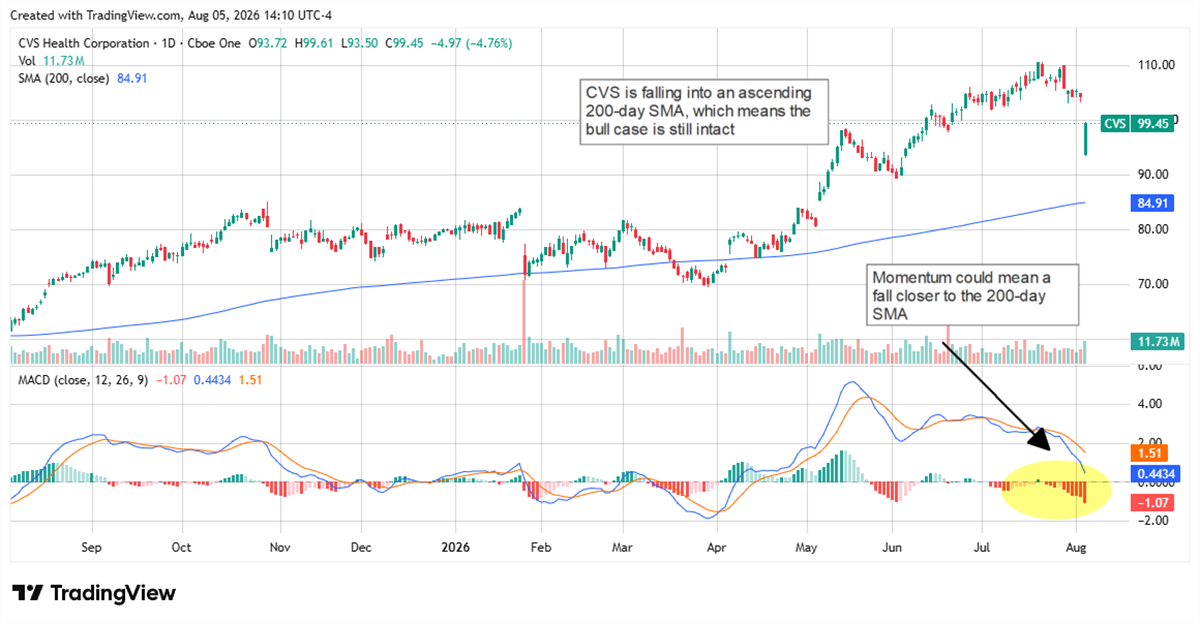
The MACD, however, tells a more cautious near-term story. The MACD line has fallen to roughly 0.44 while the signal line sits near 1.51, and the histogram has flipped negative to about −1.07. The bearish crossover began forming in late July, even before Wednesday's drop.
Volume on the earnings-day sell-off was elevated at over 18 million shares, signaling institutional participation rather than a thin, low-conviction move. For investors, the setup suggests short-term momentum has cooled after an extended run, even as the primary trend stays bullish above the 200-day average.
Is the Market Overreacting to CVS Earnings?
The post-earnings reaction to a single data point is a case study in the gap between headline numbers and market perception. The fundamentals say that CVS Health had a strong quarter. However, the stock price is flashing a warning.
That disconnect often happens after an extended rally. Investors positioned for continued upside treat any hint of a future headwind as confirmation that the story is turning, even when the near-term numbers don't support it.
Whether Wednesday's sell-off proves to be an overreaction or an early signal of real Caremark and 340B pressure likely won't be clear for another quarter or two.
Analysts may be the deciding factor. Heading into the report, analysts had been raising their price targets. That means investors shouldn’t get too hung up on the stock only being slightly below its consensus price target of $105.67. The sell-the-news reaction after earnings shouldn’t change analysts’ sentiment, which is likely to move higher.

Continue following MarketBeat
Add MarketBeat as your preferred source on Google to see our latest stories in your feed.
Before you consider CVS Health, you'll want to hear this.
MarketBeat keeps track of Wall Street's top-rated and best performing research analysts and the stocks they recommend to their clients on a daily basis. MarketBeat has identified the five stocks that top analysts are quietly whispering to their clients to buy now before the broader market catches on... and CVS Health wasn't on the list.
While CVS Health currently has a Moderate Buy rating among analysts, top-rated analysts believe these five stocks are better buys.
View The Five Stocks Here
The AI boom is creating opportunities across semiconductors, cloud computing, enterprise software, infrastructure, cybersecurity, and automation.
Inside this report, you’ll find 10 companies positioned to benefit as artificial intelligence moves from hype to real-world deployment and becomes a core growth driver for corporate America.
Get This Free Report
