MercadoLibre Today
$1,511.00 -19.28 (-1.26%) As of 02:47 PM Eastern
This is a fair market value price provided by Massive. Learn more. - 52-Week Range
- $1,469.01
▼
$2,342.00 - P/E Ratio
- 40.52
- Price Target
- $2,198.75
Mercado Libre’s NASDAQ: MELI stock price has been under pressure since mid-2025 when it announced a more aggressive investment cycle.
Choosing market share and volume over near-term profits, the company is expanding an integrated e-commerce and fintech ecosystem across Latin America.
The net result is sustained, high-level growth and impressive earnings per share, just not quite as impressive as the earnings would be if not for the investments.
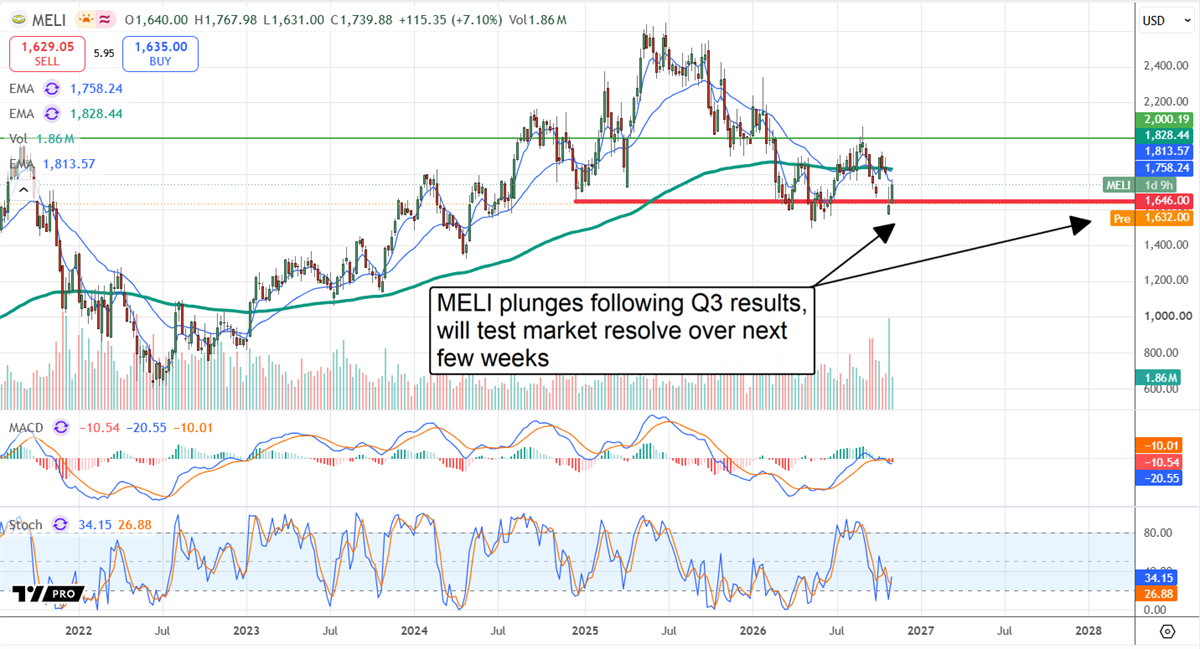
Mercado Libre's Q3 earnings report reinforced that trade-off, with strong revenue growth overshadowed by shrinking margins. With shares testing key technical support, investors face a familiar question: Is the weakness creating a buying opportunity, or is the stock's recovery still dependent on improving profitability?
Mercado Libre Stock Tests Key Support as Analysts Weigh the Upside
MercadoLibre Stock Forecast Today
12-Month Stock Price Forecast:$2,198.7545.74% UpsideModerate BuyBased on 19 Analyst Ratings | Current Price | $1,508.72 |
|---|
| High Forecast | $2,600.00 |
|---|
| Average Forecast | $2,198.75 |
|---|
| Low Forecast | $1,750.00 |
|---|
MercadoLibre Stock Forecast DetailsA combination of downward analyst price revisions and political uncertainty has weighed on Mercado Libre shares, leaving the stock susceptible to further sell-offs.
Brazil’s political environment, especially the presidential runoff on Oct. 25, added another source of pressure. President Luiz Inácio Lula da Silva's unexpected reelection triggered a broad sell-off in Brazilian assets, including Mercado Libre shares, and heightened concerns about currency volatility. The sell-off pushed MELI toward its recent lows, raising the possibility that the stock is establishing a bottom.
At least one analyst called out MELI’s post-election plunge as an overreaction: BTIG’s Marvin Fong also pointed to foreign exchange (FX) conversion as the near-term risk and said investors should look to the Q3 and Q4 results for clarity. Morgan Stanley’s Andrew Rubin echoed the sentiment, highlighting FX risk alongside the company's strengths.
Among those strengths is its expanding credit portfolio, which is not tied to local rates.
Rubin also views a forward price-to-earnings (P/E) ratio of 27 times projected 2027 earnings as an attractive entry point. That would put the stock in the $ 1,500 to $ 1,600 range, depending on the estimate—lower than the early-November price action, but aligned with a technical bottom. The technical support is approximately $1,540 and has been tested through by two successive rebounds, including one triggered by the election sell-off.
Analysts' price targets remain attractive, with the lowest target at $1,750 and the consensus target near $2,200, reflecting about 45% upside.
Recent revisions, however, have been mixed. Following Q3 earnings, BTIG lowered its price target to $2,050, while Cantor Fitzgerald reduced its target to $2,000. Both firms maintained bullish ratings, suggesting continued confidence in Mercado Libre's longer-term prospects despite near-term profitability concerns.
The question is what might put analysts in a more bullish posture. Signs of strength would likely alleviate fear of near-term margin compression and improve long-term visibility.
Institutional data suggests this group will limit downside risk as the year progresses. Institutions own approximately 88% of the stock, a sign of strong conviction, and have accumulated on balance this year.
The red flag is that early Q4 activity has been relatively balanced, reflecting uncertainty ahead of the Q3 earnings release on Nov. 4, and could easily tip into distribution if the company’s outlook deteriorates.
Mercado Libre's Q3 Earnings Reveal the Cost of Aggressive Growth
Mercado Libre’sQ3 results failed to trigger an immediately bullish stock price response, but that doesn't make them any less impressive in terms of growth.
The problem is profitability. Net margin came in at 4.2%, while operating margin declined to 6.3% from 9.8% a year earlier, reflecting the costs of aggressive investments in shipping, fulfillment, and marketing. Revenue grew 45.1% year over year (YOY) to $10.75 billion, driven by strength in both operating segments and outpacing MarketBeat’s reported consensus.
On the retail side, total payment value grew 53% YOY to $109 billion, gross merchandise volume grew 38%, and the number of products sold increased 36%. User growth and penetration were also solid, revealing the success of management's strategy. Unique average buyers increased 22%, itmes per buyer increased 12%, and same- and next-day shipping improved 49%, revealing the rapid integration of MELI services into local lifestyles.
On the fintech side, assets under management rose 67%, the credit portfolio grew 62%, and monthly active users grew 29%, fueling strong cash flow and a positive outlook.
Could Mercado Libre's Investment Strategy Unlock Higher Profits?
One risk for investors is the timing and peak of spending. The company has not established a clear timetable for when its aggressive investment cycle will moderate, and elevated spending could continue for years. In this scenario, spending fears and margin compression could keep MELI shares from reaching their full potential.
The opportunity, however, is the transition from aggressive investment to harvesting profits. Eventually, spending could slow, allowing margins to widen and MELI to experience a strong surge in earnings growth, potentially unlocking price-multiple expansion.
Spending headwinds aside, Mercado Libre continues to generate strong earnings per share (EPS). In Q3, the company reported $8.83 in GAAP EPS and $285 million in adjusted free cash flow, helping to sustain balance sheet health and advance its strategy.
The majority of the company's debt is tied to fintech and offset by corresponding receivables and low net leverage. Net debt, including fintech debt, runs at about 2x adjusted EBITDA, a manageable level given the company's financial position. Excluding fintech debt, the company maintains a net cash position. Major credit rating agencies rate it investment grade, though on the low end of the investment-grade spectrum.
Mercado Libre’s biggest threat is competition. Now that it’s opened the e-commerce gates, companies like Amazon NASDAQ: AMZN and Temu NASDAQ: PDD are moving in. The risk is lost share, sluggish growth, and persistently compressed margins as the company fights to retain leadership.
Before you consider MercadoLibre, you'll want to hear this.
MarketBeat keeps track of Wall Street's top-rated and best performing research analysts and the stocks they recommend to their clients on a daily basis. MarketBeat has identified the five stocks that top analysts are quietly whispering to their clients to buy now before the broader market catches on... and MercadoLibre wasn't on the list.
While MercadoLibre currently has a Moderate Buy rating among analysts, top-rated analysts believe these five stocks are better buys.
View The Five Stocks Here
AI spending is reshaping the market, and the opportunity extends far beyond the biggest chipmakers. Discover 10 stocks set to benefit from powerful trends in AI infrastructure, cloud computing, energy, capital returns, and consumer growth this fall.
Get This Free Report
Continue following MarketBeat
Add MarketBeat as your preferred source on Google to see our latest stories in your feed.
