Schneider Electric Today
$59.70 +1.29 (+2.21%) As of 10/9/2026 03:59 PM Eastern
- 52-Week Range
- $50.61
▼
$71.98 - Dividend Yield
- 1.12%
Schneider Electric OTCMKTS: SBGSY just made the biggest bet in its history. On Oct. 5, the French energy management giant agreed to buy PTC NASDAQ: PTC for about $22.6 billion in cash. That works out to $205 per share, a 42% premium to PTC's Oct. 2 close.
Investors, however, balked at the price tag. Schneider's Paris-listed shares fell nearly 10% on the news. The U.S.-traded American Depository Receipt (ADR) is down roughly 16% from its pre-deal level. PTC shares, meanwhile, jumped more than 33%.
That reaction tells only part of the story. PTC is a software company. For most of 2026, software stocks have been on the wrong side of the AI trade. Traders at Jefferies coined the term "SaaSpocalypse" to describe the sell-off. The fear is that AI agents will make traditional software and per-seat pricing obsolete.
That didn't stop Schneider from paying a big premium for a software company. That's worth noticing. A strategic buyer with deep industrial knowledge believes the market has mispriced at least some software. The question is whether Schneider is early or simply overpaying.
Why Schneider Wants PTC
PTC makes software that engineers use to design physical products. Its tools include Creo for computer-aided design and Windchill for product lifecycle management. More than 30,000 customers use them. PTC generated about $2.7 billion in revenue in 2025, with an adjusted EBITA margin near 40%.
Schneider already owns software for running plants and power systems. It completed its takeover of AVEVA in 2023. In June 2026, it agreed to buy industrial AI platform Cognite for $3.1 billion. PTC fills a remaining gap in product design.
Together, the three assets could form a "digital thread." Data created in PTC's design tools could flow into how products are built, run, and maintained. Schneider CEO Olivier Blum says the deal will lift software-as-a-service (SaaS) to about 24% of group revenue.
Data centers are among the first targets. AI agents need data to act on. Design files, plant models, and equipment histories are systems of record. They are hard to replicate and costly to replace. Schneider is betting that AI makes this data more valuable, not less.
The First Domino in AI Infrastructure Consolidation?
Schneider isn't the only buyer reaching for AI infrastructure. In late 2025, a consortium including BlackRock, NVIDIA NASDAQ: NVDA and Microsoft NASDAQ: MSFT agreed to buy Aligned Data Centers for about $40 billion. Schneider also took a controlling stake in liquid-cooling specialist Motivair in 2024.
The PTC deal suggests a new phase. The first wave was about building capacity. The next may be about owning the full stack, from hardware to software to data.
Siemens OTCMKTS: SIEGY has pursued that model for years, most recently by buying Altair. Rivals such as ABB OTCMKTS: ABBNY, Eaton NYSE: ETN and Vertiv NYSE: VRT could face pressure to respond.
Echoes of the Dot-Com Era?
Late-cycle megadeals have a mixed track record. In 2000, JDS Uniphase agreed to buy SDL for roughly $41 billion in stock. The fiber-optic buildout looked endless. Within a year, JDSU wrote down about $50 billion in goodwill. It had paid peak prices with inflated shares for capacity that demand couldn't absorb.
Some echoes are real. Schneider's market value has more than doubled in four years on data center demand. It plans to issue €5 billion (about $5.64 billion) to €6 billion (about $6.73 billion) in new shares near those highs. If AI spending slows, a debt-heavy balance sheet could become a burden.
The differences may matter more. Schneider is funding the deal mostly with debt, not a richly valued stock. PTC is highly profitable. Its shares had also been falling before the bid. This looks less like buying at the peak and more like buying a sold-off asset.
Support or a Broken Floor?
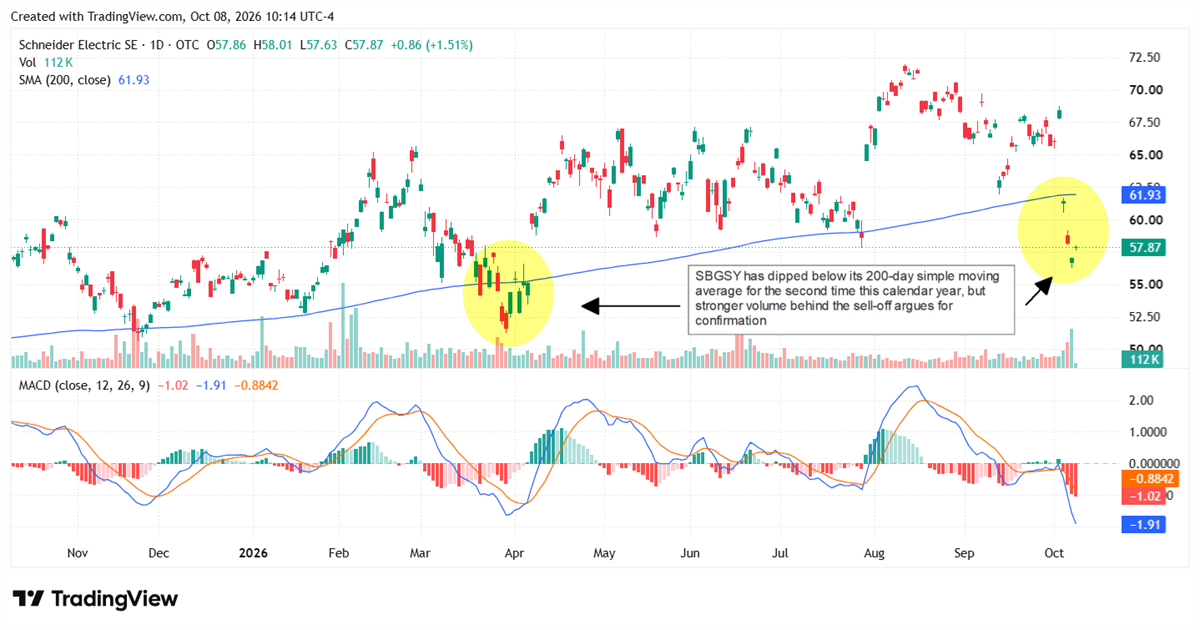
The 200-day simple moving average (SMA) has been a reliable floor for SBGSY over the past year. The stock slipped below it in late March and early April. It then rallied more than 30% into its August high. A test of the line in late July also held.
This break looks different, though. It came as a gap down on heavy volume, driven by company-specific news. Shares now trade about 7% below the 200-day SMA near $61.93. The MACD has dropped to its lowest reading of the past year.
In the near term, old support may act as resistance. Investors may want to see SBGSY reclaim the 200-day SMA before treating the April playbook as a guide.
Execution Risks Are Real, But May Provide an Entry Point
Schneider Electric is paying a premium for PTC. That premium comes with thousands of employees. It also means aligning different product roadmaps, sales incentives, and data architectures. These are the integration challenges that come with deals this large. Successfully overcoming them will be key to achieving Schneider's target of approximately €250 million (approx. $280 million) in annual cost savings by year three.
Schneider's ability to integrate PTC's business without slowing innovation or straining its balance sheet is the risk. However, SBGSY is down approximately 16% since the deal was announced. That could give risk-tolerant investors an attractive entry point in the maturing AI trade.
Before you consider Schneider Electric, you'll want to hear this.
MarketBeat keeps track of Wall Street's top-rated and best performing research analysts and the stocks they recommend to their clients on a daily basis. MarketBeat has identified the five stocks that top analysts are quietly whispering to their clients to buy now before the broader market catches on... and Schneider Electric wasn't on the list.
While Schneider Electric currently has a Buy rating among analysts, top-rated analysts believe these five stocks are better buys.
View The Five Stocks Here
Looking to profit from the electric vehicle mega-trend? Click the link to see our list of which EV stocks show the most long-term potential.
Get This Free Report
Continue following MarketBeat
Add MarketBeat as your preferred source on Google to see our latest stories in your feed.
