Verizon Communications Today
VZ
Verizon Communications
$43.61 +0.51 (+1.19%) As of 11:28 AM Eastern
This is a fair market value price provided by Massive. Learn more. - 52-Week Range
- $38.68
▼
$51.68 - Dividend Yield
- 6.49%
- P/E Ratio
- 11.35
- Price Target
- $50.47
The market overreacted to
SpaceX’s NASDAQ: SPCX spectrum grab, and
Verizon’s NYSE: VZ third-quarter results prove it. While the headline was mixed, the internals show an accelerating turnaround with years to play out. Verizon is a blue-chip, high-yielding, dividend-growing, share-buying machine with improving capacity for capital returns, and SpaceX’s mobile ambition has a long, expensive, uphill climb to even come close.
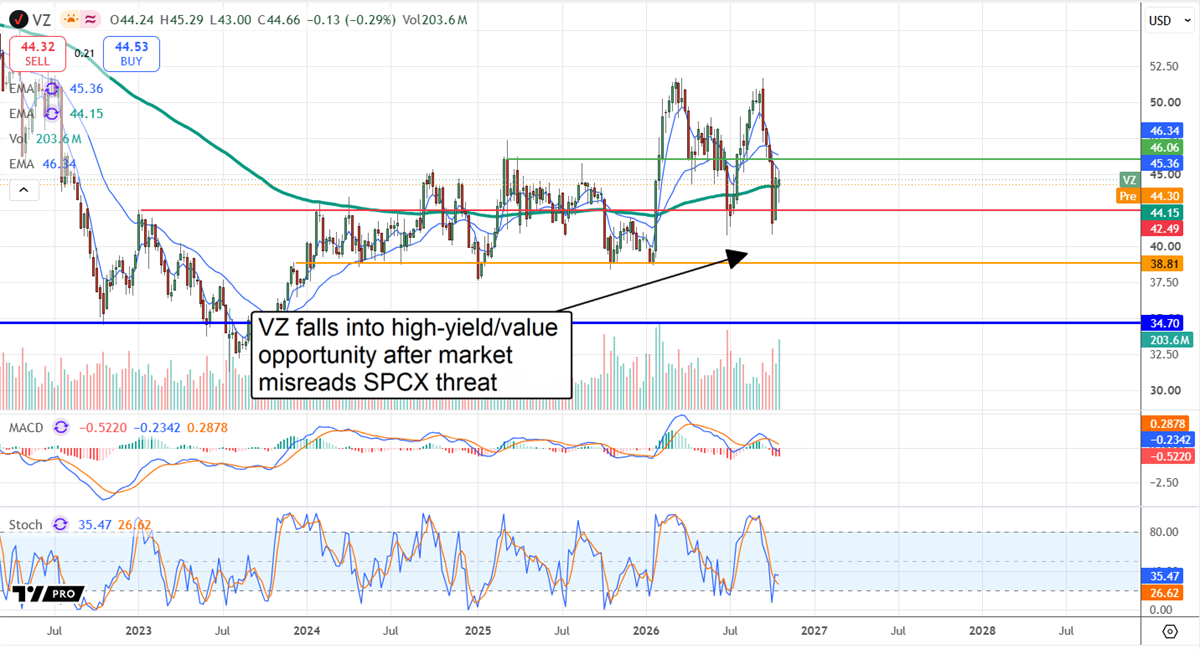
Factors driving the massive single-day sell-off sparked by SpaceX’s news include Verizon’s dividend. The stock went ex-dividend that same day, creating an inherently weak market to sell into. Factors the market may have gotten wrong are the scope of SpaceX’s purchase, which is limited, the cost, and Verizon itself. Regarding the spectrum, it's about 14 MHz of low-band spectrum, insufficient on its own to run a nationwide network. In comparison, Verizon has more than 300 MHz of spectrum holdings across multiple bands, plus the infrastructure to use it.
Verizon Has More Growth Catalysts Than SpaceX Can Disrupt
The news has a bigger impact on SpaceX and Starlink, which will most likely use the spectrum to support satellite and terrestrial coverage until it can build out a more comprehensive network. That is estimated to take three to five years and cost tens of billions in investment. Between now and then, Verizon is in the midst of an accelerating turnaround with its own catalysts. Among them are dark fiber and AST SpaceMobile NASDAQ: ASTS. Verizon committed $100 million in financing and commercial prepayments toward AST’s space-based cellular capacity, enabling improved coverage in underserved areas without new or special equipment. The partnership has VZ set up to expand its satellite coverage, and other catalysts are in play today.
Verizon surprised investors early in 2026 when it announced it would monetize dark fiber. Dark fiber refers to unused fiber-optic cables and networks installed during the DotCom era. They represent existing, unused assets and a cheap, high-margin business opportunity for Verizon. The first deal is with Google, helping it connect its data center network, securing VZ as an AI infrastructure play; the second is with Amazon’s NASDAQ: AMZN AWS. Revealed in the Q3 release, AWS expanded an existing partnership with an agreement worth more than $2 billion to support AI infrastructure needs that Starlink can't serve in the same way.
Verizon’s Q3 Results Reveal Strength Beneath the Revenue Miss
Verizon posted a mixed third quarter, with revenue falling short of the consensus forecast by about half a billion dollars, but this is no problem for investors. The bar was set high, and the underlying causes—a decline in device sales underpinned by significantly reduced subsidies and lower upgrade volumes—are offset by operational improvements in other areas. Revenue grew 1.5% year-over-year (YOY), postpaid phone net additions increased more than 820%, postpaid net account additions reached a 10-year high, mobility and broadband service revenue increased 2.9%, and churn declined year over year.
The more significant news is the margin. Reduced subsidies, improving subscriptions and user counts, and low churn translate into better margins. Net income grew 5.2%, cash flow from operations grew 2.2%, free cash flow (FCF) grew 12.1%, and adjusted EBITDA grew 8%, setting a company record. Adjusted earnings per share (EPS) came in at $1.31, up 8.3% YOY, outpacing the top-line gain despite revenue weakness.
Guidance is a catalyst for investors. Verizon left its full-year mobility and broadband service revenue guidance range unchanged but raised its subscriber and profitability forecasts. Adjusted EPS is expected to reach $5.04 to $5.06, compared to the $5.02 consensus, with full-year FCF growth approaching 12%. Third-quarter FCF reached $7.8 billion, up 12.1% YOY.
Verizon’s Dividend Growth and Buybacks Reward Patient Investors
Verizon Communications MarketRank™ Stock Analysis
4.76860254083 of 5 stars- Overall MarketRank™
- 95th Percentile
- Analyst Rating
- Hold
- Upside/Downside
- 17.7% Upside
- Short Interest Level
- Healthy
- Dividend Strength
- Strong
- News Sentiment
- 0.46

- Insider Trading
- Selling Shares
- Proj. Earnings Growth
- 5.17%
See Full AnalysisVerizon’s
cash flow improvements are central to its outlook, which includes the high-yielding dividend, share buybacks, and a multiyear stock price recovery. The dividend yields nearly 6.5%, with shares trading near the low end of 2026’s price range, a payout ratio of less than 60% based on estimated 2026 earnings, and a history of annual increases. Dividend increases are underpinned by the earnings-growth outlook and share buybacks, which reduce the share count at a semi-aggressive pace. The likely outcome is that Verizon will continue to pay and increase its dividend annually while reducing its share count, improving earnings quality, and growing its business.
Verizon’s balance sheet reflects the strength of its position. Although cash is down, assets have improved, offsetting liability increases and share buybacks to increase equity. Equity gains are incremental but positive, increasing shareholder leverage and improving upside potential for stock prices. Analysts rate VZ as a consensus of Hold, but coverage and price targets have been steady this year, forecasting a move back to the high end of the existing range.
Verizon’s biggest risk is its debt load, which is among the highest in telecom. However, its maturity schedule and cash flow buffer help offset the risk, supporting the dividend and buyback program. Looking ahead, the projected annual FCF indicates an FCF payout ratio near 50%, leaving ample cash to whittle down debt over time.
Before you consider Verizon Communications, you'll want to hear this.
MarketBeat keeps track of Wall Street's top-rated and best performing research analysts and the stocks they recommend to their clients on a daily basis. MarketBeat has identified the five stocks that top analysts are quietly whispering to their clients to buy now before the broader market catches on... and Verizon Communications wasn't on the list.
While Verizon Communications currently has a Hold rating among analysts, top-rated analysts believe these five stocks are better buys.
View The Five Stocks Here
With the proliferation of data centers and electric vehicles, the electric grid will only get more strained. Download this report to learn how energy stocks can play a role in your portfolio as the global demand for energy continues to grow.
Get This Free Report
Continue following MarketBeat
Add MarketBeat as your preferred source on Google to see our latest stories in your feed.

