United Parcel Service (NYSE:UPS - Get Free Report) had its price objective decreased by BNP Paribas Exane from $90.00 to $85.00 in a note issued to investors on Wednesday. The brokerage presently has an "underperform" rating on the transportation company's stock. BNP Paribas Exane's price target points to a potential downside of 9.43% from the stock's previous close.
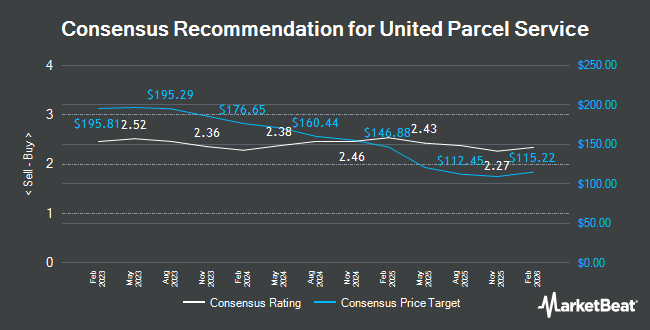
UPS has been the topic of several other research reports. BMO Capital Markets upped their target price on United Parcel Service from $110.00 to $115.00 and gave the company a "market perform" rating in a research report on Wednesday, July 29th. Stifel Nicolaus increased their price target on United Parcel Service from $114.00 to $115.00 and gave the stock a "buy" rating in a report on Wednesday, July 29th. Stephens reduced their price objective on shares of United Parcel Service from $135.00 to $130.00 and set an "overweight" rating for the company in a research report on Wednesday, July 29th. Wall Street Zen lowered shares of United Parcel Service from a "buy" rating to a "hold" rating in a research note on Saturday, September 19th. Finally, Susquehanna boosted their target price on shares of United Parcel Service from $118.00 to $120.00 and gave the company a "neutral" rating in a research report on Wednesday, July 29th. One analyst has rated the stock with a Strong Buy rating, eleven have given a Buy rating, eleven have given a Hold rating and three have given a Sell rating to the company. According to data from MarketBeat, United Parcel Service has an average rating of "Hold" and an average target price of $116.65.
Get Our Latest Stock Report on United Parcel Service
United Parcel Service Trading Up 0.4%
NYSE:UPS traded up $0.41 on Wednesday, reaching $93.85. 4,480,844 shares of the stock traded hands, compared to its average volume of 5,688,590. The firm has a market capitalization of $79.84 billion, a price-to-earnings ratio of 17.44, a price-to-earnings-growth ratio of 1.73 and a beta of 1.06. United Parcel Service has a 1-year low of $82.00 and a 1-year high of $122.41. The company has a current ratio of 1.18, a quick ratio of 1.18 and a debt-to-equity ratio of 1.58. The company's 50 day moving average is $102.53 and its 200-day moving average is $103.80.
United Parcel Service (NYSE:UPS - Get Free Report) last posted its quarterly earnings data on Tuesday, July 28th. The transportation company reported $1.76 earnings per share for the quarter, topping the consensus estimate of $1.65 by $0.11. The company had revenue of $22.83 billion during the quarter, compared to analysts' expectations of $21.86 billion. United Parcel Service had a net margin of 5.08% and a return on equity of 37.50%. United Parcel Service's revenue for the quarter was up 7.6% compared to the same quarter last year. During the same period in the prior year, the company posted $1.55 earnings per share. United Parcel Service has set its FY 2026 guidance at 7.220-7.220 EPS. Equities research analysts anticipate that United Parcel Service will post 7.21 EPS for the current fiscal year.
Hedge Funds Weigh In On United Parcel Service
A number of institutional investors have recently modified their holdings of UPS. Victory Capital Management Inc. increased its stake in United Parcel Service by 72.9% during the 4th quarter. Victory Capital Management Inc. now owns 13,818,314 shares of the transportation company's stock valued at $1,370,639,000 after purchasing an additional 5,826,824 shares in the last quarter. Pacer Advisors Inc. grew its holdings in shares of United Parcel Service by 507.8% during the fourth quarter. Pacer Advisors Inc. now owns 3,244,234 shares of the transportation company's stock valued at $321,796,000 after buying an additional 2,710,470 shares during the last quarter. Wellington Management Group LLP grew its holdings in shares of United Parcel Service by 262.7% during the second quarter. Wellington Management Group LLP now owns 3,046,707 shares of the transportation company's stock valued at $327,521,000 after buying an additional 2,206,666 shares during the last quarter. Bank of America Corp DE increased its position in shares of United Parcel Service by 23.3% during the first quarter. Bank of America Corp DE now owns 9,728,123 shares of the transportation company's stock worth $957,053,000 after acquiring an additional 1,836,651 shares in the last quarter. Finally, Manning & Napier Advisors LLC bought a new stake in shares of United Parcel Service during the second quarter worth about $192,304,000. 60.26% of the stock is owned by institutional investors and hedge funds.
United Parcel Service News Summary
Here are the key news stories impacting United Parcel Service this week:
- Positive Sentiment: UPS launched Secure Commerce, a platform combining insurance, fraud mitigation and AI-driven risk management. The offering could create additional revenue opportunities while helping business customers reduce shipment losses, fraud and supply-chain disruptions. UPS Strengthens E-Commerce Security With New Secure Commerce Platform
- Positive Sentiment: Transportation-industry prospects are improving as freight conditions recover and carriers pursue cost reductions. UPS is identified, alongside FedEx and GXO Logistics, as being positioned to benefit from stronger air-freight and cargo demand. 3 Air-Freight and Cargo Stocks to Watch as Industry Prospects Improve
- Positive Sentiment: Zacks expects UPS may again beat quarterly estimates, citing its strong earnings-surprise history and currently favorable estimate-related indicators. UPS’s latest reported quarter also exceeded consensus for both revenue and earnings, providing support for the bullish case. Will UPS Beat Estimates Again in Its Next Earnings Report?
- Neutral Sentiment: Reports highlighting distress among trucking companies point to broader supply-chain stress. Tight capacity could eventually support pricing, but bankruptcies and persistent freight-industry pressure may also signal weaker demand and higher operating risks for UPS. America’s Critical Supply Chain Is Breaking
- Negative Sentiment: UPS’s dividend appears financially stretched: its trailing free-cash-flow payout ratio is estimated at 99%, compared with 27% for FedEx. The company kept its dividend flat this year, ending a long streak of increases, raising concerns about future dividend growth and coverage. UPS Versus FedEx Dividend Comparison
- Negative Sentiment: UPS faces a difficult balancing act between raising prices and protecting shipment volumes while labor, fuel and other costs remain elevated. That pressure could limit margin expansion even if demand improves. UPS Dips Below $94 and Has a 7% Dividend Yield
About United Parcel Service
(
Get Free Report)
United Parcel Service, Inc NYSE: UPS is a global logistics and package delivery company that provides transportation and supply chain management services to businesses and consumers. Its operations include the pickup, transportation and delivery of packages, documents and freight through ground, air and international networks.
UPS also offers logistics and supply chain solutions, including warehousing, distribution, customs brokerage, contract logistics, returns management and specialized services for healthcare and other industries.
See Also
This instant news alert was generated by narrative science technology and financial data from MarketBeat in order to provide readers with the fastest reporting and unbiased coverage. Please send any questions or comments about this story to contact@marketbeat.com.
Before you consider United Parcel Service, you'll want to hear this.
MarketBeat keeps track of Wall Street's top-rated and best performing research analysts and the stocks they recommend to their clients on a daily basis. MarketBeat has identified the five stocks that top analysts are quietly whispering to their clients to buy now before the broader market catches on... and United Parcel Service wasn't on the list.
While United Parcel Service currently has a Hold rating among analysts, top-rated analysts believe these five stocks are better buys.
View The Five Stocks Here
The AI boom extends far beyond the biggest tech names. Discover 10 companies supplying the memory, storage, networking, semiconductor manufacturing, and power infrastructure that make AI possible. Learn where the next wave of AI investment opportunities may emerge—and the key risks investors should watch as the global AI buildout accelerates.
Get This Free Report
Continue following MarketBeat
Add MarketBeat as your preferred source on Google to see our latest stories in your feed.
Like this article? Share it with a colleague.
Link copied to clipboard.
