Paysafe (NYSE:PSFE - Get Free Report) had its price objective dropped by research analysts at BTIG Research from $12.00 to $11.00 in a research note issued to investors on Wednesday,Benzinga reports. The brokerage currently has a "buy" rating on the stock. BTIG Research's price objective would indicate a potential upside of 26.00% from the stock's previous close.
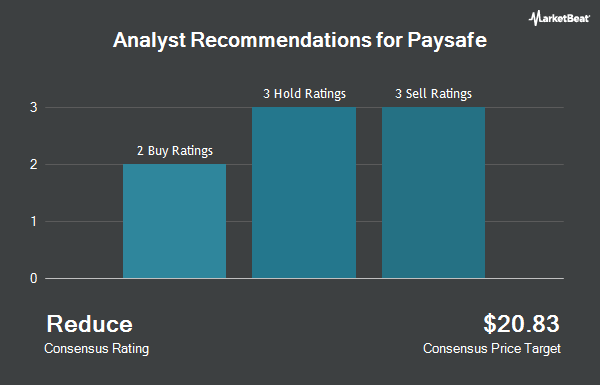
Other analysts have also issued research reports about the stock. UBS Group reaffirmed a "sell" rating and set a $7.50 target price (up from $6.75) on shares of Paysafe in a report on Thursday, May 14th. Wall Street Zen raised Paysafe from a "hold" rating to a "buy" rating in a research note on Sunday. Royal Bank Of Canada reiterated a "sector perform" rating and issued a $11.00 price objective (up from $9.00) on shares of Paysafe in a report on Thursday, May 14th. Weiss Ratings lowered Paysafe from a "sell (d)" rating to a "sell (d-)" rating in a research note on Thursday, May 14th. Finally, Susquehanna restated a "neutral" rating and set a $10.00 target price (up from $9.00) on shares of Paysafe in a report on Thursday, May 14th. One research analyst has rated the stock with a Buy rating, two have issued a Hold rating and three have issued a Sell rating to the stock. Based on data from MarketBeat.com, the stock currently has a consensus rating of "Reduce" and an average target price of $9.88.
View Our Latest Stock Analysis on Paysafe
Paysafe Price Performance
Shares of Paysafe stock traded down $0.30 during trading on Wednesday, reaching $8.73. The company's stock had a trading volume of 156,558 shares, compared to its average volume of 376,485. The stock has a 50-day moving average price of $7.58 and a two-hundred day moving average price of $7.50. The stock has a market capitalization of $451.17 million, a P/E ratio of -2.47 and a beta of 1.74. The company has a current ratio of 1.16, a quick ratio of 1.16 and a debt-to-equity ratio of 4.03. Paysafe has a one year low of $5.95 and a one year high of $15.02.
Paysafe (NYSE:PSFE - Get Free Report) last announced its quarterly earnings data on Thursday, May 14th. The company reported $0.41 EPS for the quarter, beating analysts' consensus estimates of $0.40 by $0.01. The firm had revenue of $442.72 million for the quarter, compared to analyst estimates of $424.41 million. Paysafe had a positive return on equity of 11.32% and a negative net margin of 11.44%.
Insider Buying and Selling at Paysafe
In other Paysafe news, insider Richard Swales sold 10,000 shares of Paysafe stock in a transaction dated Friday, May 15th. The stock was sold at an average price of $7.69, for a total transaction of $76,900.00. Following the transaction, the insider directly owned 44,456 shares in the company, valued at approximately $341,866.64. The trade was a 18.36% decrease in their ownership of the stock. The transaction was disclosed in a legal filing with the SEC, which is accessible through this link.
Institutional Inflows and Outflows
A number of hedge funds have recently modified their holdings of the company. Dimensional Fund Advisors LP boosted its position in Paysafe by 3.5% during the 3rd quarter. Dimensional Fund Advisors LP now owns 2,439,793 shares of the company's stock worth $31,522,000 after acquiring an additional 82,440 shares during the last quarter. Private Management Group Inc. raised its holdings in shares of Paysafe by 60.3% in the fourth quarter. Private Management Group Inc. now owns 2,384,594 shares of the company's stock valued at $19,291,000 after purchasing an additional 897,103 shares during the last quarter. Charles Schwab Investment Management Inc. lifted its position in shares of Paysafe by 57.0% in the fourth quarter. Charles Schwab Investment Management Inc. now owns 543,416 shares of the company's stock worth $4,396,000 after purchasing an additional 197,268 shares in the last quarter. Jacobs Levy Equity Management Inc. lifted its position in shares of Paysafe by 2.0% in the third quarter. Jacobs Levy Equity Management Inc. now owns 516,289 shares of the company's stock worth $6,670,000 after purchasing an additional 9,947 shares in the last quarter. Finally, Geode Capital Management LLC boosted its holdings in Paysafe by 1.8% during the second quarter. Geode Capital Management LLC now owns 399,449 shares of the company's stock worth $5,041,000 after purchasing an additional 7,155 shares during the last quarter. 54.39% of the stock is currently owned by institutional investors.
About Paysafe
(
Get Free Report)
Paysafe is a global payments provider that delivers a comprehensive suite of online and offline payment solutions. The company operates a diverse portfolio of products, including digital wallets under the Skrill and Neteller brands, prepaid voucher services through paysafecard, and integrated payment processing solutions for merchants. Paysafe's platform is designed to serve a wide range of industries, from e-commerce and digital goods to gaming, financial services, and regulated verticals, offering tailored risk and compliance management alongside its core transaction capabilities.
Founded through a series of mergers and strategic acquisitions, Paysafe traces its origins to the launch of paysafecard in 2000 and the establishment of Optimal Payments in 1996.
Read More
This instant news alert was generated by narrative science technology and financial data from MarketBeat in order to provide readers with the fastest reporting and unbiased coverage. Please send any questions or comments about this story to contact@marketbeat.com.

Continue following MarketBeat
Add MarketBeat as your preferred source on Google to see our latest stories in your feed.
Before you consider Paysafe, you'll want to hear this.
MarketBeat keeps track of Wall Street's top-rated and best performing research analysts and the stocks they recommend to their clients on a daily basis. MarketBeat has identified the five stocks that top analysts are quietly whispering to their clients to buy now before the broader market catches on... and Paysafe wasn't on the list.
While Paysafe currently has a Reduce rating among analysts, top-rated analysts believe these five stocks are better buys.
View The Five Stocks Here
Enter your email address and we’ll send you MarketBeat’s list of ten stocks set to soar in Summer 2026, despite the threat of tariffs and what's happening in Iran. These ten stocks are incredibly resilient and are likely to thrive in any economic environment.
Get This Free Report
Like this article? Share it with a colleague.
Link copied to clipboard.
