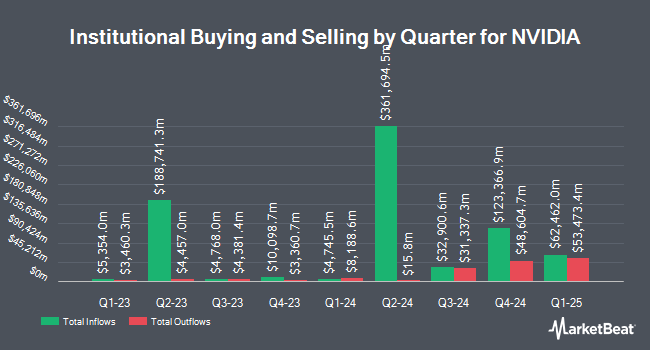
Nelson Capital Management LLC increased its holdings in NVIDIA Corporation (NASDAQ:NVDA - Free Report) by 1.9% in the first quarter, according to the company in its most recent Form 13F filing with the Securities and Exchange Commission. The institutional investor owned 1,630,355 shares of the computer hardware maker's stock after buying an additional 29,904 shares during the period. NVIDIA accounts for 34.7% of Nelson Capital Management LLC's holdings, making the stock its largest position. Nelson Capital Management LLC's holdings in NVIDIA were worth $284,334,000 as of its most recent SEC filing.
Several other institutional investors have also made changes to their positions in the stock. Decker Wealth Management LLC acquired a new stake in NVIDIA during the first quarter worth approximately $5,656,000. Greenwood Gearhart LLC lifted its position in shares of NVIDIA by 5.5% during the 1st quarter. Greenwood Gearhart LLC now owns 281,784 shares of the computer hardware maker's stock valued at $49,143,000 after acquiring an additional 14,760 shares during the period. Eaton Cambridge Inc. lifted its position in shares of NVIDIA by 19.4% during the 1st quarter. Eaton Cambridge Inc. now owns 22,028 shares of the computer hardware maker's stock valued at $3,842,000 after acquiring an additional 3,583 shares during the period. KBC Group NV grew its holdings in shares of NVIDIA by 12.0% during the 1st quarter. KBC Group NV now owns 19,004,336 shares of the computer hardware maker's stock worth $3,314,356,000 after purchasing an additional 2,035,607 shares in the last quarter. Finally, True North Advisors LLC increased its position in shares of NVIDIA by 3.0% in the first quarter. True North Advisors LLC now owns 131,925 shares of the computer hardware maker's stock worth $23,008,000 after purchasing an additional 3,792 shares during the period. 65.27% of the stock is currently owned by institutional investors.
Key NVIDIA News
Here are the key news stories impacting NVIDIA this week:
- Positive Sentiment: Strong results from Microsoft, particularly in Azure and Copilot, renewed expectations that hyperscalers will continue spending heavily on AI data centers—a key demand driver for NVIDIA’s accelerators and networking products. Why Nvidia stock is rebounding after Big Tech earnings
- Positive Sentiment: Analysts and commentators remain bullish on the AI spending cycle. Wolfe Research’s Chris Caso argued that semiconductor oversupply is unlikely before 2028, while multiple analysts maintain targets well above the current trading level. Top chip analyst on semiconductor oversupply
- Positive Sentiment: NVIDIA’s reported connection to Hut 8’s planned $19.6 billion Texas AI data-center lease highlights potential future demand for NVIDIA-powered infrastructure, although the headline value depends partly on future renewal options. NVIDIA linked to Hut 8 AI data center lease
- Neutral Sentiment: NVIDIA scheduled its fiscal 2027 second-quarter results call for August 26. The event is the next major catalyst, with investors focused on revenue growth, guidance and evidence that customer AI capital expenditures remain sustainable. NVIDIA schedules second-quarter financial results call
- Negative Sentiment: Investors continue to debate “circular financing” and credit risks in AI infrastructure. NVIDIA’s proposed OpenAI credit backstop and exposure to highly leveraged AI-cloud customers have raised concerns that a financing problem could weaken demand or increase customer risk. NVIDIA’s OpenAI backstop and AI financing risk
- Negative Sentiment: Investor Michael Burry reportedly increased his short positions in NVIDIA and Micron, reinforcing bearish arguments that AI-related valuations and infrastructure deals have become excessive. Ongoing insider selling and a recent congressional sale add to the caution, though they are not necessarily company-specific signals. Michael Burry adds to NVIDIA and Micron short positions
Insider Transactions at NVIDIA
In related news, Director John Dabiri sold 625 shares of the business's stock in a transaction on Wednesday, May 27th. The shares were sold at an average price of $214.00, for a total value of $133,750.00. Following the sale, the director owned 14,163 shares of the company's stock, valued at $3,030,882. The trade was a 4.23% decrease in their ownership of the stock. The sale was disclosed in a document filed with the SEC, which is available through the SEC website. The transaction was executed under a pre-arranged Rule 10b5-1 trading plan. Also, Director Stephen C. Neal sold 15,500 shares of the stock in a transaction on Wednesday, June 3rd. The shares were sold at an average price of $215.73, for a total value of $3,343,815.00. Following the completion of the sale, the director owned 116,135 shares of the company's stock, valued at $25,053,803.55. The trade was a 11.77% decrease in their ownership of the stock. Additional details regarding this sale are available in the official SEC disclosure. Over the last 90 days, insiders have sold 1,901,125 shares of company stock worth $410,583,015. Company insiders own 3.94% of the company's stock.
Analyst Upgrades and Downgrades
A number of research analysts recently commented on NVDA shares. Melius Research set a $400.00 price target on NVIDIA in a research note on Thursday, May 21st. Wolfe Research reissued an "outperform" rating and issued a $275.00 target price on shares of NVIDIA in a report on Thursday, May 21st. Daiwa Securities Group raised their price target on shares of NVIDIA from $215.00 to $255.00 and gave the company an "outperform" rating in a research note on Friday, May 22nd. Royal Bank Of Canada set a $280.00 price target on shares of NVIDIA in a report on Thursday, May 21st. Finally, DZ Bank reissued a "buy" rating on shares of NVIDIA in a research note on Thursday, May 21st. Three equities research analysts have rated the stock with a Strong Buy rating, forty-eight have assigned a Buy rating and two have issued a Hold rating to the company's stock. According to data from MarketBeat, NVIDIA has a consensus rating of "Buy" and an average price target of $304.26.
Read Our Latest Stock Analysis on NVDA
NVIDIA Stock Performance
Shares of NVDA stock opened at $195.04 on Friday. The firm has a market capitalization of $4.72 trillion, a price-to-earnings ratio of 29.87, a PEG ratio of 0.37 and a beta of 2.21. The company has a current ratio of 3.44, a quick ratio of 2.85 and a debt-to-equity ratio of 0.04. The business's 50-day moving average price is $205.71 and its 200-day moving average price is $196.09. NVIDIA Corporation has a 12 month low of $164.07 and a 12 month high of $236.54.
NVIDIA (NASDAQ:NVDA - Get Free Report) last released its quarterly earnings data on Wednesday, May 20th. The computer hardware maker reported $1.87 earnings per share (EPS) for the quarter, beating the consensus estimate of $1.76 by $0.11. The company had revenue of $81.61 billion during the quarter, compared to the consensus estimate of $78.42 billion. NVIDIA had a return on equity of 96.94% and a net margin of 62.97%.The firm's revenue was up 85.2% compared to the same quarter last year. During the same quarter in the prior year, the firm posted $0.81 earnings per share. Equities research analysts forecast that NVIDIA Corporation will post 8.79 EPS for the current year.
NVIDIA declared that its board has approved a share buyback program on Wednesday, May 20th that authorizes the company to repurchase $80.00 billion in outstanding shares. This repurchase authorization authorizes the computer hardware maker to purchase up to 1.5% of its shares through open market purchases. Shares repurchase programs are typically an indication that the company's board of directors believes its shares are undervalued.
NVIDIA Increases Dividend
The firm also recently declared a quarterly dividend, which was paid on Friday, June 26th. Shareholders of record on Thursday, June 4th were given a $0.25 dividend. This is an increase from NVIDIA's previous quarterly dividend of $0.01. The ex-dividend date was Thursday, June 4th. This represents a $1.00 annualized dividend and a yield of 0.5%. NVIDIA's dividend payout ratio is currently 15.31%.
NVIDIA Profile
(
Free Report)
NVIDIA Corporation, founded in 1993 and headquartered in Santa Clara, California, is a global technology company that designs and develops graphics processing units (GPUs) and system-on-chip (SoC) technologies. Co-founded by Jensen Huang, who serves as president and chief executive officer, along with Chris Malachowsky and Curtis Priem, NVIDIA has grown from a graphics-focused chipmaker into a broad provider of accelerated computing hardware and software for multiple industries.
The company's product portfolio spans discrete GPUs for gaming and professional visualization (marketed under the GeForce and NVIDIA RTX lines), high-performance data center accelerators used for AI training and inference (including widely adopted platforms such as the A100 and H100 series), and Tegra SoCs for automotive and edge applications.
Read More
Want to see what other hedge funds are holding NVDA? Visit HoldingsChannel.com to get the latest 13F filings and insider trades for NVIDIA Corporation (NASDAQ:NVDA - Free Report).
This instant news alert was generated by narrative science technology and financial data from MarketBeat in order to provide readers with the fastest reporting and unbiased coverage. Please send any questions or comments about this story to contact@marketbeat.com.
Before you consider NVIDIA, you'll want to hear this.
MarketBeat keeps track of Wall Street's top-rated and best performing research analysts and the stocks they recommend to their clients on a daily basis. MarketBeat has identified the five stocks that top analysts are quietly whispering to their clients to buy now before the broader market catches on... and NVIDIA wasn't on the list.
While NVIDIA currently has a Buy rating among analysts, top-rated analysts believe these five stocks are better buys.
View The Five Stocks Here
With the proliferation of data centers and electric vehicles, the electric grid will only get more strained. Download this report to learn how energy stocks can play a role in your portfolio as the global demand for energy continues to grow.
Get This Free Report
