Every portfolio in a volatile market has two jobs, and most investors only run one. Part of the money should be trading the noise. The rest should be getting paid to ignore it. The last few weeks have delivered 1% daily moves in both directions, and the reflex is to step back and wait for calm, but Bryan Bottarelli and Karim Rahemtulla of Monument Traders Alliance argue that waiting for a quiet tape is not a plan.
6 Pressures Hitting the Market at the Same Time
Count what the market is currently digesting. A midterm election cycle. A Federal Reserve that has returned to raising rates for the first time in more than three years, with the funds rate at 3.75% to 4.00% and futures pricing meaningful odds of another move before year-end. Inflation that consumers feel at the register. A federal debt load where interest expense now runs close to a fifth of annual tax receipts. Enormous AI-related capital expenditures (CapEx), with no settled view on whether those valuations are fair. And geopolitical conflict on top of it.
Markets handle one or two of those at a time. Six is a different animal, which is why the 10-year Treasury yield touched levels not seen since 2002 earlier this month before easing back to near 5%.
That matters because the cost of money is now the story. AI buildouts that were funded with equity are moving to the bond market, and the bond market charges for risk in a way the stock market often does not.
Why Forced Selling Creates the Better Entry Point
Rahemtulla frames fear as the mechanism, not the obstacle. The more volatile the tape, the more irrational the marginal seller, and the better the prices available to anyone who has already decided what they want to own. Bottarelli learned the same lesson on the trading floor: the moment everyone else stops out is the moment worth buying.
The risk is obvious. Buying into a decline without a defined exit is how accounts get damaged. The upside is that a plan written before the drawdown removes the decision from the worst possible moment.
3 ETFs Built for Short-Horizon Volatility Trades
iShares Russell 2000 ETF Today
IWM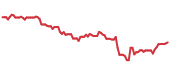
iShares Russell 2000 ETF
$276.99 +1.24 (+0.45%) As of 04:10 PM Eastern
- 52-Week Range
- $228.90
▼
$305.18 - Dividend Yield
- 0.99%
- Assets Under Management
- $74.32 billion
Bottarelli’s short-term work centers on three liquid index funds. iShares Russell 2000 ETF NYSEARCA: IWM tracks the Russell 2000 and reacts harder to rate moves than large-cap benchmarks, since small companies feel borrowing costs immediately. Invesco QQQ Trust NASDAQ: QQQ swings with the daily risk-on, risk-off argument over AI and chip valuations. SPDR Gold Shares NYSEARCA: GLD moves as investors rotate toward hard assets.
The trigger is mechanical. When one of those closes down 1% or more, the group buys short-dated call options and exits on a rebound in the following session. Holding a day or two rather than a month keeps time premium small and the outlay low. Monument’s own back-testing puts the odds of a bounce at some point the next day in the 80% to 85% range, with the probability rising as the sell-off deepens. That is internal research, not a guarantee, and short-dated options can expire worthless.
Using an index fund rather than a single small-cap name also strips out headline risk from any one company. That framework, and the longer-horizon names the firm is accumulating ahead of the crowd, sit inside their special report on under-the-radar volatility plays for investors who want the full ticker list.
Gold Miners Offer Operating Leverage to a Rising Metal
For gold exposure with more torque, Rahemtulla points to Agnico Eagle Mines NYSE: AEM, which he considers the strongest operator in the sector on margins and asset quality.
Agnico Eagle Mines Today
AEM
Agnico Eagle Mines
$175.79 +1.85 (+1.07%) As of 03:59 PM Eastern
This is a fair market value price provided by Massive. Learn more. - 52-Week Range
- $134.38
▼
$255.24 - Dividend Yield
- 1.02%
- P/E Ratio
- 15.39
- Price Target
- $224.33
The math is what makes a miner different from the metal. Extraction costs are largely fixed, with fuel the main variable. A producer pulling gold out of the ground for $200 an ounce earns $800 when gold sells at $1,000. If gold doubles, that same producer still spends roughly $200 and now earns $1,800. Margins widen faster than the metal moves.
That cuts both ways, and it is the part worth sitting with. The same leverage that expands margins on the way up compresses them on the way down, which makes a miner a more volatile holding than the bullion itself.
Gold traded near $2,000 an ounce three years ago and sits above $4,100 today, which is less a statement about gold than about what a dollar now buys. Agnico Eagle also supports covered-call writing for investors who want income alongside the exposure.
Municipal Income at Yields Unavailable 5 Years Ago
Nuveen Municipal Value Fund Today
NUV
Nuveen Municipal Value Fund
$8.32 +0.09 (+1.03%) As of 03:59 PM Eastern
This is a fair market value price provided by Massive. Learn more. - Dividend Yield
- 0.72%
The income side is where Rahemtulla sees the cleaner setup. Nuveen Municipal Value Fund NYSE: NUV is an unleveraged closed-end fund holding a diversified municipal portfolio that is largely investment grade, distributing monthly at roughly 4.7%.
Municipal bonds fund water systems, highways and toll roads, and the default rate across their history sits well under 1%. That is the appeal: the credit risk is modest, and the income arrives free of federal tax.
Run the numbers and the gap widens. For a 35% bracket taxpayer in a state with no income tax, 4.7% tax-free approaches a 6.7% taxable-equivalent yield. A Treasury paying 5% leaves that same investor closer to 3.3% after tax. Five years ago the 10-year paid a fraction of a percent, so this is a setup income investors have not had in years.
The fund trades millions of shares daily, so liquidity is not the constraint it often is in individual bonds, and it sits near the low end of its 52-week range. If rates eventually come down, that leaves room for price appreciation on top of the income. If rates keep climbing instead, the price pressure runs the other way, which is the risk of buying duration in a hiking cycle.
Sizing the 2 Books Against Each Other
Allocation depends on age and income needs. An investor nearing retirement wants the larger share in fixed income and dividend payers. Someone checking markets once a day might run roughly 90% in longer-horizon positions and reserve 10% for shorter-term trades, where a small sleeve can move the needle without putting the core at risk. Monument’s own short-term trading program is built around that smaller sleeve.
Stay focused on the cost of money, because that is what is repricing everything else.
Before you consider SPDR Gold Shares, you'll want to hear this.
MarketBeat keeps track of Wall Street's top-rated and best performing research analysts and the stocks they recommend to their clients on a daily basis. MarketBeat has identified the five stocks that top analysts are quietly whispering to their clients to buy now before the broader market catches on... and SPDR Gold Shares wasn't on the list.
While SPDR Gold Shares currently has a Hold rating among analysts, top-rated analysts believe these five stocks are better buys.
View The Five Stocks Here
The AI boom extends far beyond the biggest tech names. Discover 10 companies supplying the memory, storage, networking, semiconductor manufacturing, and power infrastructure that make AI possible. Learn where the next wave of AI investment opportunities may emerge—and the key risks investors should watch as the global AI buildout accelerates.
Get This Free Report
Continue following MarketBeat
Add MarketBeat as your preferred source on Google to see our latest stories in your feed.

