Investors looking ahead to when the high-bandwidth memory (HBM) shortage will end can start looking a little further out. Micron’s NASDAQ: MU response to SK Hynix's bold U.S. entry reveals that HBM shortages persist and will likely linger into the next decade (as indicated by the SK Hynix CEO), and that both companies are scrambling to ramp production.
Micron Technology Today
MU
Micron Technology
$1,074.89 -22.50 (-2.05%) As of 04:00 PM Eastern
- 52-Week Range
- $179.61
▼
$1,255.00 - Dividend Yield
- 0.06%
- P/E Ratio
- 14.48
- Price Target
- $1,385.93
While SK Hynix will use its IPO funds to bolster U.S. capacity, Micron is using its robust cash flow and financial position to do the same. The company upped its planned 10-year investment outlook to $250 billion domestically, money to be spent on U.S.-based fabrication capacity and HBM technology advancement.
The battle is for market share. SK Hynix commands a lion’s share of the market due to its close ties with NVIDIA NASDAQ: NVDA, but its dominance isn’t assured. Micron, for its part, is working to align more closely with NVIDIA’s standards to carve out a larger share of business from this single client.
Meanwhile, Micron is capturing a significant share of the second-tier AI infrastructure market, including Amazon NASDAQ: AMZN, which uses HBM for its Trainium chips, Alphabet NASDAQ: GOOGL, which uses it for its Tensor Processing Units, and Microsoft NASDAQ: MSFT, which uses HBM for its Maia architecture. Looking ahead, Micron is expected to benefit from the dual tailwinds of high demand, fixed-cost leverage, and pricing power for many years.
The latest news in DRAM and HBM sales is that price caps are being lifted or removed from long-term contracts, opening the door to maximum pricing power. While Micron has yet to follow suit, similar moves are possible. Until then, Micron is sitting pretty, providing an in-demand product with a multiyear sales bump underway and an updraft in pricing power.
Analysts Take Note, Micron Sends Strongly Bullish Signal
Analysts responded favorably to the $250 billion spending plan, with chatter highlighting the investment boost as a strongly bullish signal, reaffirming AI demand and the extended memory upcycle. Long-term revenue visibility translates not only into growth stability, but also into cash flow and capacity for capital returns.
As it stands, Micron’s dividend is a token but ultra-reliable, and the buyback program is in position for robust future increases. Among the catalysts for share prices is the potential for buybacks to start reducing the share count in the not-too-distant future.
Until then, MarketBeat tracks 38 analysts who rate Micron stock as a consensus Buy, with a 92% Buy-side bias. The trends include steady coverage, firming sentiment, and robust price target increases, with consensus forecasting nearly 30% upside as of mid-July and the high-end pegged at $2,000. The $2,000 target is significant, as it represents more than 100% upside from the mid-July trading levels and may be reached within a matter of quarters.
Institutional activity suggests the downside risk is limited in Q3. The group owns more than 80% of the stock and has bought on balance over the trailing 12 months, accelerating buying in early Q3. The early Q3 balance is greater than $2-to-$1, providing a solid support base, and is likely to remain strong, given the trends, outlook, and increased spending plans. The risk from this vector is that this group sells into the rally as the price advances, but there is little sign of that now. With analysts raising targets and the outlook strengthening, institutional support is likely to remain solid for the foreseeable future.
Triple-Digit Upside for Micron: Near, Mid, and Long-Term
Micron’s valuation metrics suggest a robust upside potential in the near-, mid-, and long-term. The stock trades at a paltry 12x its current-year earnings guidance, a multiple that is lower than that of AI-critical peers and the S&P 500, which trade at least 100% higher relative to their earnings. Looking ahead, the valuation falls to about 6x as soon as the subsequent year, suggesting another 100% upside is possible within the next two to three quarters. Longer-term, the estimates fail to account for the extended HBM shortage, setting the stage for a persistent, robustly bullish cycle of analyst revisions that may last several years.
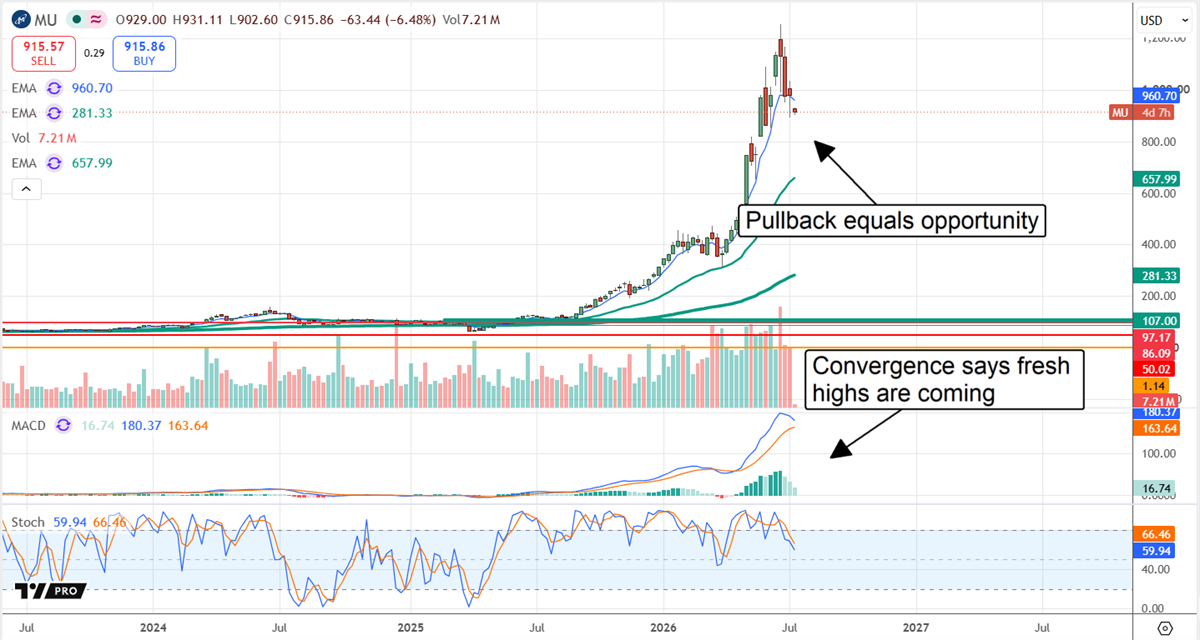
Micron’s early July price pullback is an opportunity in this scenario. While the 25% price correction is alarming, it’s a small move for this market, which remains up by approximately 700% on a trailing 12-month basis. The more critical chart detail is the preceding peak and its accompanying MACD convergence, a signal of market strength suggesting fresh highs will be set. The only question is the timing of the move, and it may be triggered soon. Micron is slated to report its fiscal Q4 results in late September, but releases from NVIDIA, the Mag Seven, and AI-critical hyperscale providers can also do the trick by affirming demand and spending trends are intact.
Before you consider Micron Technology, you'll want to hear this.
MarketBeat keeps track of Wall Street's top-rated and best performing research analysts and the stocks they recommend to their clients on a daily basis. MarketBeat has identified the five stocks that top analysts are quietly whispering to their clients to buy now before the broader market catches on... and Micron Technology wasn't on the list.
While Micron Technology currently has a Moderate Buy rating among analysts, top-rated analysts believe these five stocks are better buys.
View The Five Stocks Here
AI spending is reshaping the market, and the opportunity extends far beyond the biggest chipmakers. Discover 10 stocks set to benefit from powerful trends in AI infrastructure, cloud computing, energy, capital returns, and consumer growth this fall.
Get This Free Report
Continue following MarketBeat
Add MarketBeat as your preferred source on Google to see our latest stories in your feed.
Like this article? Share it with a colleague.
Link copied to clipboard.
